










State Minister for Housing Persis Namuganza has urged banks to adopt more considerate lending and loan recovery practices, warning against hastily repossessing homes from borrowers who struggle to repay housing loans.
Namuganza said some families, particularly those that lose a breadwinner, are left vulnerable when they fail to meet loan obligations and their homes are taken over by financial institutions.
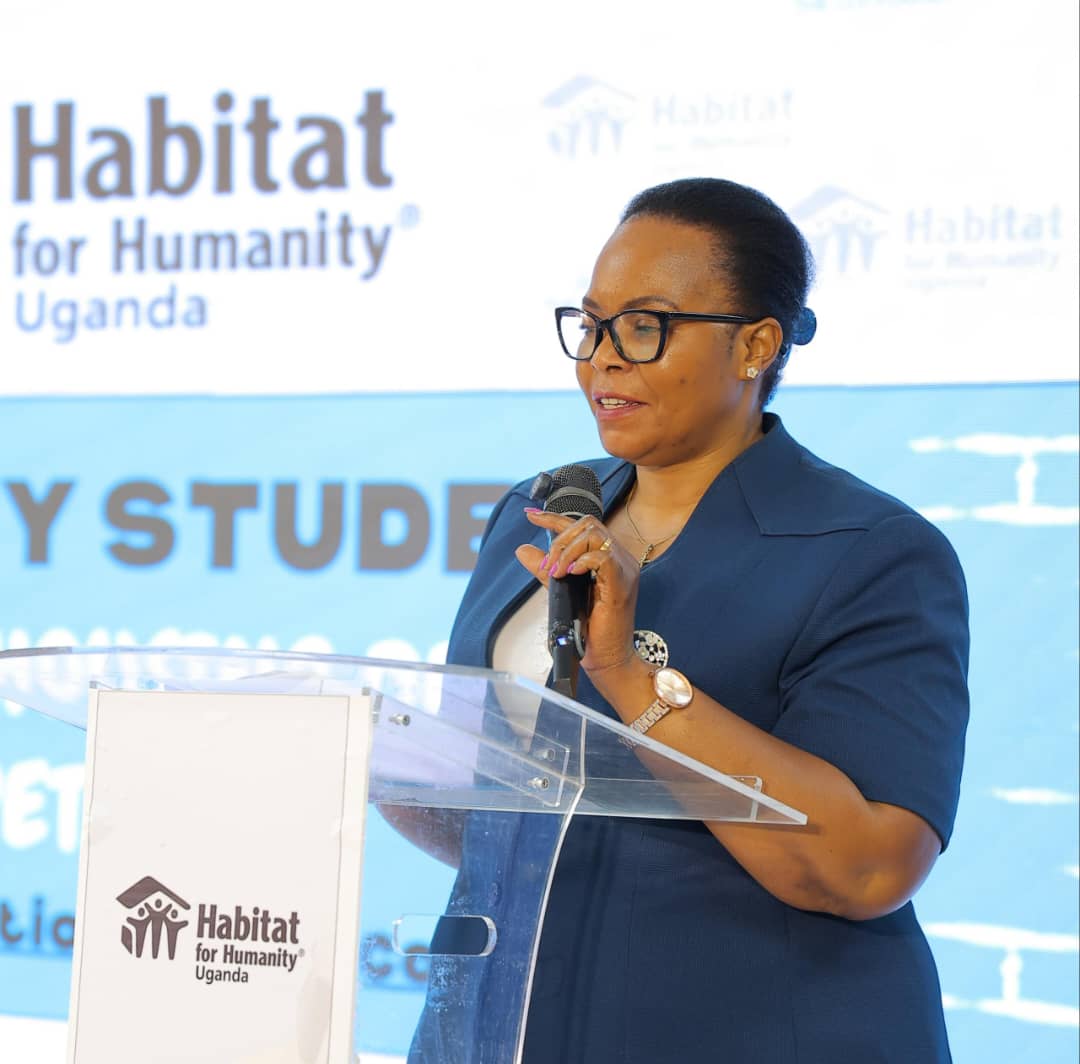
She made the remarks on Thursday at Hotel Africana in Kampala during the 2026 University Students Awards organised by Habitat for Humanity Uganda, where university students showcased innovative and low-cost housing solutions.
Namuganza said her office regularly receives complaints from families facing financial difficulties after losing a family member who had been servicing a housing loan.
“My office is full of cases. If the husband dies, you see the woman coming,” she said.
The minister questioned the purpose of housing finance if families can easily lose their homes after failing to maintain loan repayments.
“We need some banks that loan our people for housing. But here, you have other banks that paint bank property on people’s houses and take them when they fail to pay. So what is the spirit of lending out that money when you know I will lose my property?” she said.
She also raised concerns about some bank managers who, after extending loans to borrowers, closely monitor their properties, seemingly waiting for them to default so the buildings can be repossessed.
Namuganza said there is a need to review how housing loans are structured and ensure financial institutions support home ownership rather than making families more vulnerable to losing their homes.
Her comments came as Habitat for Humanity Uganda promoted alternative approaches to reducing the cost of housing through university-led innovation.
The organisation’s National Director, Paul Okiring, said students participating in the competition had demonstrated that affordable housing can be designed and constructed at substantially lower costs.
“We are very excited that today we are able to showcase innovation from students from different universities who have demonstrated to us that there is scalable impact in terms of designing affordable housing for vulnerable people in Uganda,” Okiring said.
He said some of the student proposals ranged from about Shs14 million to Shs40 million, while the winning design from the International University of East Africa (IUEA) was estimated to cost about Shs13.2 million.
A team from Kyambogo University emerged as the overall winner, while Mumbere Aggrey Nzanzu from IUEA was recognised for a project focused on sustainability, user comfort and affordability.
Nzanzu said housing solutions should be designed around the needs of the people who will eventually occupy them.
“Construction should be more about how the end user will be directly affected, rather than looking at it from one cost perspective,” he said.
Namuganza welcomed the student innovations, saying Uganda needs more affordable ways of providing decent housing as the population grows and construction costs continue to rise.
“The house remains a necessity. We know that before we produce, before we work for a job, before we go to school, we need a place where we sleep. We need a house and we need a home,” she said.
She also urged innovators to ensure that affordable housing does not come at the expense of environmental sustainability.
“They are designing, yes, cheap affordable housing, but we have to have green work, environment. I need to see that coming up, so that we really protect our environment,” she said.
Namuganza said the Government plans to work with private-sector players through public-private partnerships (PPPs) to increase the supply of affordable housing.
She said the Government could provide land while private partners contribute financing and construction capacity, with a rent-to-own model being considered to enable more Ugandans to acquire homes.
“We can only afford to achieve massive housing through PPP, and the main contribution from government is land,” she said.
The minister also criticised the quality of some houses being sold by private developers, saying buyers are sometimes charged high prices for substandard homes.
“We don’t want you to be sold substandard houses, but these houses are being sold expensively, and after one or two years, they are all collapsing,” she said.
Namuganza said the Government is expediting a proposed Real Estate Bill aimed at strengthening regulation of property developers and addressing concerns over housing standards and prices.
Habitat for Humanity Uganda Board Chairperson Robert Kaggwa Nsibirwa called on the Government, financial institutions, private-sector players and development partners to work together to expand access to decent and affordable housing.
“I call upon all our partners, institutions, private sector actors, and well-wishers to join Habitat for Humanity Uganda in advancing the cause of decent and affordable housing for vulnerable families,” Nsibirwa said.
The 2026 University Students Awards, supported by the Citi Foundation, brought together students developing housing designs focused on affordability, sustainability and practical solutions to Uganda’s housing challenges.
The winning concepts are expected to be further developed into demonstration housing units, potentially providing models that can be adopted by developers, policymakers and communities.