











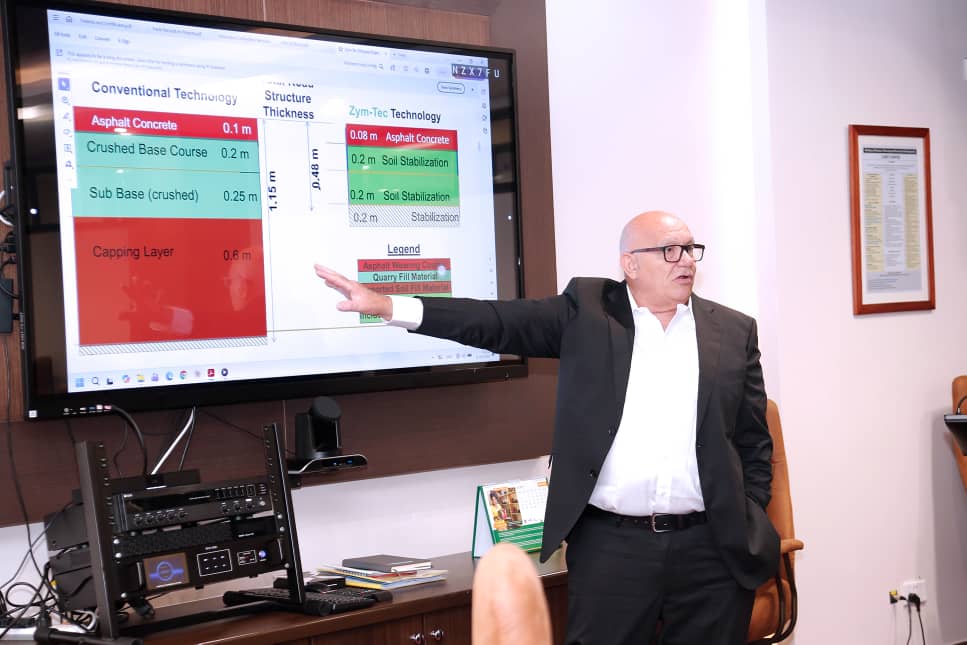
Government is exploring an innovative construction technology that could reduce the cost and time required to build roads and houses by turning locally available soil into construction material.
The technology was presented to the State Minister for Finance, Amos Lugoloobi, and National Planning Authority (NPA) Chairperson Prof. Pamela Mbabazi by Yosef Atoon, CEO and Founder of I-TEC-WIZYMTEC Technologies Ltd, an investor from India.
The technology uses a special enzyme to strengthen soil found at construction sites and transform it into material suitable for road and housing construction.
If proven effective under Ugandan conditions, the technology could reduce the need to transport construction materials over long distances or import them, potentially lowering project costs, shortening construction timelines and increasing the use of locally available materials.
It could also help reduce pressure on Uganda’s foreign exchange reserves by limiting expenditure on imported construction inputs.
However, Lugoloobi cautioned that Government will not adopt the technology on the basis of claims alone, stressing the need for independent technical assessment before any large-scale deployment.
“Government is interested in the technology’s potential but stressed that any adoption must be based on independent technical validation and evidence, rather than immediate large-scale deployment,” Lugoloobi said.
He said the National Planning Authority, together with relevant stakeholders, will assess the technology against Uganda’s technical and economic requirements.
The assessment will examine its performance under Ugandan conditions, cost-effectiveness, compliance with engineering standards, environmental impact, scalability, local content and prospects for technology transfer.
The approach is intended to establish whether the technology can deliver commercially and technically viable results before Government commits public resources to wider deployment.
Prof. Mbabazi welcomed the proposed innovation, saying reducing the cost of infrastructure development is consistent with Uganda’s broader development objectives under the Fourth National Development Plan (NDP IV).
“Efforts to reduce infrastructure development costs align with Uganda’s broader development vision as outlined in NDP IV and are desirable and a blessing to reduce government cost on infrastructure stock,” Prof. Mbabazi said.
She encouraged the investor to continue engaging with relevant Government agencies and other stakeholders to facilitate the technical assessment.
According to Prof. Mbabazi, the technology could first be subjected to pilot projects if it passes the required technical scrutiny.
“Subject to satisfactory technical assessment, pilot projects may be undertaken to generate Uganda-specific evidence before wider deployment,” she said.
The proposed evaluation comes as Uganda continues to seek ways of containing the rising cost of infrastructure development while expanding roads, housing and other public infrastructure.
For government, the key question will be whether the technology can deliver durable infrastructure at a lower cost without compromising engineering, environmental and safety standards.
A successful pilot could also open opportunities for local production and technology transfer, potentially creating a new market for locally sourced construction materials and reducing dependence on imported inputs.