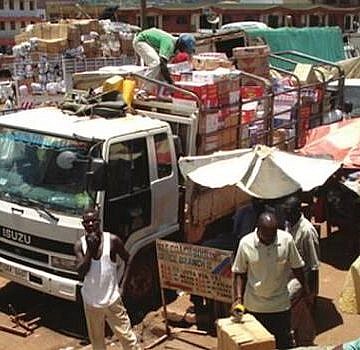












Government has announced plans to transition from traditional one-stop border posts to “no-stop border posts” through the introduction of smart gate technology and electronic systems aimed at reducing delays and improving trade clearance across borders.
The announcement was made during the launch of the Regional Grain Learning Mission organised by the Eastern Africa Grain Council (EAGC) in partnership with Danish Industries East Africa at FairWay Hotel in Kampala.
Speaking at the event, the Commissioner for External Trade at the Ministry of Trade, Industry and Cooperatives, Cleopas Ndorere, said the next phase of trade facilitation will focus on digital systems that reduce human interaction and speed up movement of goods.
Ndorere said government, working with development partners, is already strengthening existing one-stop border posts and preparing to introduce smart border infrastructure.
“Our next step is transitioning from one-stop border posts to no-stop border posts. By introducing smart gates and an electronic single window, traders can register their products and obtain sanitary, phytosanitary and fumigation certificates online,” he said.
He explained that under the proposed system, traders will complete declarations before cargo reaches the border.
“When a truck arrives at a smart gate, the system will automatically scan the vehicle, verify the pre-registered cargo and allow it to pass with minimal human interaction,” Ndorere said.
According to the Commissioner, the reforms are expected to reduce border congestion, lower administrative costs and improve the efficiency of regional grain trade.
Ndorere said the digital border systems complement broader government interventions aimed at strengthening regional commerce, including the Simplified Trade Regime and Trade Information Desks that support small-scale cross-border traders.
He noted that government is also enforcing sanitary and phytosanitary standards, reducing aflatoxin risks and improving packaging and labeling to enhance competitiveness of Ugandan grain in regional markets.
The Commissioner said border modernisation will also support broader regional transport corridors serving markets beyond Uganda and Kenya.
“Cross-border grain movements are dynamic; commodities purchased in Uganda or Kenya often serve broader markets in the Democratic Republic of Congo or South Sudan. Robust infrastructure across all corridors is essential,” he said.
Ndorere further urged grain sector players to embrace value addition and maintain quality standards to maximise opportunities created by improved border systems.
“We have been hearing complaints from many people who buy across the country about quality. You buy a bag of 100 kilograms and half the maize is full of cobs. That is very unfortunate and it kills honest business,” he said.
Speaking at the same event, EAGC Uganda Country Director Herbert Kyeyamwa said the learning mission was designed to deepen regional integration and strengthen business partnerships in the grain sector.
“We are gathered here because of a shared vision to build a more integrated, competitive and resilient grain sector in East Africa,” Kyeyamwa said.
He noted that the mission, bringing together 12 enterprises from Kenya and approximately 20 from Uganda, reflects a growing commitment to improving agricultural trade and unlocking opportunities across borders.
Kyeyamwa said the exchange seeks to address long-standing challenges affecting the sector, including market access, post-harvest losses and quality management.
“The purpose of this mission is to directly confront these challenges by creating a unique platform for practical learning and strategic interaction,” he said.
He encouraged participants to use the business-to-business engagements to generate lasting commercial partnerships.
“The business-to-business sessions commencing today are the engine for trade and collaboration between our nations. They are designed to convert conversations into concrete trade intent forms and, ultimately, formalised agreements,” Kyeyamwa added.
The regional exchange brought together agricultural small and medium enterprises from Uganda and Kenya to strengthen cross-border trade, expand market linkages and share operational best practices within the regional grain value chain.
The Grain Learning Mission includes business engagements and field visits to processing facilities, cooperatives and trading hubs across Uganda as participants seek practical lessons to strengthen regional grain trade.