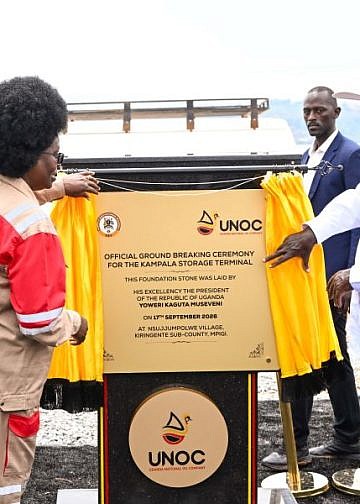









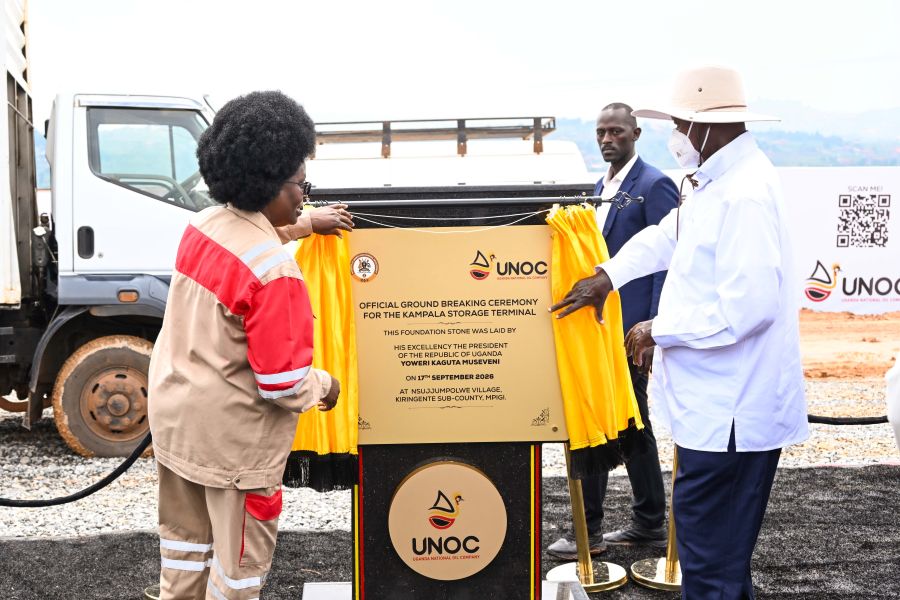
President Museveni has broken ground for the construction of the 320-million-litre Kampala Storage Terminal in Mpigi District
He described the project as a major milestone in strengthening Uganda’s petroleum security and capacity to supply fuel to domestic and regional markets.
The Kampala Storage Terminal, being developed by the Uganda National Oil Company (UNOC), is located on 300 acres of land and is expected to cost approximately USD 250 million.
The facility is designed to increase Uganda’s capacity to store refined petroleum products and strengthen the country’s strategic fuel reserves.
Uganda currently has an estimated national petroleum storage capacity of 160 million litres, comprising a 30-million-litre facility in Jinja, a 70-million-litre facility at Mahathi in Kawuku and about 60 million litres operated by private-sector fuel companies.
President Museveni said adequate storage infrastructure is critical as Uganda continues to develop its petroleum sector and pursue greater security of fuel supply.
“When we took over government in 1986, we tried to hand over the administration of government to the learned technocrats in the ministries. Now, in the Ministry of Energy, with Permanent Secretaries and Commissioners, it took a Senator in Kenya to bring a serious matter to my attention that Uganda was buying petroleum products through middlemen in Kenya. Unbelievable,” President Museveni said.
The President said the government subsequently intervened and introduced measures that have helped reduce the cost of petroleum products.
He cited reductions in the cost of diesel from USD118 to USD83 per metric tonne, petrol from USD97.5 to USD61.5 per metric tonne and aviation fuel from USD114.25 to USD79.25 per metric tonne.
“Now that we are moving well on developing our resources, we must plan for storage,” President Museveni said, noting that Uganda’s existing petroleum storage capacity remains inadequate for the country’s needs.
He said the new terminal will contribute to the establishment of strategic reserves and improve the reliability and efficiency of fuel supply.
However, the President stressed that the project should not be regarded as the final solution to Uganda’s storage needs, saying the country must continue planning for larger facilities to meet its long-term petroleum requirements.
President Museveni commended Vitol Bahrain for supporting Uganda’s fuel supply chain, including through the supply of petroleum products on credit, with the Government making payments when funds become available.
He also welcomed cooperation among East African countries in developing the region’s petroleum sector.
The President said Uganda will participate in the development of a larger refinery in Tanga, Tanzania, as part of regional efforts to strengthen petroleum security.
“I am happy that the President Samia Suluhu has sent a delegation, so we are working together with East Africa to develop our petroleum,” President Museveni said.
President Museveni also commended the people of Mpigi for preserving papyrus wetlands that he observed on his way to the project site, urging communities to protect wetlands and other natural ecosystems.
“This is how God made Uganda and we should try to keep it that way,” he said.
He cautioned against encroachment on wetlands and other water bodies, stressing the importance of protecting the environment as the country develops.
The President also raised concern about the proximity of a garbage dumping site to the petroleum storage facility, describing the situation as dangerous and calling for the site to be relocated.
“We must find alternative means of dealing with waste. One of the ways is through incineration, which is also a source of electricity,” he said.
The Chairman of the UNOC Board of Directors, Mr Mathias Katamba, described the Kampala Storage Terminal as a major milestone in Uganda’s petroleum sector and said it would contribute to positioning the country as a regional hub for petroleum products.
Mr. Katamba said UNOC is ready to commence implementation of the project, having secured the required government and building permits from the relevant local authorities, as well as a petroleum facility construction permit from the Ministry of Energy and Mineral Development.
He said the contract effective date for the Engineering, Procurement and Construction (EPC) works is September 18, 2026, with site works expected to commence immediately following the groundbreaking ceremony and laying of the foundation stone.
Detailed engineering is expected to be completed by March 2027, while commissioning of the terminal is scheduled within 24 months of the contract effective date, around September 2028.
Mr. Katamba said the project builds on studies and planning that culminated in the Kampala Storage Terminal Master Plan in 2017.
He said the expanded storage capacity will support the establishment of strategic national petroleum stocks and strengthen security of supply for refined petroleum products.
The Minister of Energy and Mineral Development, Dr Monica Musenero, said the facility is being developed as a strategic storage hub that will play a critical role in strengthening Uganda’s petroleum supply chain.
She welcomed UNOC’s commitment to complete the project within 24 months and pledged the Ministry’s support towards its successful implementation.
Dr Musenero, however, emphasised the need to improve road connectivity to the terminal, particularly the link to the Mpigi Expressway but also called for the development of railway connectivity to facilitate the efficient transportation of petroleum products.
The Permanent Secretary in the Ministry of Energy and Mineral Development, Eng. Irene Batebe, said the terminal will strengthen Uganda’s ability to maintain strategic petroleum stocks and respond to potential disruptions in fuel supply.
She said the Kampala Storage Terminal will significantly increase Uganda’s existing petroleum storage capacity.
Eng. Batebe added that the government is also working to expand other storage facilities, including the Jinja Storage Terminal, as part of broader efforts to strengthen the country’s petroleum supply and security.
The Kampala Storage Terminal is expected to enhance Uganda’s ability to maintain strategic petroleum reserves, reduce vulnerability to supply disruptions and improve the distribution of refined petroleum products to domestic and regional markets.