








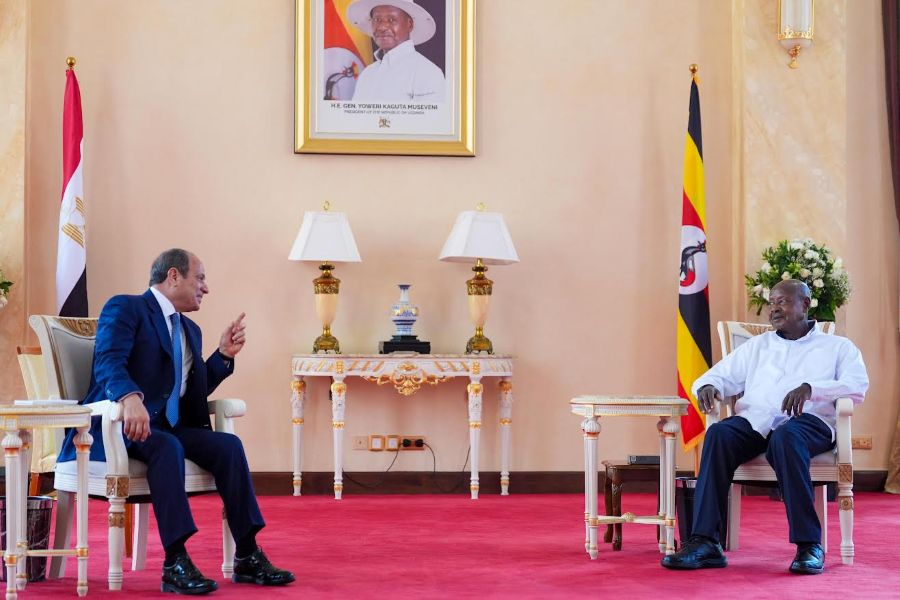
President Museveni today held bilateral talks with Abdel Fattah El-Sisi at State House, Entebbe, where the two leaders agreed to deepen cooperation in trade, industrialisation, renewable energy, fish farming, and sustainable management of the River Nile.
President El-Sisi, who was on an official visit, was accompanied by Egypt’s Minister of Foreign Affairs, Emigration and Egyptian Expatriates, Dr. Badr Abdelatty, and the Minister of Water Resources and Irrigation, Prof. Hani Sewilam.
The discussions focused on strengthening longstanding bilateral relations between Uganda and Egypt, as well as enhancing collaboration in regional peace and security, economic transformation, and water resource management.
President Museveni welcomed President El-Sisi to Uganda and called for practical cooperation aimed at addressing poverty and accelerating socio-economic transformation.
He highlighted environmental degradation, particularly the encroachment on wetlands, as a growing challenge in the Nile Basin, attributing it to population pressure and limited economic opportunities.
Museveni proposed large-scale fish farming as a key solution, saying aquaculture could create jobs, increase export earnings, and help protect wetlands.
“The biggest help I want from you is fish farming. Fish is in high demand globally and this project can help our people move out of subsistence agriculture while also protecting the wetlands,” Museveni said.
He further noted that a major feature of underdevelopment in Africa is overreliance on low-productivity agriculture, adding that Uganda’s strategy is to transition more people into manufacturing and services to improve incomes and reduce pressure on land.
Museveni also emphasised the role of electricity and renewable energy in driving industrialisation and economic growth.
On regional and international affairs, he expressed concern over ongoing instability in Libya, the conflict in Palestine, and tensions involving Iran, calling for continued advocacy for dialogue and peaceful resolution of conflicts.
He reflected on the role of African liberation movements under leaders such as Gamal Abdel Nasser, Kwame Nkrumah, and Julius Nyerere in supporting independence struggles through the Organisation of African Unity Liberation Committee.
“We cannot remain silent when people continue to suffer through endless wars and instability,” Museveni said.
President El-Sisi congratulated Museveni on his recent electoral victory and commended his leadership style, describing it as balanced and visionary.
“The world today is often driven by interests rather than justice and values, but Your Excellency continues to demonstrate wisdom and balance in leadership,” El-Sisi said.
He reaffirmed Egypt’s commitment to supporting Uganda’s development agenda, particularly in fish farming, renewable energy, industrialisation, and value addition.
El-Sisi said Egypt would collaborate with Uganda to develop modern aquaculture projects and encourage Egyptian investors to participate in the sector.
He also pledged support for renewable energy development and urged African countries to prioritise value addition instead of exporting raw materials.
He cited iron ore, copper, leather, meat processing, and fruit processing as sectors with strong potential for industrial growth and job creation.
“The global market is thirsty for these products. Africa must process its raw materials and agricultural products to create jobs and generate more income,” El-Sisi said.
The Egyptian leader further proposed stronger private sector linkages and announced plans to establish a Joint Business Council to facilitate trade and investment between the two countries.
He also invited Museveni to attend the African Business Forum scheduled for June 2026 in Egypt.
The two leaders also discussed peace and security in Sudan, South Sudan, Somalia, eastern Democratic Republic of Congo, and the Horn of Africa, reaffirming support for African-led peace initiatives and respect for sovereignty and territorial integrity.
On the Nile Basin, El-Sisi noted that Egypt faces severe water scarcity, with per capita water availability now below 500 cubic metres annually. He emphasised Egypt’s commitment to dialogue and cooperation among Nile Basin countries for sustainable and equitable water use.
In a joint communiqué, the two leaders directed their respective institutions to implement outcomes of Museveni’s August 2025 visit to Egypt and strengthen cooperation in agro-processing, pharmaceuticals, renewable energy, water management, and infrastructure development.
The communiqué also noted Egypt’s readiness to finance and mobilise funding for water-related infrastructure projects in Uganda through the Nile Development Fund.
Both leaders agreed to deepen cooperation under the African Union, the African Continental Free Trade Area, and COMESA frameworks, aligned with Agenda 2063 and the United Nations Sustainable Development Goals.