










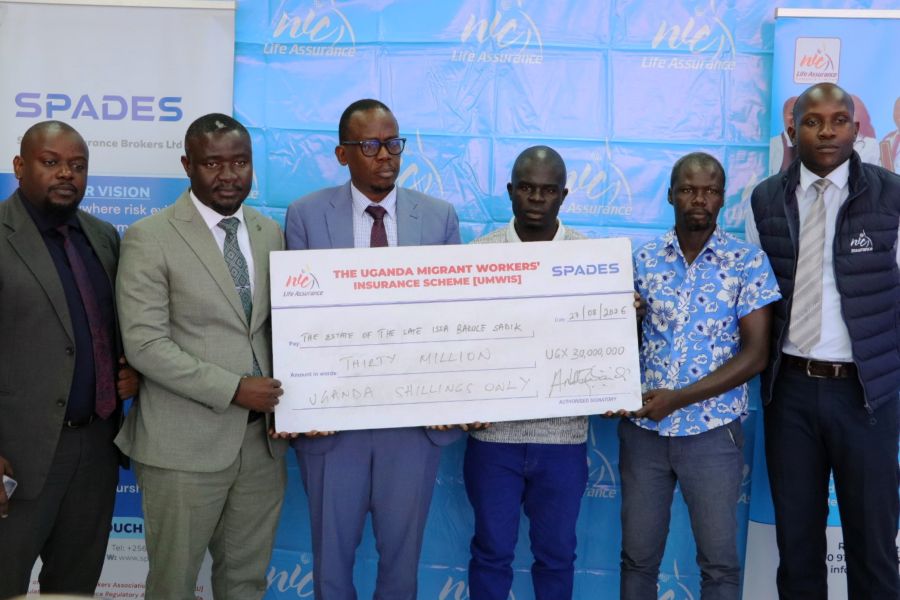
NIC Life Assurance has paid Shs30 million to the family of a Ugandan migrant worker who died in Dubai, highlighting the role of insurance in supporting workers and their families when tragedy strikes abroad.
Sadiq Bakole, 30, from Arua, died in December 2025, just one month after travelling to Dubai to look for work. He had previously worked in South Sudan for about five years.
Bakole was enrolled on the Uganda Migrant Workers Insurance Scheme (UMWIS), a product offered by NIC Life Assurance in partnership with Spades Insurance Brokers.
The scheme costs Shs250,000 for two years, equivalent to about Shs10,000 per month, and provides cover against a range of risks faced by Ugandans working abroad.
Speaking during the handover of the Shs30 million compensation to Bakole’s family in Kampala, Spades Insurance Brokers Managing Director Chris Ssengendo said the payout demonstrated the importance of insurance for migrant workers.
“When he passed away, NIC Life as insurers and Spades Insurance Brokers were obligated to honour our promise. We got in touch with the family. Today, we are happy to say that we have made the payment,” Ssengendo said.
Ssengendo said the insurance scheme was developed about two and a half years ago to protect Ugandans working outside the country, initially focusing on workers in the Gulf region.
He said the scheme had since been expanded to cover Ugandans working anywhere outside Uganda.
“We have worked with the government through the Ministry of Gender, Labour and Social Development, and through the same channels we assured one of our customers, Sadiq Bakole, who went to work in Dubai, for a payment of Shs250,000, which covers a period of two years,” he said.
According to NIC Life officials, the scheme provides a Shs30 million benefit to the family in the event of the insured worker’s death.
It also provides up to Shs20 million for permanent total disability and up to Shs15 million for specified critical illnesses.
The policy further provides for the repatriation of the deceased’s body to Uganda, burial expenses and support for workers who are unable to return home after losing their jobs or falling ill.
For Bakole’s family, the insurance cover came at a time when they were struggling to find a way to bring his body home.
His elder brother, Sadiq Bakit, said the family was devastated when they received news of Bakole’s death, just weeks after he had travelled to Dubai.
“He worked in South Sudan for about five years. Then he managed to contribute some little money that enabled him to pay for a ticket to travel abroad to look for some support for the family members. Unfortunately, he went and never took long. He only stayed in Dubai for a month and some days, we got information that he had passed on,” Bakit said.
He said the family initially did not know how it would afford to repatriate Bakole’s body.
“Luckily, through NIC insurance, they actually encouraged us. They told us that our brother was insured with their company and, as such, they were going to assist us to repatriate the body and cater for the burial arrangements,” he said.
Bakit said NIC Life facilitated the transportation of the body from Dubai to Uganda and supported the family’s burial arrangements.
NIC Life Assurance CEO Anthony Lubandi said the payout was intended to demonstrate that insurance companies can provide meaningful support to migrant workers and their families when tragedy occurs.
“Not many people can afford to pay Shs15 million or maybe Shs20 million to bring back the body of their loved one. The Migrant Workers Insurance Scheme answers that,” Lubandi said.
He said the scheme provides up to Shs30 million to a deceased worker’s family, in addition to repatriation and burial support.
“The compensatory benefit is extended to the family, not to replace the life, but to ease the pain because this person was contributing to the family,” Lubandi said.
Lubandi urged the government to consider making insurance mandatory for Ugandans travelling abroad for work.
“We believe that our government should take a keen interest in this and ensure that it’s almost made mandatory. The cost is not that big, it is really affordable, but the benefits far outweigh what a person would pay to have themselves covered for two years,” he said.
Ssengendo also called on government, recruitment agencies and migrant workers to embrace the insurance scheme, arguing that families should not have to raise money through public appeals to repatriate relatives who die abroad.
He said the scheme was intended to provide a “plan B” for migrant workers and their families when unexpected events occur.
“People don’t call for bad things to happen, but when the worst happens, there should be risk mitigation. There should be a plan B, and the plan B should be the Uganda Migrant Workers Insurance Scheme,” Ssengendo said.
NIC Life officials said about 4,500 Ugandan migrant workers have so far registered for the scheme, while more than Shs276 million has been paid out in claims over the past two years.
The insurers said the scheme is currently available to Ugandans working anywhere outside the country, rather than only those in the Gulf region.