

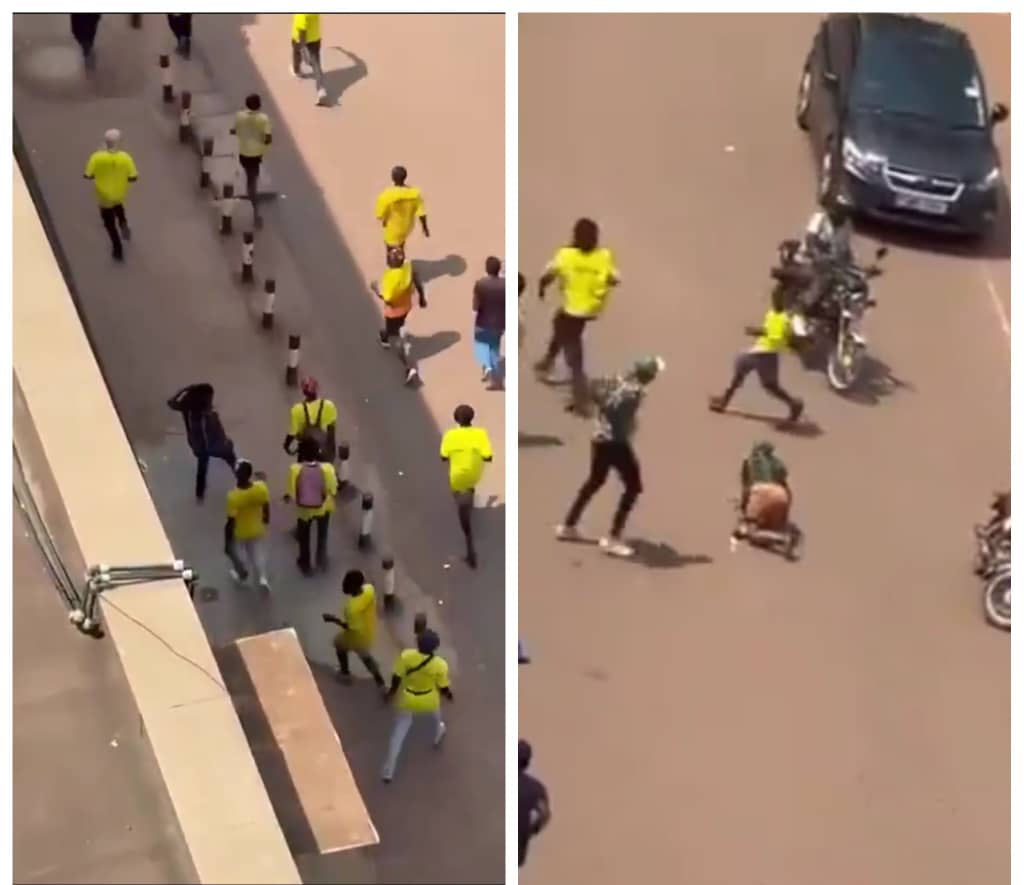
The ruling National Resistance Movement (NRM) has publicly distanced itself from the violent scenes that played out on the streets of Kampala on Saturday, where groups of youths donning the party’s iconic yellow t-shirts were captured on camera assaulting civilians and robbing businesses in broad daylight.
The disturbing incidents unfolded shortly after President Museveni also the NRM National Chairman picked up nomination forms at the party headquarters on Kyadondo Road, signaling his intention to run for the party’s presidential flagbearer slot in the upcoming elections.
But as videos of the chaos flooded social media, prompting outrage and condemnation, NRM Secretary General Richard Todwong addressed journalists to both condemn the violence and cast doubt on the true identity of the perpetrators.
“We cannot rule out that those could be elements of the opposition that dressed in our t-shirts and caused that incident,” Todwong said.
He claimed that such behaviours are similar to other political parties not NRM.
“Because in the history of NRM, our youth have never behaved like that. That behaviour is not for NRM. It is similar to the behaviours of other parties.
Footage widely circulated on social media showed men in NRM-branded shirts dragging victims through the streets, harassing motorists, attacking mobile money agents, and looting phones and cash in a wave of violence that shocked the public.
Police have since arrested over 30 suspects, several of whom were caught on CCTV. Some were clearly identifiable by their clothing and actions.
Despite this, Todwong insisted the culprits were not genuine NRM members, claiming the violence was possibly orchestrated by political saboteurs masquerading as NRM supporters to damage the party’s image during a high-profile event.
“The footage is there, the faces are known. The police are investigating each and every one of them who was involved in this,” he added.
While denying that the party sanctioned or recognized the attackers, Todwong offered a formal apology to the victims.
“We don’t condone such behaviour, and we do apologize to those who were affected. The fact that they used our t-shirts to cause that is bad enough,” he said.
He emphasized that the NRM had already initiated internal investigations and is working closely with security agencies to hold all individuals accountable regardless of political affiliation.
“That behaviour is not for NRM,” Todwong reiterated. “It is similar to the behaviours of other parties.”
Todwong’s remarks have added a new layer of tension to Uganda’s pre-election climate, with critics questioning whether the NRM is deflecting responsibility or genuinely uncovering a covert campaign of political infiltration.
Some political observers argue that the party must confront hard truths about youth mobilization and street-level discipline rather than pointing fingers.
Others agree with Todwong that the scale and nature of the violence suggest a deliberate attempt to hijack the party’s visibility and create chaos under its banner.