










President Museveni has unveiled a plan to transform his demonstration farms into centres of excellence for the 4-acre agricultural model, aimed at lifting Ugandan households out of poverty through structured small-scale commercial farming.
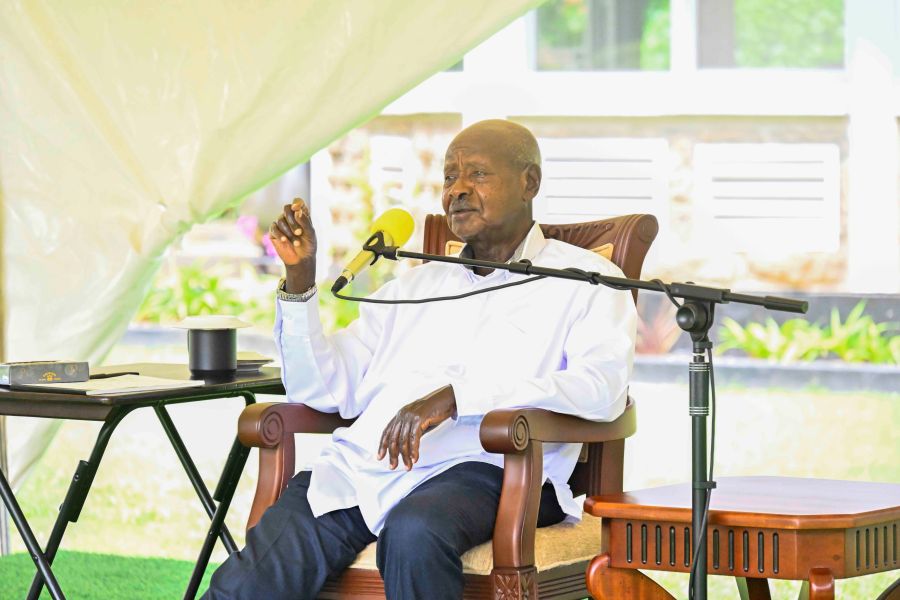
Speaking on Thursday at the State Lodge in Mayuge District, the president said the farms will serve both as training grounds for modern farming techniques and as distribution hubs for free agricultural inputs.
“We’re going to develop this farm here according to plan, but at the same time, start giving materials to you people. Those who want coffee, pigs, chicken, or fingerlings for fish, we shall give them directly,” Museveni told residents of Kityerera Parish.
The 4-acre model recommends dedicating one acre to coffee, one to food crops, one to fruit trees such as mangoes and pineapples, and one to pasture for livestock. Backyard spaces can be used for poultry, piggery, or fish farming—especially in wetland areas.
“These seven activities can generate sufficient income for any homestead. If you do them well, you’ll not only escape poverty but also create employment and wealth,” the President said.
Museveni recalled how similar interventions in the cattle corridor during the 1990s boosted domestic milk production by replacing indigenous cattle with Friesians, cutting imports from Kenya, New Zealand, and Australia.
He highlighted success stories such as Joseph Ijala, a former taxi driver from Serere District who now earns over Shs 1 billion annually from poultry and dairy farming on 2.5 acres, and Nyakana from Fort Portal, who earns Shs 130 million annually on just 1.2 acres.
The President said the Kityerera farm will be modelled after his successful projects in Kisozi and the cattle corridor, incorporating all seven recommended enterprises, including fish farming. He warned against destructive practices like rice growing in wetlands, noting that fish farming could earn Shs 66 million from one acre with eight ponds.
Museveni also cited the work of Prof. Florence Muranga, who produces up to 53 tons of matooke per acre compared to the national average of five tons, as proof that scientific farming can transform incomes.
To encourage uptake of the model, the president urged residents to form SACCOs to access credit and pledged direct government provision of livestock and fish farming inputs.
He also announced security measures to curb livestock theft, including deploying 18 police officers per sub-county, using police dogs, and installing surveillance cameras.
Museveni praised Busoga’s contribution to the liberation struggle, naming several Bush War heroes from the region, and reiterated his commitment to improving livelihoods in the area.
The meeting was attended by Third Deputy Prime Minister Rukia Nakadama Isanga and Minister for the Presidency Babirye Milly Babalanda. Nakadama lauded the President’s development vision, saying, “You told us that you don’t want poor neighbours, and that’s why you’ve brought us here.”