









The Stanbic Business Incubator Limited (SBIL) has concluded training for the first cohort under the Green Businesses and Jobs for the Green Transformation Project, a flagship programme designed to empower women-led enterprises championing environmental sustainability.
During the final session, more than 32 women-led green enterprises presented their business plans, demonstrating how they intend to strengthen access to finance, improve operational efficiency, and expand their environmental impact.
The Green Transformation Project is implemented in partnership with GIZ—Germany’s development cooperation agency—and Uganda’s Ministry of Gender, Labour and Social Development. It is currently being rolled out in Kenya, Tanzania, and Uganda as part of efforts to accelerate women’s economic empowerment and promote a region-wide shift toward sustainable growth.
The broader Women for the Green Transformation in Africa (WE4D) programme is jointly funded by the Government of Norway and the European Union (EU).
A central goal of the Stanbic–GIZ collaboration is to widen training opportunities for women and support enterprises involved in renewable energy, circular economy initiatives, waste management, blue economy ventures, ecotourism, and sustainable agriculture.
The two-year programme consists of four cohorts featuring classroom training, workshops, site visits, and personalised coaching.
Fatumah Kayaga Ntanzi, GIZ Programme Coordinator at SBIL, commended the participants for completing the training.
“Thirty-two businesses have successfully completed this phase and pitched before the judges. The panel assessed how well participants understood the training, their readiness to apply the knowledge, and their commitment to transforming their businesses,” she said.
Over the two-month programme, participants strengthened their financial literacy, gained practical business management skills, and deepened their understanding of sustainable growth strategies critical to thriving in the green economy.
They were also introduced to governance frameworks, value chain development principles, and efficiency tools aimed at reducing operational costs.
Kayaga added that the next step involves linking the SMEs to financing opportunities and connecting them to potential investors, including venture capital funds.
Charles Kabiswa, Team Leader and Executive Director at Regenerate Africa, noted the strong progress made by participating enterprises.
“We are proud to partner with SBIL in training 200 women-led SMEs. It is inspiring to see how businesses are embracing greener models—whether in renewable energy, sustainable agriculture, circular economy, or waste management. Many are producing briquettes, energy-saving stoves, solar solutions, or engaging in agro-processing and food systems,” he said.
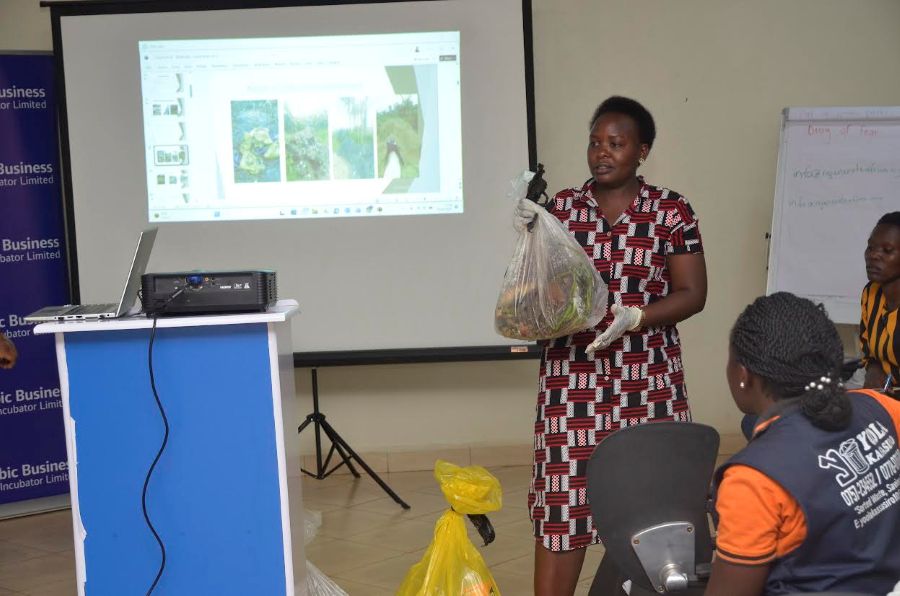
Several entrepreneurs expressed renewed confidence in scaling their innovations following the training. Veronica Nandugwa Brenda, CEO of Yoola Kasasilo, shared:
“I was encouraged to expand my vision nationally and pursue government certification. I aim to build a large-scale compost system to convert organic waste into fertiliser. The feedback was invaluable and motivates me to refine my business further.”
Dr. Proscovia Athieno, founder of Aroza Group Limited, also reflected on the skills gained.
“I have learnt practical ways to reduce my company’s carbon footprint—like conserving water, improving energy efficiency, and ensuring a positive community impact. I am deeply grateful to Regenerate Africa, SBIL, and our partners at GIZ,” she said.