







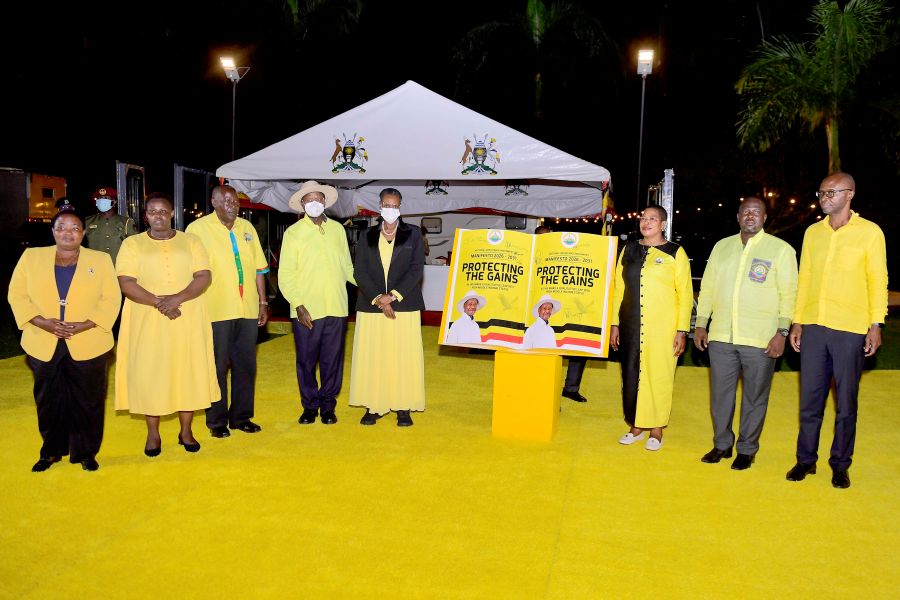
President Museveni, who is also the National Chairman of the ruling National Resistance Movement (NRM), has officially launched the party’s manifesto for the 2026–2031 term.
At a grand ceremony held at Munyonyo Commonwealth Resort Hotel and attended by Cabinet ministers, Members of Parliament, senior NRM officials, and party secretariat leaders, the manifesto was unveiled under the theme: “Protecting the Gains and Securing a Qualitative Leap into High Middle-Income Status.”
Museveni retraced the NRM’s 60-year historical journey while laying out ambitious commitments for the next five years.
He expressed gratitude to the NRM delegates for once again entrusting him with leadership, noting that the party had not only re-elected him as National Chairman for the 2025–2031 term but also nominated him as the flag bearer for the 2026 elections.
“I want to thank you for supporting my candidature, first of all, electing me Chairman of the NRM again for another five years, 2025 to 2031, and then also electing me as flag bearer,” Museveni said, reminding the gathering of NRM’s long-standing role in Uganda’s liberation.
He described the liberation struggle between 1965 and 1986 as a decisive period when NRM leaders risked everything to free Uganda from dictatorship and chaos.
Museveni emphasized that the NRM’s most important gift to Uganda has been peace and security, ensured largely by the people and the Uganda People’s Defence Forces (UPDF). “Our army is very strong. Nobody can bring war here. If you bring war here, we will destroy you,” he said, drawing applause.
He cautioned that peace must be distinguished from security, pointing out that crime—especially theft—continues to frustrate citizens and undermine government development programs such as the Parish Development Model (PDM).
“People get money for PDM. They buy pigs, goats, chicken—they are stolen. And you find the policemen colluding with the thieves. The judiciary releases them. You leaders should not accept this in your areas,” Museveni warned.
He urged leaders to enforce discipline and reject any culture of leniency toward crime. “Any thief who steals properties of the villages must go to jail and stay there and pay for what he has stolen before he comes out. Be very strict—don’t play around.”
Moving beyond peace and security, Museveni highlighted the three key pillars of Uganda’s transformation: development, infrastructure, and wealth creation.
He explained that development encompasses both economic and social infrastructure—such as roads, electricity, schools, hospitals, and ICT—while wealth creation remains the foundation for sustaining the NRM’s legacy.
He recalled how the student movement in the 1960s launched a campaign in the cattle corridor that transformed a once-impoverished region into a prosperous one through dairy farming. “Despite infrastructure challenges, regions like Ngoma and Matongo are now prosperous, with residents owning cars and having money,” Museveni said.
With 40 million acres of arable land, he stressed that Uganda has the capacity to create over 105 million jobs if even 7 million acres are properly utilized.
“There will be so many jobs that even refugees in the camps will get out and work,” he quipped.
He also criticized the trend of Ugandans seeking jobs in the Middle East, insisting that Uganda has enough opportunities if productivity is enhanced. “People going to the Middle East to look for jobs—what are you going to look for? The Middle East should be coming here to work. You leave jobs here, you go to work in the Middle East,” he remarked, provoking laughter among delegates.
Museveni praised Uganda’s scientific advancements, especially in health, noting that Ugandan scientists have developed medicines for cancer, diabetes, malaria, and other global diseases.
“Our people have discovered medicines; we are going to save the world from so many problems,” he said, positioning science and innovation as another transformative frontier for Uganda.
NRM First National Vice Chairperson Moses Kigongo thanked Museveni for accepting to run again and assured him of victory in the 2026 elections. “We are ready. The country is ready. And I can assure you that we are going to win the election,” Kigongo said.
He warned party members against indiscipline and infighting, urging them to love one another and work together. “This infighting must stop and stop now. Let us move together as one group,” he urged.
Speaker of Parliament and NRM Second National Vice Chairperson Anita Among praised Museveni’s visionary leadership and consistency, stating that the NRM’s evolution from the 10-Point Programme had been deliberate and transformative.
“It is now time for us to protect the gains we have registered in the transformation of our beloved country,” she emphasized.
NRM Secretary General Richard Todwong explained that the 2026–2031 manifesto, themed “Protecting the Gains as We Make a Qualitative Leap into Higher Middle-Income Status,” builds systematically on previous manifestos.
Reflecting on the party’s history, Todwong reminded members that NRM manifestos have evolved consistently since 1986, beginning with the 10-Point Programme, which emphasized democracy, security, national unity, elimination of sectarianism, economic independence, and social services restoration.
He noted that themes like “Tackling the Tasks Ahead” in 1996, “Prosperity for All” in 2006, “Peace, Unity and Transformation for Prosperity” in 2011, “Steady Progress” in 2016, and “Securing Your Future” in 2021 have all shaped Uganda’s transformation.
“The size of the economy has doubled in spite of global shocks such as COVID-19 and disruption in external markets,” Todwong said, projecting that by the end of FY 2025/26, Uganda’s economy will expand to Shs 254.2 trillion (USD 66.1 billion).
He highlighted achievements from the outgoing 2021–2026 manifesto. Poverty levels declined from 21.4 percent in 2016 to 16.1 percent in 2025.
Jobs rose from 258,286 in 2020/21 to 345,039 by 2025, showing recovery from COVID-19 disruptions. The Ugandan shilling remained the most stable currency in Africa in the 2024/25 period.
He added that the number of factories rose to 50,000, up from 37,559 in 2019/20. Export earnings reached USD 13.3 billion in 2024/25, driven by sectors such as coffee, gold, dairy, cocoa, and manufactured goods. Electricity generation increased to 2,051 megawatts in 2024, powered by Karuma and Isimba hydropower plants.
In the health sector, Todwong said that life expectancy improved to 68 years, up from 45 in 1986. Maternal and infant mortality rates drastically declined.
Universal Primary and Secondary Education boosted school enrollment to 9.1 million learners by 2025, while literacy rates rose to 74 percent. “These are not just numbers—they are lives transformed,” he said.
Looking ahead, Todwong outlined the core themes of the new manifesto. He announced that PDM funding for the Greater Kampala Metropolitan Area will rise to Shs 300 million per parish, with additional grants for persons with disabilities, village leaders, and religious leaders.
On education, he pledged curriculum reforms to focus on producing job creators, recruitment of 49,406 new teachers, and progressive salary enhancements for civil servants, including arts teachers.
On governance, Todwong reiterated the NRM’s zero tolerance to corruption, support for decentralization, land reforms, and stronger security guarantees.
At the regional level, the NRM committed to advancing the East African political federation, implementing a single currency, and eliminating non-tariff barriers to promote trade and integration.