










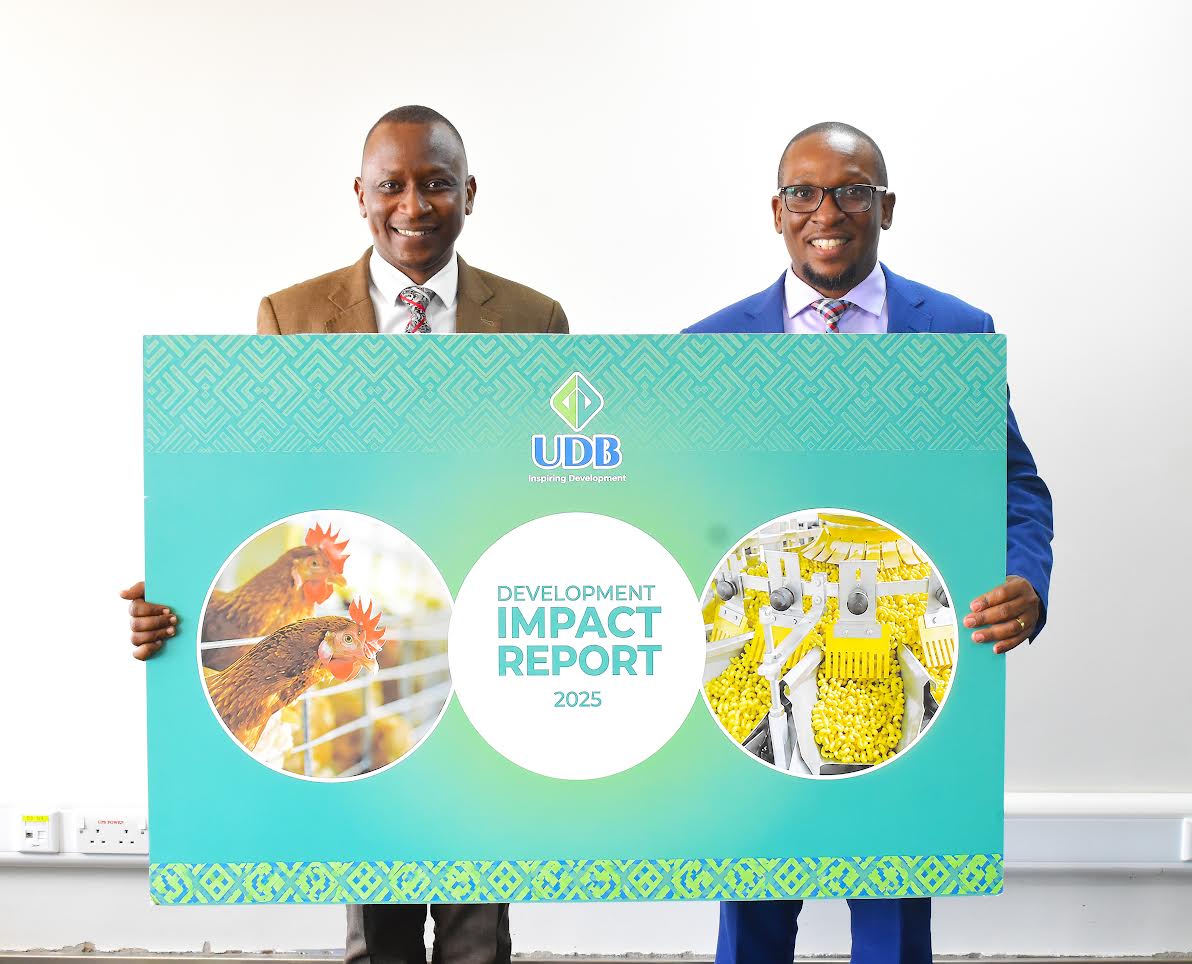
Uganda Development Bank (UDB) says businesses supported through its financing created and sustained 69,202 jobs in 2025, underscoring the growing contribution of development finance to employment, enterprise growth and Uganda’s wider economic transformation.
The figure represents a 24.6% increase from the 55,553 jobs recorded in 2024, according to UDB’s 2025 Development Impact Report launched today.
The report, which assessed 525 UDB-funded enterprises, also points to growth in business output, profitability, tax contributions and foreign exchange earnings during the year.
Annual output among enterprises financed by the Bank increased by 3.4%, from Shs6.05 trillion in 2024 to Shs6.26 trillion in 2025. Net profitability rose by 9.1%, from Shs1.06 trillion to Shs1.16 trillion.
The businesses also increased their contribution to government revenue, with tax payments rising by 22.5% from Shs316 billion in 2024 to Shs387 billion in 2025.
Foreign exchange earnings recorded the sharpest growth. UDB-supported enterprises generated Shs1.85 trillion during the year, representing a 66.5% increase from Shs1.11 trillion in 2024.
The industrial sector accounted for the largest share of the foreign exchange earnings, generating about Shs1.48 trillion, equivalent to 80% of the total. The services sector contributed approximately Shs220 billion.
UDB attributed the growth to increased production capacity, improved market access, investment in productive equipment, land utilisation and access to working capital, particularly in manufacturing, agro-processing, tourism and other export-oriented activities.
The report highlights employment as one of the key measures of UDB’s contribution to Uganda’s economic development.
Women accounted for 39% of the 69,202 jobs created and maintained, while young people aged 35 and below held 73% of the jobs. Persons with disabilities accounted for 0.3%.
The quality of employment also showed improvement. Permanent positions accounted for 41% of the jobs, representing a 39% increase from 2024.
The assessment found that 62% of the enterprises surveyed contributed to the National Social Security Fund (NSSF) for their employees.
Women and young people are also increasingly participating in enterprise ownership. Among the 525 businesses assessed, women represented 34% of shareholders and held 27% of the shares, while youth accounted for 28% of shareholders.
UDB said some enterprises initially supported through its special programmes have expanded from small-scale operations into medium-sized businesses and subsequently progressed into the Bank’s mainstream lending portfolio.
The industrial sector recorded the largest share of enterprise output, followed by services.
The report links the expansion to increased productive capacity, access to markets, investment in equipment, improved land utilisation and working capital.
Of the 525 enterprises assessed, 524 reported positive net profitability,