









The government has officially launched feasibility and environmental studies for the proposed 400MW Kiba Hydropower Project, with Energy Minister Ruth Nankabirwa Ssentamu warning that Uganda risks facing a power deficit if new generation projects are not accelerated.
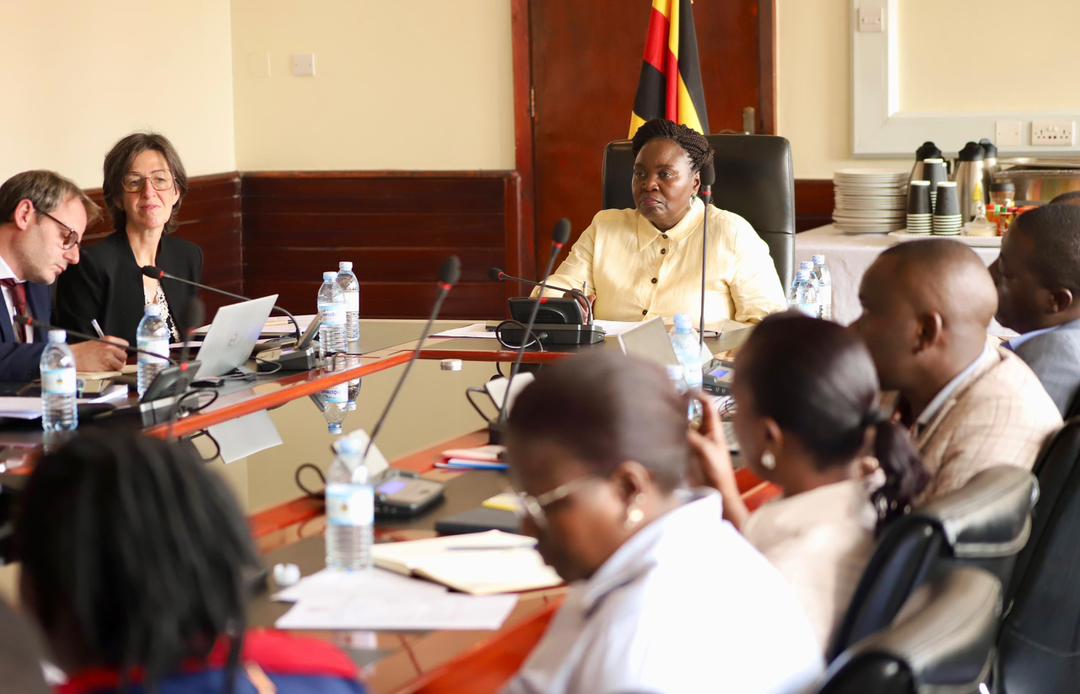
Speaking during a stakeholder meeting at Amber House in Kampala on Friday, Nankabirwa described the commencement of the studies as a major step toward strengthening Uganda’s long-term energy security and supporting industrial growth.
“The country must move quickly to develop new generation capacity if we are to sustain industrialization and avoid future power shortages,” Nankabirwa said.
Uganda’s current installed electricity generation capacity stands at 2,094.1MW, although dependable supply remains significantly lower at approximately 1,450MW due to hydrological fluctuations, transmission bottlenecks and the intermittent nature of solar energy.
According to data from the Uganda Electricity Transmission Company Limited (UETCL), national peak electricity demand reached 1,337.15MW in February 2026, leaving a narrow reserve margin.
The minister said electricity demand continues to rise sharply, driven largely by industrial expansion and emerging investments such as data centres.
Large industries including Devki Steel, Hima Steel and Tororo Cement currently account for about 155MW of electricity demand, while proposed data centre investments have requested up to 887MW.
Uganda also continues to export electricity to neighbouring countries. In February alone, exports to Kenya, Rwanda and Tanzania totaled 269.7MW, with Kenya expected to increase imports to 300MW by 2027.
Government projections indicate the country could face a 40MW deficit in the 2025/26 financial year, potentially widening to 217.4MW by 2027/28 if planned generation projects delay.
Nankabirwa warned that failure to address the shortfall could force government to resort to expensive thermal generation and possible load shedding, increasing pressure on electricity tariffs.
“The financial implications could be enormous both for government and consumers,” she noted.

The Kiba Hydropower Project has been prioritised under the Fourth National Development Plan and the NRM Manifesto as part of efforts to expand reliable base-load power generation.
Permanent Secretary in the Ministry of Energy and Mineral Development Eng. Irene Bateebe directed consultants to ensure the studies prioritise biodiversity conservation and underground engineering options to minimise environmental disruption.
The studies are being undertaken by a joint venture of Aban Pazhouh Sering Ingegneria SRL and Ab Niru Consulting Engineers.
Gaetano Beninati, representing the consultants, said the assignment will assess the technical, economic and environmental viability of the project before implementation.
“We are exploring several alternatives, including underground powerhouse configurations, to reduce the environmental footprint while maximizing energy production,” Beninati said.
The proposed run-of-river hydropower plant is expected to generate approximately 2,686.6GWh annually and will be located along the Nile corridor downstream of Ayago and upstream of Murchison and Uhuru Falls.
Government is also studying options for evacuating power from the project through a 400kV transmission line, although underground cabling may be required because of the environmentally sensitive location.
The feasibility study is expected to be completed within 14 months.