











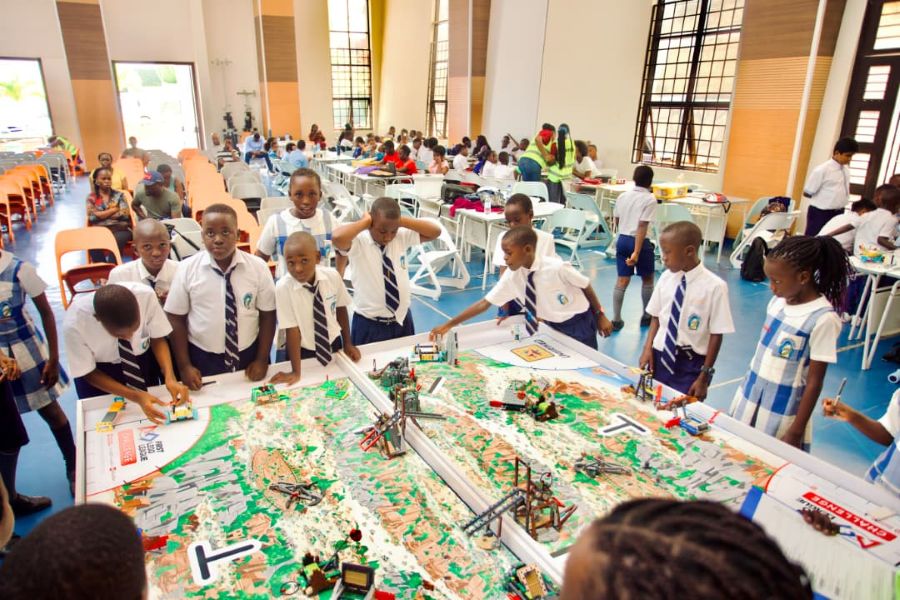
Uganda’s next generation of innovators has been showcased at the Third National STEM and Robotics Skills Competition, as hundreds of learners gathered at Kabojja International School in Kampala for one of the country’s fastest-growing youth technology events.
Organised by Next Gen Restyling Limited under the World Skills Federation Uganda, the competition brought together 380 learners in 48 teams from 30 government, private and international schools. Participants aged between four and 25 demonstrated innovations in robotics, electronics, engineering design and hackathon development.
Founder of Next Gen Restyling Limited, Mellon Kenyangi, said the initiative goes beyond competition, describing it as a long-term investment in Uganda’s future workforce.
“We are building innovators, not job seekers. Young people make up the largest segment of our population. If their creative and problem-solving abilities are not nurtured, we risk losing enormous potential. This platform equips them with confidence and practical skills to solve real-world problems,” Kenyangi said.
Now in its third edition, the competition has grown from a small school-based challenge into a national STEM showcase, drawing regional and international interest. Eight teams emerged as top innovators, earning opportunities to represent Uganda at international STEM engagements, including events in the United States.
International participation featured visiting teams from Maryland and Texas, who also extended STEM training to underserved communities. Organisers confirmed that student exchange programmes are planned for Bushenyi and Sironko districts in 2026.
Despite its expansion and growing impact, organisers noted that the initiative operates with limited funding, relying heavily on partnerships with American institutions. Kenyangi called for stronger support from government agencies and the private sector.
“Innovation does not thrive on rhetoric alone. It requires deliberate investment. We are appealing to stakeholders to support platforms that are already producing measurable results,” she said.
Government Support for STEM Growth
The competition received endorsement from government representatives, reflecting Uganda’s broader push towards science, technology and innovation.
Christine Mugimba, Director for ICT and Research at the Uganda Communications Commission (UCC), cited progress made through the Universal Communications Access Fund, which has equipped more than 1,000 secondary schools with ICT laboratories.
“Robotics and artificial intelligence are no longer future concepts; they are here. Our responsibility is to expose learners early and enable them to apply technology to Uganda’s development challenges,” Mugimba said.
She reaffirmed UCC’s commitment to ICT competitions, girls-in-ICT programmes and teacher training to promote inclusive participation in the digital economy.
Ronald Ddungu, Principal Education Officer at the Ministry of Education and Sports, said Uganda’s new lower-secondary curriculum emphasises project-based and applied learning, creating opportunities for robotics and engineering innovation.
“This curriculum shifts education from theory to practice, and competitions like this align directly with our national education goals,” Ddungu said.
Innovating for Real-World Solutions
The exhibition showcased practical solutions addressing environmental, health and technological challenges. Learners from Greenhill Primary School Buwate presented an EcoSense Kit, a soil-moisture detection device designed to help prevent landslides.
Hackathon participants from Maryhill High School developed an autonomous caregiver system aimed at improving patient support and emergency response.
Teachers described the event as an extension of the classroom, where academic concepts are applied in real-life contexts.
“These competitions are exhibitions of learning. They allow students to demonstrate how science and mathematics translate into practical solutions,” said Nicholas Kajoba, a teacher at Maryhill High School.
As Uganda advances towards a science-driven economy, the National STEM and Robotics Skills Competition is emerging as a key platform for youth empowerment, linking education, technology and industry exposure.
Organisers say their goal is to expand the programme nationwide and reach more underserved schools.
“By investing in young innovators today, we are securing Uganda’s innovation economy for the future,” Kenyangi said.