








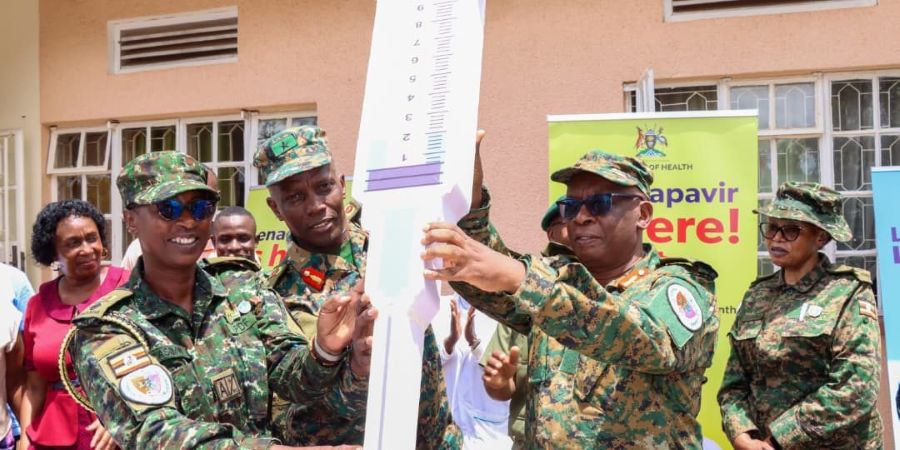
The Uganda Peoples’ Defence Forces (UPDF) has rolled out lenacapavir, a long-acting injectable HIV prevention drug, in a move aimed at improving protection among soldiers and strengthening its HIV response.
The rollout, carried out at the HIV Centre at the General Military Hospital (GMH) Bombo, introduces a PrEP injection that is given once every six months, offering an alternative to daily pills.
Major General Dr Ambrose Musinguzi, the UPDF Joint Staff for Health Services, said the new tool adds strength to the force’s prevention efforts.
“The introduction of this new technology is an added weapon in our arsenal. It comes at the right time and strengthens the gains we have already made in the fight against HIV,” he said.
He said the army has long used a combination of strategies including testing, treatment, and behaviour change programmes to reduce infections, but stressed the need for continuous improvement.
Maj Gen Musinguzi also warned that new medical innovations can face resistance due to misinformation, calling on health workers to guide soldiers with accurate information.
“This drug will be a game changer, but like all new interventions, it requires clear communication, proper guidance, and strong systems to support its implementation,” he added.
UPDF health officials said the rollout is aligned with national efforts to end HIV as a public health threat by 2030. Lt Col Evelyn Asiimwe, Director HIV/AIDS in the UPDF, said the injection is expected to improve uptake compared to daily oral PrEP.
“Today, we are excited to roll out this long-acting HIV prevention injection within the UPDF. While oral PrEP has been available, uptake has not been optimal, and this new option provides a more convenient and effective alternative,” she said.
She said initial doses have already been received, with GMH Bombo and another military facility serving as rollout centres, supported by satellite clinics.
More than 50 health workers have been trained to administer the injection, which will also be offered at outpatient and maternal health services.
Dr Denis Bwayo, from the URC-UPDF HIV programme, said systems must ensure continuity so soldiers do not miss follow-up doses.
“We must ensure that once clients are enrolled, the system can track them and provide subsequent doses without interruption,” he said.
He added that over 22,000 UPDF clients are currently on treatment, with viral suppression rates above 95 per cent.
From the Ministry of Health, Dr Miamuna Kinalwa welcomed the rollout but urged caution and strong monitoring.
“This marks a significant step in expanding prevention choices. However, we must remain vigilant in monitoring outcomes, strengthening health worker capacity, and ensuring proper use of this intervention,” she said.
Dr Mary Kiba of GMH Bombo explained that lenacapavir works by stopping the virus from multiplying and provides protection for up to six months.
“This is a long-awaited innovation. With just one injection, an individual is protected for six months, addressing adherence challenges associated with daily medication,” she said.
She added that the method is especially useful for people who struggle with daily pills or face stigma in taking them.
The rollout brought together military health leaders, government officials, and partners as the UPDF pushes for wider uptake of modern HIV prevention tools among its personnel.