










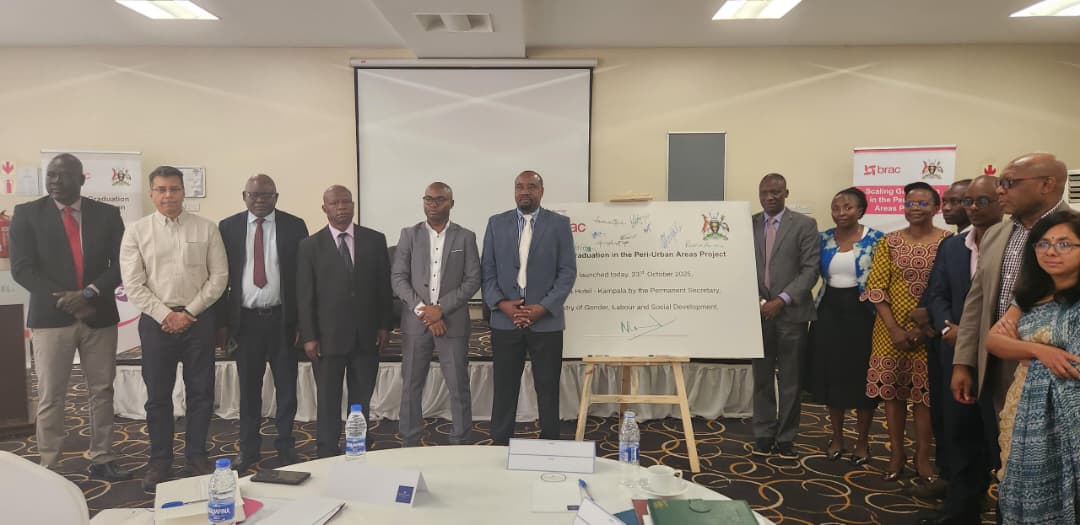
More than 3,300 women-headed households in the Busoga sub-region are set to benefit from a new shs 17.4 billion (USD 5 million) project launched by BRAC Uganda to help ultra-poor families transition from extreme poverty to sustainable livelihoods.
The Scaling Graduation in Peri-Urban Areas Project, which will run for 27 months, is being implemented in Luuka, Iganga, and Bugiri districts, targeting vulnerable households — especially those led by women — through productive asset transfers, livelihood training, and financial inclusion.
Speaking at the launch, Atuhaire Speaking, Country Director of BRAC Uganda, said the initiative builds on BRAC’s globally recognized Graduation Model, which integrates social protection, empowerment, and access to financial services.
“We are here to officially launch a 27-month project designed to enable people to graduate out of poverty,” Atuhaire said. “It is based on BRAC’s 52 years of experience in empowering people through mindset change, skills training, and access to assets and finance.”
She added that Busoga was chosen because it remains one of the regions most affected by poverty.
“Busoga still ranks high in poverty levels, and this project leverages our existing programs to ensure that women and their families can rebuild their livelihoods,” she said.
Project Manager Joseph Kabanda explained that the program will apply BRAC’s Ultra-Poor Graduation Model, which focuses on four key pillars — social protection, social empowerment, financial inclusion, and livelihood promotion.
“We are working closely with government officials, including parish chiefs, LC1s, and community development officers, to identify and support the most vulnerable out-of-work households,” Kabanda noted. “Our target areas are peri-urban communities and trading centres where poverty is hidden but severe.”
Kabanda added that field officers will provide continuous coaching and mentorship over the project period to help beneficiaries build sustainable income sources and savings habits.
“By the end of the project, we expect participants who once struggled to afford a daily meal to have food security, stable savings, and multiple productive assets,” he said.
Representing the Ministry of Gender, Labour and Social Development, Commissioner Bernard Mujuni, speaking on behalf of Permanent Secretary Aggrey Kibenge, commended BRAC for complementing government efforts to address poverty and inequality.
“We appreciate BRAC’s leadership in championing this model that aligns with our national social protection strategy and the Sustainable Development Goals,” Mujuni said. “The project promotes inclusive growth, decent work, and resilience among the most vulnerable.”
He urged stakeholders to draw lessons from the Busoga initiative for future national replication.
“This model deserves to be replicated nationwide,” he added. “It not only tackles immediate needs of ultra-poor households but also builds their long-term resilience and self-reliance.”
The project is expected to create sustainable pathways for economic empowerment among women and vulnerable families, contributing to Uganda’s broader goals of reducing poverty and promoting inclusive development.