











Uganda and China have launched the 2026 China-Uganda Year of People-to-People Exchanges, a year-long initiative aimed at strengthening cultural understanding and expanding economic cooperation between the two countries.
Vice President Jessica Alupo officially inaugurated the initiative on Sunday at the Millennium Grounds in Lugogo, describing it as a strategic step toward deepening bilateral relations beyond infrastructure development to include stronger social and economic integration.
Alupo said the exchange year reflects a deliberate shift in Uganda–China relations, emphasizing human connections as a foundation for sustainable trade and long-term partnership.
“For our cooperation to be durable and mutually beneficial, it must be anchored in people-to-people engagement,” Alupo said, noting that the initiative would enhance cultural literacy, skills development, and business collaboration.
The launch coincided with celebrations marking the Lunar New Year of the Horse and brought together government officials, diplomats, business leaders, and members of the Chinese community in Uganda.
A key focus of the 2026 exchange year is expanding Uganda’s access to the Chinese market, particularly following Beijing’s decision to grant Uganda 100 percent zero-tariff treatment on exports.
Alupo said the initiative would help Ugandan producers better position their goods for the Chinese market, contributing to increased exports and economic growth.

She highlighted progress in the agricultural sector, including the introduction of aquaculture exports and the expansion of coffee trade between Ugandan and Chinese firms, describing these developments as significant gains for the national economy.
Alupo credited frameworks such as the Belt and Road Initiative and the Forum on China–Africa Cooperation for facilitating trade growth and infrastructure development. She also acknowledged China’s contribution to Uganda’s road network, energy sector, and human capital development through scholarships in science and technology.
Beyond economic cooperation, the Vice President pointed to long-standing political ties between Uganda’s ruling National Resistance Movement and the Chinese Communist Party, noting that governance benchmarking programs in China have helped Ugandan officials acquire practical leadership experience.
She further reaffirmed Uganda’s commitment to working with China at the multilateral level, particularly within the African Union’s efforts to reform the United Nations Security Council.
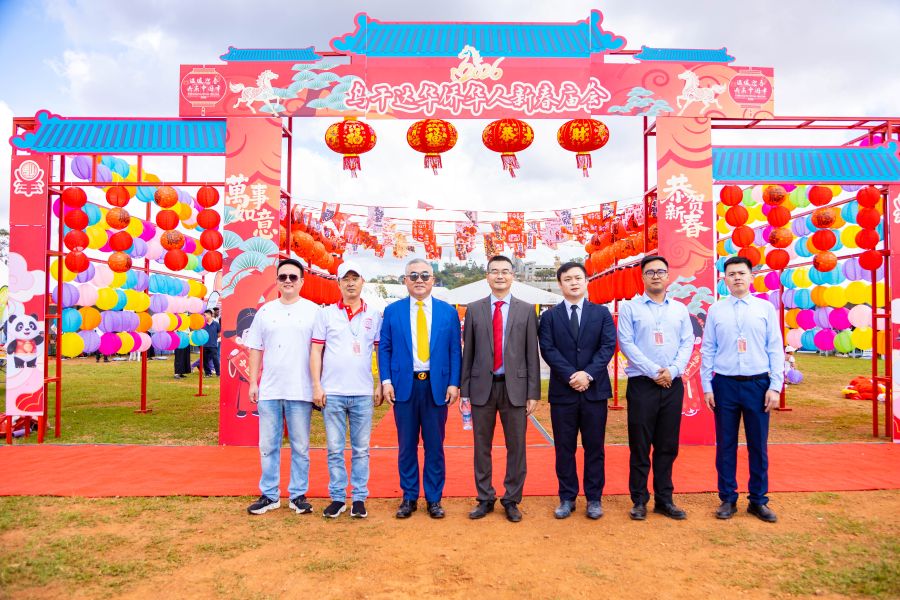
Fan Xuecheng, Chargé d’Affaires at the Chinese Embassy in Uganda, said bilateral trade reached record levels in 2025 following the zero-tariff policy.
He reported that Ugandan exports to China reached USD 84 million in the first half of the year alone, with agricultural products showing strong growth.
Fan said China remains open to additional Ugandan exports and noted that Chinese-supported industrial parks continue to create employment opportunities. He also highlighted major infrastructure projects undertaken with Chinese support, including the Kampala–Entebbe Expressway, the expansion of Entebbe International Airport, and the Karuma and Isimba hydropower plants.
“These projects have transformed Uganda from a landlocked country into a land-linked one,” Fan said, emphasizing that future China–Africa cooperation would remain people-centered and rooted in mutual respect. He thanked Uganda for its continued support of the one-China principle.

Paul Zhang, Chairman of the Tian Tang Group and developer of the Sino-Uganda Mbale Industrial Park, said cultural understanding is essential for successful trade and industrial cooperation.
“Manufacturing and investment cannot thrive without mutual trust and cultural appreciation,” Zhang said, adding that the exchange year would provide opportunities for Ugandans to experience Chinese traditions and values firsthand.
Education and skills development will be central to the 2026 initiative. Fan noted the role of institutions such as the Confucius Institute and the Lingshi Institute for Technology in promoting language training and technical education. He said scholarship programs continue to support Ugandan students studying in China, while more Chinese students are pursuing academic opportunities in Uganda.
The launch event concluded with Vice President Alupo signing a commemorative horse symbol to mark the start of the exchange year, reaffirming Uganda’s commitment to strengthening the China–Uganda comprehensive strategic cooperative partnership.