










Telecommunications giant Airtel Africa has posted a strong financial performance for the year ended March 2026, buoyed by rising demand for internet services, rapid expansion in mobile money transactions, and continued investments in digital infrastructure across its African markets.
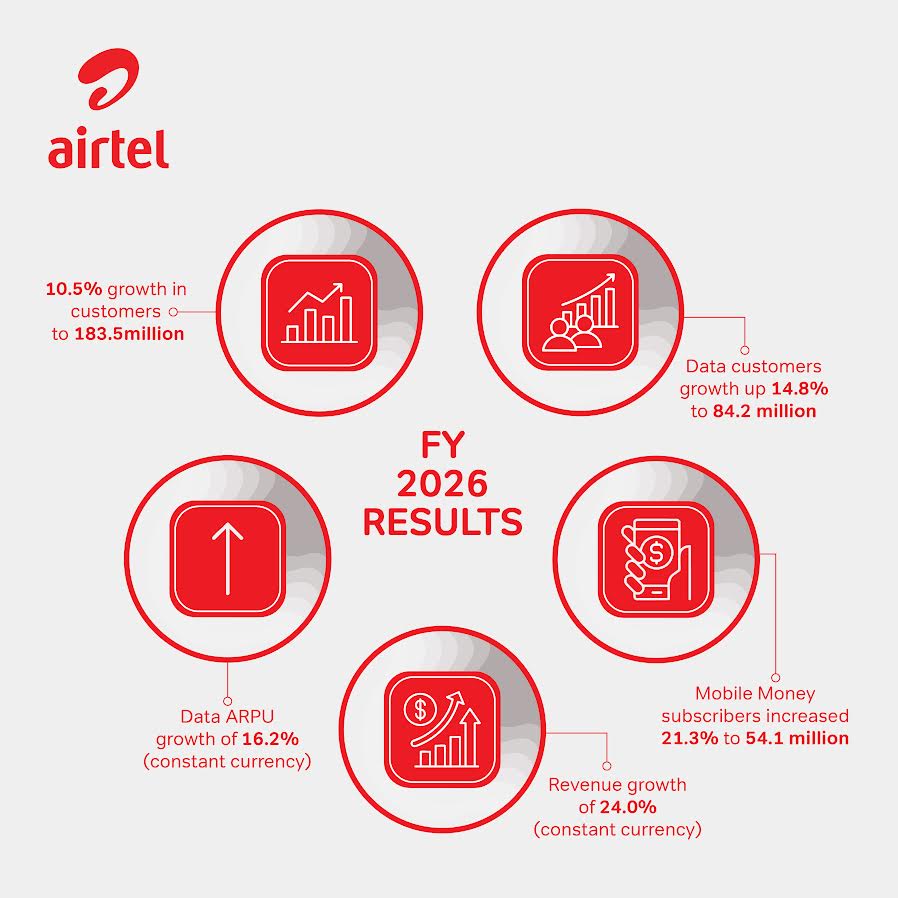
The company’s latest results show subscriber numbers climbed to 183.5 million customers, reflecting a 10.5 percent increase from the previous year and representing the largest annual customer growth recorded by the group so far.
Growth in smartphone adoption continued to fuel internet usage, with smartphone penetration nearing the halfway mark at 49.5 percent. Airtel Africa said this helped increase its data subscriber base to 84.2 million users, while average monthly data consumption per customer rose significantly to 8.9GB.
Strong usage trends boosted the company’s data business, which has now become Airtel Africa’s largest revenue stream after registering a 35.2 percent rise in earnings in constant currency terms.
The group also recorded significant growth in its financial technology segment through Airtel Money. Mobile money subscribers increased to 54.1 million customers, while annual transaction volumes processed on the platform exceeded $215 billion during the final quarter of the financial year.
According to the company, increased use of digital payments, broader financial service offerings, and higher customer activity continued to strengthen Airtel Money’s role within its operations.
Group revenue rose to $6.4 billion during the year, representing growth of 29.5 percent in reported currency terms. Nigeria remained one of the strongest-performing markets, supported by tariff adjustments and improved macroeconomic conditions, while Francophone Africa also maintained steady growth momentum.
Profitability improved considerably during the period, with profit after tax more than doubling to $813 million compared to $328 million recorded a year earlier. The company attributed the improvement to stronger operational performance and gains from foreign exchange movements.
Airtel Africa also recorded improved operating margins, with EBITDA margins rising to 49.3 percent and crossing the 50 percent mark in the final quarter of the year.
To strengthen network quality and expand coverage, the company invested heavily in infrastructure during the period. Capital expenditure rose to $884 million, funding the rollout of more than 3,250 additional network sites and the expansion of its fibre network to nearly 82,000 kilometres.
The telecom operator plans to scale up investments further in the next financial year, with projected capital expenditure expected to reach approximately $1.1 billion. Planned investments will target network expansion, broadband connectivity, and data centre development as demand for digital services continues to grow across the continent.
The company’s balance sheet also strengthened during the year, with leverage levels declining as earnings improved.
Airtel Africa’s board proposed a higher shareholder payout, recommending a final dividend of 4.26 cents per share, bringing total dividends for the year to 7.1 cents per share.
Chief Executive Officer Sunil Taldar said the company’s performance reflected both favourable market conditions and continued execution of its digital growth strategy.
He noted that the increased adoption of artificial intelligence and digital technologies had improved operational efficiency, customer onboarding processes, and service delivery across the business.
Taldar also said Airtel Africa remained committed to proceeding with the planned Airtel Money initial public offering, although changing global market conditions had pushed the expected listing timeline to the second half of 2026.
The company, however, cautioned that rising energy prices linked to global geopolitical tensions could increase operating costs and exert pressure on margins in the coming months.