










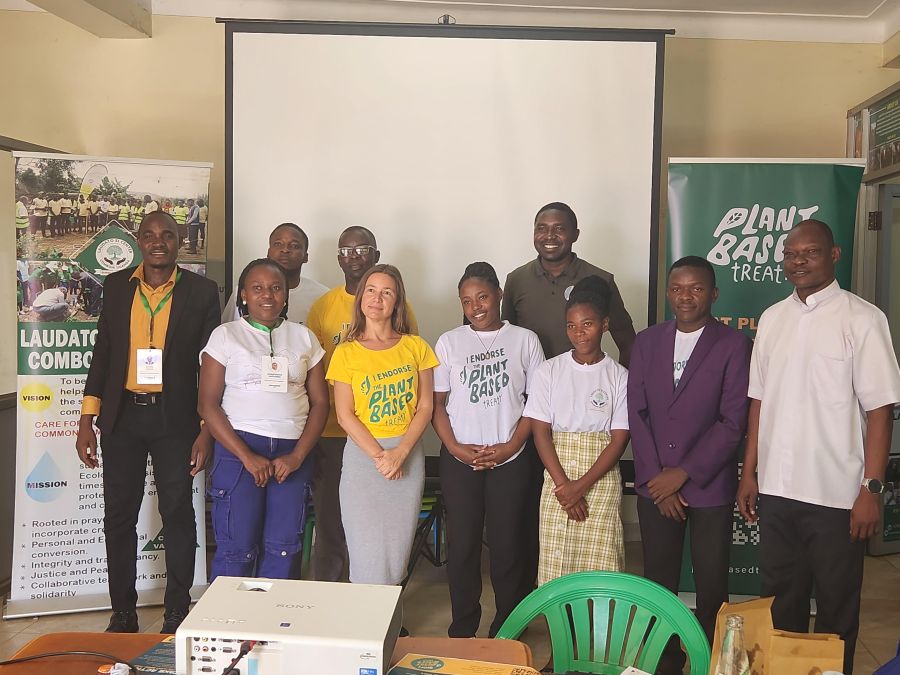
Laudato Si Comboni Centre Uganda has joined the Plant-Based Treaty Uganda Chapter, marking a significant step in strengthening faith-based advocacy for sustainable food systems, environmental protection, and public health.
During an engagement held at Our Lady of Fatima Catholic Parish in Mbuya, Kampala on Monday, environmental enthusiasts from Plant-Based Treaty Uganda met leaders of the Laudato Si Comboni Centre to discuss climate action through food system transformation.
Speaking at the event, Moses Kalyango, the Plant-Based Treaty campaigner for the Uganda Chapter, said engaging the Church was critical to advancing climate justice.
“Today we are here at Laudato Si Comboni Centre to collaborate with them so that we push our campaigns through the Church,” Kalyango said.
“The Plant-Based Treaty is about collecting endorsements from individuals, businesses and cities, and using that support to pressure national governments to endorse the treaty, which complements the Paris Agreement under the UNFCCC.”
Kalyango called on Ugandans to support the initiative, noting that food systems lie at the heart of the climate crisis.
“Plant-Based Treaty is about saving the climate through food systems. We are calling on people to shift from animal agriculture to plant-based farming because of the damage animal agriculture has caused to our climate,” he added.
Welcoming the collaboration, Rev. Fr. John Kennedy Onoba, Executive Director of Laudato Si Comboni Centre Uganda, described the partnership as timely and aligned with the Church’s environmental mission.
“This collaboration comes at the right time. Uganda’s diet is heavily animal-based, and aggressive advertising of animal products has shaped people’s food choices,” Fr. Onoba said.
He noted that engagement with Plant-Based Treaty advocates had broadened his understanding of the environmental and health benefits of plant-based food systems.
“This training opened my eyes to the benefits of plant-based foods, not only for health but also for the environment. From the environmental perspective, embracing plant-based food systems greatly reduces carbon emissions,” he explained.
Fr. Onoba emphasized the role of fruit trees in climate mitigation and community livelihoods.
“Fruit trees provide economic benefits, improve nutrition, and absorb carbon. They are rarely cut and contribute to long-term environmental protection,” he said.
Also addressing church leaders, Cindy Veltens, the Global Campaigner for Plant-Based Treaty Africa Region, linked plant-based diets to both climate resilience and improved public health.
“Plant-based food systems help reduce climate change, but they also address the health crisis caused by non-communicable diseases,” Veltens said.
“What we eat is empowering. Every day, we decide what goes on our plates, and those choices affect our health and the planet.”
She urged governments to adopt supportive policies. “We want governments to act in the best interest of citizens, not corporate marketing. Policies must prioritize healthy, climate-friendly and economically sustainable food systems,” she said.
Catherine Ayinebyona, a Plant-Based Treaty campaigner with the Uganda Chapter, highlighted food security as a key benefit of plant-based farming.
“In our traditional societies, granaries ensured food during times of hunger. Their disappearance has contributed to food insecurity,” she said.
She warned that reliance on animal-based foods poses health risks.
“Many animal products are processed with additives, hormones and antibiotics, which threaten human health and contribute to antibiotic resistance,” Ayinebyona noted.
The Plant-Based Treaty is a global campaign advocating the phase-out of unsustainable animal agriculture, the adoption of healthy plant-based diets, and the restoration of ecosystems.
By joining the Plant-Based Treaty Uganda Chapter, Laudato Si Comboni Centre Uganda has committed to amplifying the campaign through faith networks, environmental education, and community engagement—linking care for creation with human health, food security, and climate justice.