










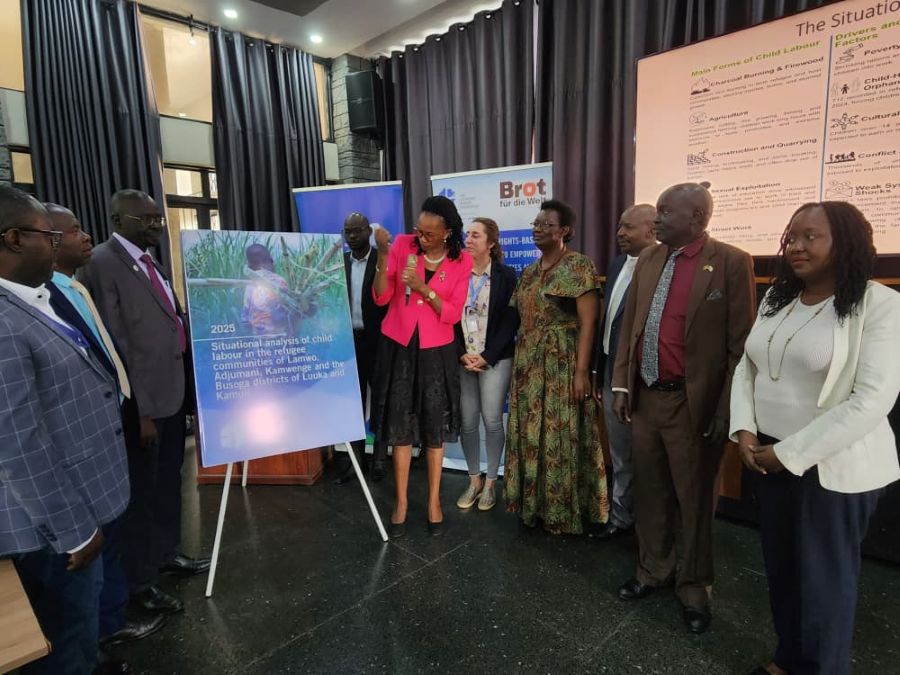
The Lutheran World Federation (LWF) has sounded alarm over a growing crisis of child labour in refugee-hosting districts and the poverty-stricken Busoga sub-region, unveiling a situational analysis and policy brief that paints a grim picture of exploitation, poverty traps, and weakened child protection systems.
Launched Thursday at Fairway Hotel in Kampala, the report zeroes in on Lamwo, Adjumani, Kamwenge, Luuka, and Kamuli districts—highlighting both the scale of the vice and urgent recommendations for action.
Adriana Franco Chitanana, speaking through the LWF Uganda Country Program, said the report was not just about exposing the problem but offering solutions.
“This brief sheds light on the urgent challenges and, more importantly, the practical solutions needed to end child labour, particularly among refugee populations, vulnerable host communities, and in the Busoga region.”
She emphasized LWF’s reach in Uganda, pointing to the organisation’s long-standing investment in child protection.
“Between 2022 and 2024, LWF reached an average of over 400,000 children annually—including more than 300,000 refugee children. We supported them through child protection, GBV prevention, psychosocial support, and access to health and education.”
In Busoga, Chitanana noted, the interventions have begun to reverse some of the trends:
“We successfully removed 921 children from child labour, households involved in child labour dropped from 94% to 45%, and more than 37,000 children and youth received awareness materials in local languages.”
But she warned against complacency:
“Despite these efforts, child labour remains a persistent threat—violating children’s rights, harming their health, and disrupting their education. We appeal to all stakeholders to strengthen laws, expand access to education, and ensure due diligence in supply chains.”
Esther Davinia Anyakun, Minister of State for Labour, Employment and Industrial Relations, praised LWF and partners for providing evidence to drive policy decisions. She acknowledged both refugee and host community contexts as major drivers of child exploitation.
“Uganda hosts the highest number of refugees in Africa, and the second highest in the world. With foreign funding declining, the factors that push refugee children into child labour are multiplied.”
Turning to Busoga, the minister said the deep-rooted poverty, worsened by sugarcane out-grower systems, has fueled child exploitation.
“Families have lost land, their main form of livelihood. They are compelled to withdraw their children from school and send them to the sugarcane plantations.”
She stressed government’s constitutional duty.
“Article 34(4) of our Constitution is clear—children must be protected from social and economic exploitation. That is why government continues to implement the National Child Labour Policy of 2006 and has launched the National Action Plan for Elimination of Child Labour.”
Anyakun added that reforms are already underway to address gaps.
“We are working to update the child labour policy to reflect agricultural value chains like sugarcane growing, as well as refugee and forced displacement contexts which were omitted in 2006.”
The minister further revealed that government has set aside new resources.
“In the 2025/2026 National Budget, shs2 billion has been allocated for the fight against child labour. This builds on our acceptance of UN recommendations to pay special attention to refugee children.”
Grim findings from the situational analysis
The policy brief, presented by consultant Edrine Wanyama, revealed disturbing trends. Children are being pulled into sugarcane cutting, quarrying, sand mining, charcoal burning, street hawking, and even transactional sex.
“In regions like Busoga, children are denied education and exposed to exploitation, abuse, and long-term poverty traps,” Wanyama said.
He noted that more than 700 child-headed families were recorded in refugee settlements by mid-2024, with many minors left to fend for siblings.
Weak enforcement, cultural norms, and poverty were cited as the main drivers. Employers bribe officials to look the other way, while parents often normalize child labour as a survival strategy.
The report urged the Ministry of Gender, Labour and Social Development to increase funding for district labour and probation officers, while Parliament was called upon to hold the ministry accountable and allocate resources for education and child protection.
It also called on the Uganda Police to step up enforcement by mounting roadblocks in child labour hotspots, raiding boarding houses harboring child labourers, and prosecuting perpetrators.
Communities were asked to take responsibility by making festivals and markets child-labour free, while cultural and religious leaders were encouraged to include anti-child labour messages in their sermons and public addresses.
Adriana Chitanana underscored that ending child labour is beyond the capacity of a single actor.
“Together, we can ensure that every child enjoys a life of dignity—free, protected, and full of promise. But this requires governments, civil society, and the private sector to tackle the root causes with bold, coordinated action.”
With the deadline to eliminate child labour by 2025 fast approaching under Uganda’s National Action Plan, the brief is both a warning and a roadmap.