











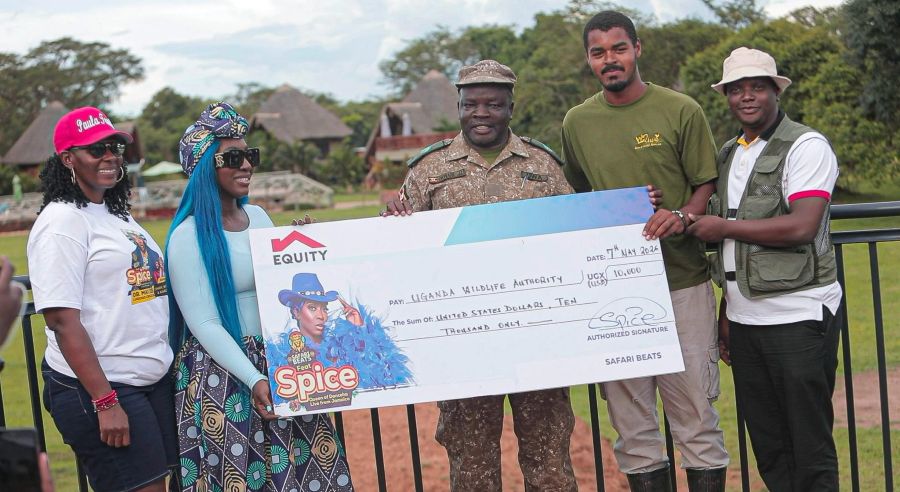
Jamaican dancehall and reggae artiste Spice has donated approximately shs37 million to Uganda’s rhino conservation programme and named a Southern White Rhino after herself during a visit to Ziwa Rhino Sanctuary.
The visit formed part of the singer’s week-long tourism and cultural tour organised by the Uganda Tourism Board (UTB) ahead of her maiden concert in Uganda scheduled for May 9 at Lugogo Cricket Oval in Kampala.
During the ceremony at Ziwa Rhino Sanctuary, Spice, whose real name is Grace Latoya Hamilton, officially named the rhino “Spice Nankula Nile” in an event conservation officials described as one of the sanctuary’s most significant naming ceremonies in recent years.
Speaking during the event, the Jamaican artiste said Uganda’s wildlife conservation efforts had inspired her to contribute towards protecting endangered species.
“Standing here, watching Spice Nankula Nile graze in the wild, I am at a loss for words. Back home in Jamaica, we fight for many causes, but these animals have no voice. Learning about Uganda’s efforts to bring rhinos back from the brink of extinction inspired me to contribute. This donation is my small part in a larger story,” she said.
Spice added that the experience had left her with a lasting emotional connection to Uganda.
“I came to Uganda for a concert and am leaving with a rhino, a clan name, and a piece of this country in my heart. Spice Nankula Nile will grow up here in this sanctuary, and one day roam a national park. Every year I perform, I will tell this story. Uganda gave me something no stage ever has,” she said.
Uganda’s rhino conservation programme has been regarded as one of the country’s most significant wildlife recovery initiatives. Rhinos were declared locally extinct in Uganda by 1983 following years of poaching, civil unrest, and habitat destruction.
Conservation efforts resumed in 2005 with the establishment of Ziwa Rhino Sanctuary through a partnership between Rhino Fund Uganda and the Uganda Wildlife Authority (UWA). The sanctuary, located about 164 kilometres north of Kampala, began with six Southern White Rhinos and has since expanded its population to 59 through breeding and sustained protection.
Earlier this year, UWA carried out Uganda’s first rhino translocation exercise, relocating rhinos from Ziwa to Ajai Wildlife Reserve after more than four decades of local extinction in the area. Additional rhinos have also been transferred to Kidepo Valley National Park as part of a broader national conservation strategy.
The government’s long-term conservation plan includes future rhino reintroductions in Murchison Falls National Park and the eventual restoration of Eastern Black Rhinos.
The conservation initiative is supported by the “Name a Rhino” campaign launched in 2023, which seeks to raise approximately shs41 billion to support habitat expansion, veterinary services, ranger welfare, and community conservation programmes.
Uganda Tourism Board Chief Executive Officer Juliana Kagwa said Spice’s involvement had amplified Uganda’s conservation message internationally.
“Spice has done more than just write a cheque; she has given a name and personality to a symbol of Uganda’s conservation story. Each time she shares her rhino’s story, she highlights Uganda’s achievements and ongoing struggles, showing visitors that they are part of something bigger,” Kagwa said.
According to sanctuary officials, Spice’s donation will support operational costs at Ziwa, including ranger operations responsible for guarding the rhinos around the clock within the protected sanctuary.
Senior Warden James Okware, who represented UWA during the naming ceremony, said rhino conservation had become central to Uganda’s tourism and ecological restoration agenda.
“Uganda is not just protecting rhinos. We are rebuilding an entire ecological and economic system around them. Ziwa is already a critical stopover on the route to Murchison Falls, completing Uganda’s Big Five offering,” Okware said.
Officials say the donation will contribute towards Uganda’s long-term goal of establishing a stable and sustainable rhino population across multiple protected areas.