










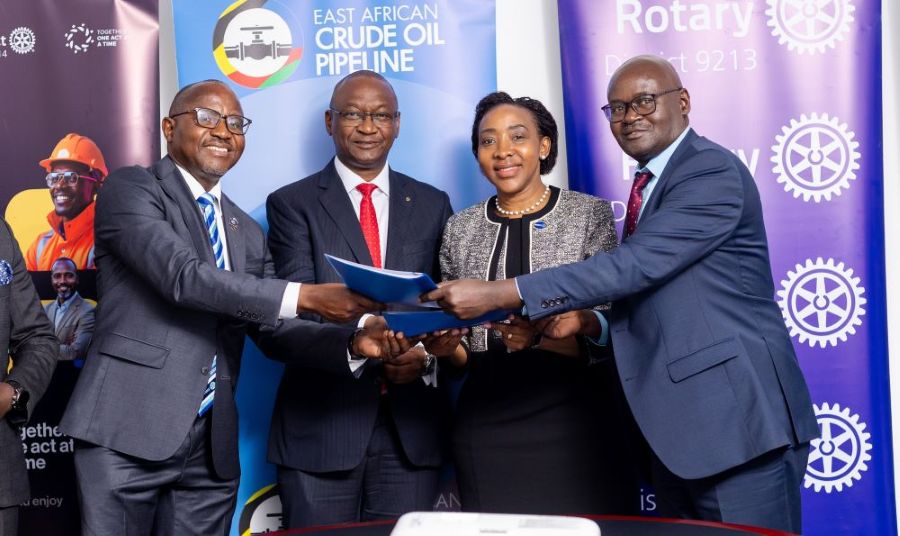
The East African Crude Oil Pipeline (EACOP) company has signed a Memorandum of Understanding with Rotary International Districts 9213 and 9214 to implement an environmental sustainability program in schools across 10 Ugandan districts along the pipeline’s 1,443-kilometre route.
Dubbed the EACOP Green Schools Initiative, the program aims to equip schools with environmental education resources and promote sustainability practices such as tree planting, climate awareness, and waste management. The targeted districts include Hoima, Kikuube, Kakumiro, Kyankwanzi, Mubende, Gomba, Sembabule, Lwengo, Rakai, and Kyotera.
Speaking during the signing ceremony, Rotary District 9213 Governor Geoffrey Kitakule said the partnership aligns with Rotary’s growing commitment to environmental conservation.
“This partnership is timely. Rotary’s commitment to supporting the environment aligns perfectly with the Green Schools Initiative,” Kitakule said. “There is no better way to secure a sustainable future than working with young people — the champions of tomorrow.”
He also noted Rotary’s broader environmental projects, including forest restoration efforts, conservation of the Nile Basin, and an upcoming initiative to launch a floating hospital for Uganda’s island communities.
EACOP Deputy Managing Director JB Habumugisha welcomed the partnership, calling it a “proactive response to the pressing need for sustainable solutions.”
“We see this as an opportunity to make a lasting impact on communities along the pipeline route by investing in environmental education and green infrastructure,” Habumugisha said.
Christine Kyeyune Kawooya, Governor of Rotary District 9214, echoed similar sentiments, emphasizing the role of youth in climate action.
“Our communities depend on how well we prepare the next generation to care for the environment,” she said. “This initiative empowers students to become custodians of the environment.”
Under the program, participating schools will benefit from a range of initiatives. These include tree planting drives and the creation of green spaces with fruit and vegetable gardens, as well as enhanced climate education and environmental awareness campaigns. The project will also see the installation of solar systems to promote clean energy use, improvements in waste management systems, and upgrades to school sanitation and rainwater harvesting facilities.
The EACOP Green Schools Initiative reflects a growing effort by oil and energy companies to integrate environmental responsibility into infrastructure projects.
EACOP Ltd. is the company spearheading construction and operation of the crude oil export pipeline that will transport oil from Uganda’s Lake Albert region in Hoima to the port of Tanga in Tanzania. The joint venture includes TotalEnergies, Uganda National Oil Company (UNOC), Tanzania Petroleum Development Corporation (TPDC), and China National Offshore Oil Corporation (CNOOC).