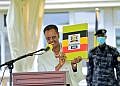









The Financial Intelligence Authority (FIA) has secured ISO/IEC 27001 certification for its information security management system, marking what officials described as significant milestone in Uganda’s efforts to strengthen financial intelligence, protect sensitive data and combat money laundering and other financial crimes.
The certification, which confirms that the authority’s information security management system has been independently assessed against internationally recognised standards, is expected to strengthen confidence among banks, law enforcement agencies and international partners that handle and exchange sensitive financial intelligence with Uganda.
The achievement comes as the country prepares for its third round of mutual evaluation in 2028, an assessment that will examine the effectiveness of Uganda’s anti-money laundering and countering the financing of terrorism framework.
Speaking during the function, Finance Minister Henry Musasizi said the certification underscored the strategic importance of digital infrastructure and cybersecurity to Uganda’s economic transformation agenda, warning that weaknesses in financial intelligence systems could undermine investor confidence and expose the country to financial crime.
“Uncompromising adherence to confidentiality, integrity and data availability is non-negotiable for national security and macroeconomic stability,” Musasizi said.
He explained that the FIA handles sensitive intelligence used to detect and combat money laundering, terrorism financing and illicit financial flows, making the protection of information central to the integrity of Uganda’s financial system.
Musasizi said the certification should be viewed as an operational commitment rather than a one-off achievement, urging the authority to continuously improve its systems and strengthen coordination with the central bank, commercial banks, security agencies and the judiciary.
He noted that Uganda’s progress in addressing deficiencies in its anti-money laundering framework had helped restore investor confidence and reduce friction in international financial transactions.
The minister cautioned that a return to the Financial Action Task Force (FATF) grey list could increase the cost of sovereign borrowing, disrupt cross-border commerce and weaken confidence among international financial institutions.
“ISO certification is not a finish line. It is an operating standard,” he said, calling on the FIA to maintain high standards of information security and service delivery.
Musasizi also reaffirmed the Ministry of Finance, Planning and Economic Development’s commitment to providing the authority with the resources required to fulfil its mandate and safeguard Uganda’s financial system.
FIA Executive Director Samuel Wandera Were said the certification demonstrated that the authority had established systems and controls to protect confidential information and ensure that it was accessed only by authorised persons.
He said the authority receives sensitive financial information from banks and other reporting entities and processes intelligence reports that are shared with law enforcement agencies and financial intelligence units in other countries investigating financial crimes.
According to Were, the sensitive nature of this information makes robust information technology systems essential to maintaining the trust of institutions that submit reports to the FIA.
“Acquiring this certificate demonstrates that we have put in place strong mechanisms, have built our IT system properly, and are robust enough to protect and share information only with authorised persons,” he said.
Were said the independent assessment was important because institutions could assume their systems were secure without recognising weaknesses that might expose them to cyberattacks or unauthorised access.
He added that the certification provides assurance to financial institutions that confidential information, including details of financial transactions, is handled within a secure environment.
However, Were cautioned against treating the certification as a guarantee that Uganda would automatically maintain its favourable standing under international anti-money laundering assessments.
He explained that grey-listing decisions depend on a broader range of requirements established by the FATF, including the effectiveness of investigations, prosecutions, financial sanctions and asset recovery measures.
“The certificate alone wouldn’t take us off the grey list, but it is an assurance of what we have at the FIA,” he said.
Were said Uganda was aligning its laws, institutions and operational systems with evolving international standards ahead of the 2028 mutual evaluation.
The assessment will take place under the framework of the Eastern and Southern Africa Anti-Money Laundering Group (ESAAMLG), of which Uganda is a member.
He noted that emerging financial technologies, particularly virtual assets and cryptocurrencies, were creating new challenges for authorities responsible for detecting and preventing illicit financial flows.
Were said Uganda had drafted legislation intended to regulate players in the virtual asset sector and prevent criminals from exploiting digital assets to launder money.
He emphasised that the interconnected nature of the global financial system required countries to maintain effective mechanisms for detecting suspicious transactions and sharing intelligence across jurisdictions.
The FIA’s preparations, he added, involve addressing revised international standards and demonstrating that national institutions can effectively identify, investigate and disrupt financial crime.
Alongside the certification, the authority launched its Client Service Charter, which sets out its service commitments, reporting expectations, timelines, grievance redress mechanisms and performance indicators.
The Charter is intended to strengthen accountability, clarify the obligations of reporting entities and improve the quality of services provided to public and private sector stakeholders.
The FIA board chairperson said the certification and Charter reflected the authority’s commitment to continuous improvement in information security and service delivery.
He explained that the Charter would guide reporting entities on compliance requirements while strengthening cooperation with institutions such as the Bank of Uganda, the Inspectorate of Government, Uganda Police Force, Internal Security Organisation and National Information Technology Authority-Uganda.
The chairperson also said the FIA was the only financial intelligence unit among 51 in Africa to have obtained the certification, highlighting the authority’s investment in secure information management.
Deputy Inspector General of Government Patricia Achan Okiria welcomed the initiatives, saying they could improve information exchange, strengthen compliance and support investigations into corruption and financial crime.
She said financial intelligence was essential to tracing suspicious financial flows, identifying beneficiaries of potentially illicit funds and recovering public resources lost through corruption.
“Following the money is very, very important. It is often just as important as establishing how a corruption offence is committed,” Okiria said.
She explained that while investigations may establish that public funds were irregularly paid out, financial intelligence helps investigators establish where the money went, who benefited and what assets may have been acquired.
Okiria said the FIA and the Inspectorate of Government had complementary mandates, with the FIA providing financial intelligence while the Inspectorate investigates and prosecutes corruption and related offences within its mandate.
She urged public institutions to strengthen information-sharing arrangements, referrals, feedback mechanisms and joint capacity-building initiatives to ensure financial intelligence informs investigations at the earliest possible stage.
Okiria added that effective collaboration among government agencies would be critical to Uganda’s preparations for the 2028 mutual evaluation, describing the exercise as a national responsibility requiring coordinated action across all relevant institutions.