








Government has called on private sector players to complement its efforts in combating water scarcity, particularly in rural and underserved regions.
While commissioning nine newly constructed community boreholes in Kumi District, the State Minister for Energy, Eng. Okaasai Sidronius Opolot, underscored the urgent need for strategic partnerships between government, corporate entities, and communities to improve access to clean and safe water.
“Addressing water scarcity is not just a health issue—it is fundamental to economic development, poverty eradication, and improved quality of life. No single stakeholder can do this alone,” said Minister Okaasai, who also serves as Member of Parliament for Kumi County.
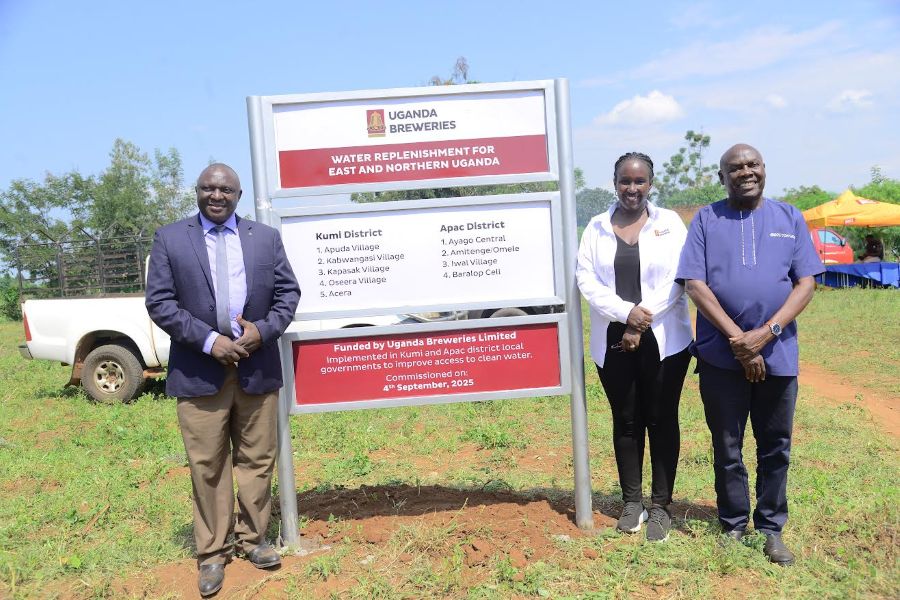
The boreholes—five in Kumi District and four in Apac District—were constructed by Uganda Breweries Limited (UBL) under its Water for Life program, benefiting over 5,000 residents across nine rural communities.
In Kumi, the water points will serve residents of Apuda, Kabwangasi, Kapasak, Oseera, and Acera villages. In Apac, the boreholes were drilled in Ayago Central, Amitenge/Omele, Iwal, and Baralop Cell.
Residents previously walked an average of 3.5 kilometers to the nearest water source—a burden that has negatively affected health, education, and livelihoods. The new boreholes are expected to significantly reduce that strain.
Sheila Sabune, UBL’s Corporate Relations Director, said the project reflects the company’s commitment to sustainable development and environmental responsibility.
“Through our Water for Life initiative, we are not only replenishing the water used in our operations, but also contributing to the well-being of communities by ensuring access to a basic human need,” she stated.
According to local health officials, Kumi District has seen a rise in waterborne diseases such as diarrhea, dysentery, and typhoid, largely due to dependence on unsafe and distant water sources. Furthermore, the daily water collection burden has led to increased school absenteeism and dropouts, especially among girls.
Minister Okaasai emphasized that long-term solutions will require investment in groundwater management, resilient infrastructure, and community-driven approaches to water resource management.
The government is appealing to other corporate players to replicate such initiatives, reinforcing the idea that corporate social responsibility (CSR) can be a critical tool in addressing national development challenges.