










President Museveni has welcomed plans to establish a 700,000-barrel-per-day oil refinery in Lamu, Kenya, calling for more refining capacity across East Africa to promote industrialisation, create jobs and ensure the region derives greater value from its natural resources.
Museveni said the proposed Dangote East Africa Petroleum Refinery and Petrochemicals Special Economic Zone in Lamu should complement planned refining projects in Uganda and Tanzania, arguing that regional cooperation and value addition are critical to Africa’s economic transformation.
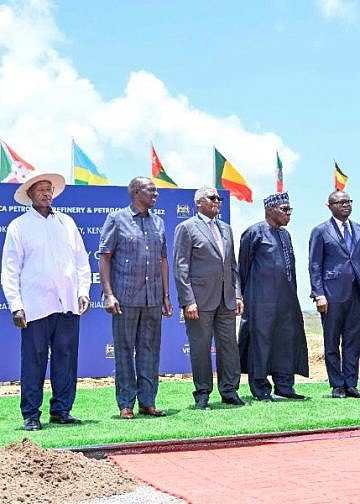
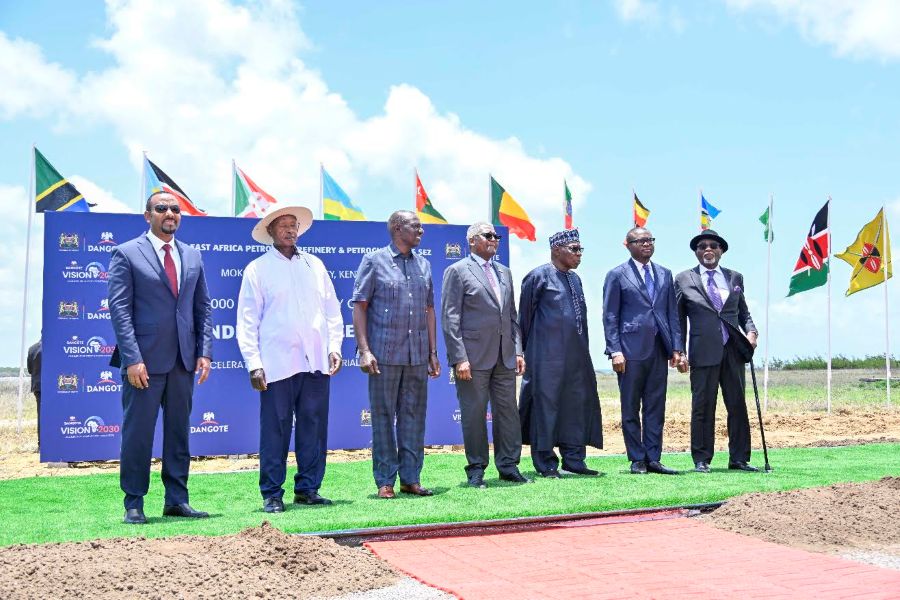
The President made the remarks on Thursday during the groundbreaking ceremony for the refinery in Mokowe, Lamu County, where he joined Kenyan President William Ruto, Nigerian industrialist Aliko Dangote and other African leaders.
“I am very happy about this refinery. In Uganda, we have got some petroleum. I discussed this with Mr. Dangote, His Excellency Ruto and Samia,” Museveni said.
Museveni said Uganda remained committed to constructing its own refinery to process crude oil for domestic consumption and supply markets in the interior of Africa.
“We are going to build a small refinery in Uganda. We had planned this long ago. We can’t change that. The refinery will produce for Uganda and for the interior parts of Africa,” he said.
He also said he would revisit earlier discussions with Tanzanian President Samia Suluhu Hassan about a proposed refinery in Tanga to establish why the project had stalled.
“I want to discuss with Samia and His Excellency Ruto to find out what happened to that refinery in Tanga. What was the problem?” Museveni said.
He said having several refineries in the region would not be a problem as long as countries coordinated their plans and pursued shared economic interests.
“The refinery here in Lamu can be there. The one in Tanga can be there. The one in Uganda will be there. The one in Nigeria can also be there. But I’m really happy with this one at Lamu too,” he said.
Museveni stresses value addition
Museveni said Africa had lost significant economic opportunities by exporting raw materials and importing finished products, urging governments to invest in local processing and manufacturing.
He cited coffee, cotton and gold as examples of commodities whose value increases substantially through processing, arguing that the additional income and employment generated should benefit African economies.
“When we sell a bean of coffee, after the husking, removing the skin, you get $2 a kilo. When it is roasted, ground and packed, the one who did it gets $40,” he said.
Museveni said the gap between the value of raw materials and finished products represented lost income, industrial opportunities and jobs for African countries.
He said Uganda’s decision to prioritise domestic oil refining before exporting crude was intended to ensure the country captures more economic benefits from its petroleum resources.
The President recalled that when Uganda’s oil deposits were discovered, some people questioned the economic viability of establishing a refinery. However, he said his visits and discussions with other oil-producing countries reinforced his view that African countries need domestic refining capacity.
He also cited gold, saying further purification could significantly increase the value of the mineral before it reaches the market.
The same principle, he said, applies to cotton, where employment opportunities extend beyond growing and ginning to spinning, weaving, textile production and other manufacturing processes.
Museveni said developing such industries would help African countries expand employment, strengthen their economies and reduce dependence on imported manufactured goods.
Museveni also renewed his call for deeper political integration among East African countries, arguing that greater integration would enable the region to share jobs, revenue and industrial opportunities more effectively.
He said the proposed Lamu refinery illustrated the importance of regional integration, particularly where countries share natural resources, markets and infrastructure.
Museveni compared the situation with Nigeria, where crude oil produced in one part of the country can be transported to another for refining without the complications associated with international borders.
He argued that under a more integrated East African arrangement, Ugandans could access employment opportunities in industries established in neighbouring countries while participating in the wider regional economy.
He cited discussions with President Ruto about a proposed iron ore processing factory in Mombasa, questioning how Uganda would benefit if its raw materials were processed in Kenya but Ugandans had limited access to the resulting jobs and economic opportunities.
“Although the refinery is here, they will also get profit. But it does not answer the issue of jobs,” Museveni said, referring to Dangote’s proposal to reserve a share of the refinery’s equity for East African countries.
He said political integration would help address such concerns by facilitating the movement of people, sharing of revenue and access to employment across the region.
Museveni congratulated Dangote on the investment and thanked Ruto for supporting the project in Kenya.
President Ruto described the groundbreaking as a major step towards transforming Kenya and the wider African economy through industrialisation, energy security and value addition.
He said the project would turn the region’s ambition to process its own resources into a major industrial undertaking.
“Today we break ground in Lamu. We turn a proposal into an industry. We transform a long-held ambition into real opportunity for Kenya, for East Africa and for our continent, Africa,” Ruto said.
He said the refinery would be designed to process up to 700,000 barrels of crude oil per day and serve markets across East Africa and beyond.
Ruto thanked Museveni for his support and encouragement during discussions leading to the investment, saying the Ugandan leader had consistently advocated for regional economic cooperation.
He described the investment as more than a petroleum project, saying it would support energy security, industrialisation and regional integration.
Ruto also emphasised the need for communities in Lamu and other parts of Kenya to benefit from the investment through employment, skills development and opportunities for local businesses.
He said technical and vocational institutions and universities should prepare welders, technicians, engineers and managers to meet the project’s labour requirements.
Local enterprises, he added, should be positioned to supply transport, food, accommodation, construction materials, maintenance, logistics and professional services.
Dangote Industries Limited Chairman and Chief Executive Officer Aliko Dangote said the project was intended to strengthen Africa’s industrial capacity by reducing dependence on imported refined petroleum products and retaining more value within the continent.
He said Africa needed to move beyond exporting crude oil, minerals and agricultural commodities while importing finished products manufactured elsewhere.
“Africa cannot build lasting prosperity by exporting what it has and importing what it needs. We must produce more of what we consume; we must process more of what we produce,” Dangote said.
He said the project would be supported by African governments, financial institutions and private enterprise, creating opportunities across the energy, petrochemical, logistics, engineering and manufacturing sectors.
Dangote said the company planned to establish a training school to equip 1,000 local residents with technical and engineering skills.
He also said the project could support approximately 60,000 jobs during construction, while local businesses would be encouraged to participate in its supply chains.
The industrialist said the refinery would form the centre of a wider industrial ecosystem, generating demand for skilled workers, suppliers, entrepreneurs and service providers.
He pledged to return to Kenya to commission the facility within 40 months of the groundbreaking.
Dangote said the project would have a processing capacity of approximately 700,000 barrels of crude oil per day and include petrochemical production and power-generation facilities.
He said the company had earmarked up to 30% of the refinery’s equity for East African countries, allowing participating states to share in the investment’s returns.
The refinery is planned for Lamu Port along the Lamu Port-South Sudan-Ethiopia Transport (LAPSSET) Corridor, a regional infrastructure initiative intended to connect Kenya with Ethiopia, South Sudan and other markets.
According to project details presented at the ceremony, the facility is expected to process crude from Kenya’s Lokichar oil fields in Turkana and other sources in East Africa.
Its intended markets include Kenya, Uganda, Tanzania, Ethiopia, South Sudan, the Democratic Republic of Congo and other countries in the region.
The investment is estimated at $16 billion and is expected to support downstream industries, including petrochemicals, fertiliser manufacturing, packaging and other petroleum-related businesses.
The project is also expected to complement existing and planned regional infrastructure, including the East African Crude Oil Pipeline linking Uganda’s oil fields in Hoima to the Tanzanian port of Tanga.
Dangote said the investment was part of a broader plan to expand the group’s investments across strategic sectors, including infrastructure, minerals, ports, power and chemicals.
He added that the group had earmarked $50 billion for projects under its current investment plan, which runs to 2030.
The groundbreaking ceremony brought together leaders and representatives from across Africa, including Togolese President Jean-Lucien Savi de Tové, Benin’s President and Ethiopian Prime Minister Abiy Ahmed Ali.
Former Nigerian President Olusegun Obasanjo also attended, alongside delegations from Burundi, Rwanda, South Sudan, Tanzania and other countries.
Lamu County Governor Issa Timami welcomed the investment, saying it offered renewed prospects for employment, business growth and infrastructure development in a region whose residents had long awaited greater economic opportunities.
He thanked the Kenyan government and Dangote for choosing Lamu as the site of the project and expressed hope that local communities would benefit from the investment.
The refinery is expected to strengthen regional energy security and support the broader objective of building an East African industrial economy in which more raw materials are processed locally, creating jobs and retaining a greater share of the value generated within the continent.