










President Museveni has proposed the construction of the Juba–Nimule road, the development of an electricity interconnection and stronger security cooperation between Uganda and South Sudan to boost bilateral trade and economic cooperation.
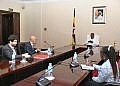
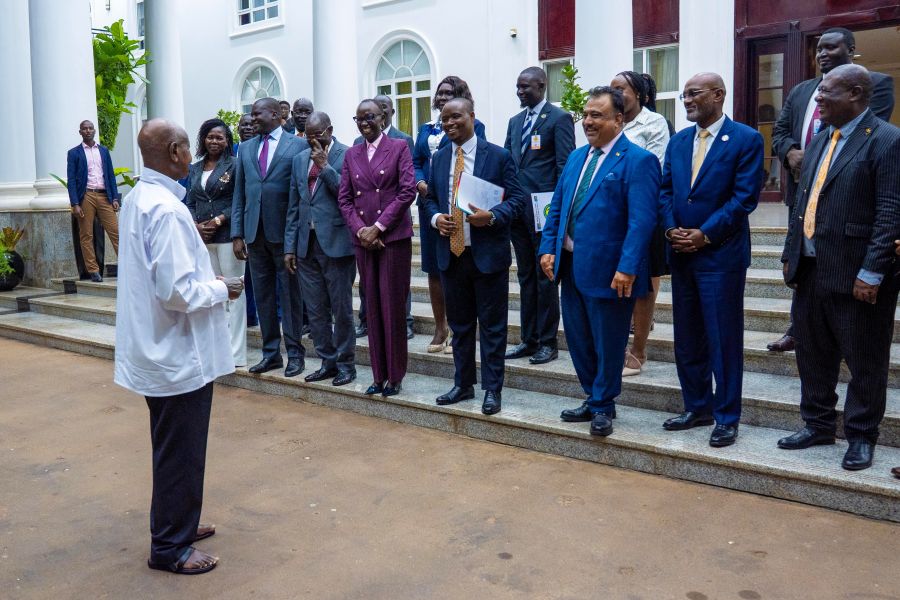
Museveni made the proposals during a meeting with a delegation of senior South Sudanese government officials led by the Minister of Trade and Industry, Dr. Labanya Margaret Mathya, at State House, Entebbe.
The discussions focused on measures to strengthen trade relations, eliminate barriers affecting cross-border business and improve the movement of goods and people between the two countries.
Museveni noted that Uganda’s annual exports to South Sudan are estimated to have grown from $500 million to $700 million, highlighting the importance of strengthening economic ties and addressing challenges that continue to affect traders.
“We should work on three areas: working with the African Development Bank on constructing the Juba–Nimule road for business between the two countries, building the power line, and then also our two armies cooperating on securing the borders,” Museveni said.
The President also proposed establishing a one-stop border centre to simplify procedures, reduce delays and facilitate cross-border trade.
The proposed infrastructure projects and security measures are expected to support trade by improving transport links, enhancing electricity connectivity and creating a safer operating environment for businesses and traders.
Dr. Labanya said the delegation was in Uganda to participate in a business forum aimed at exchanging ideas and identifying practical solutions to challenges affecting trade between the two countries.
She acknowledged Uganda’s significant contribution to South Sudan’s imports and called for measures to make trade more seamless, efficient and mutually beneficial.
“Uganda is one of the biggest exporters to South Sudan. We really appreciate and are extremely glad for that trade in our country. It meets very few hurdles like non-tariff barriers between Nimule and Juba. We came to see better ways to make trade more seamless, acceptable and tasteful to both countries,” she said.
Dr. Labanya emphasised that cooperation should extend beyond the exchange of goods to encompass peace, healthcare and the sharing of knowledge and ideas.
“Trade is everything. We trade in peace, health and in our own intellectual ideas between the two countries and ensuring that the exchange of trade continues,” she said.
She also assured Ugandan traders that her office remained open to addressing their concerns.
On security, Dr. Labanya acknowledged complaints from traders about roadblocks and other impediments along major trade routes, particularly between Nimule and Juba.
She said several reported roadblocks had recently been removed, while efforts were continuing to address outstanding concerns.
“Security of the population, mainly the traders, is key. Some of them were subjected to roadblocks. Most of them were removed recently,” she said.
Uganda’s Minister of Trade, Industry and Cooperatives, Sanjay Tanna, said both countries faced similar challenges in facilitating trade, including non-tariff barriers, delays in clearing goods, insecurity and high financial service costs.
He added that Ugandan traders had raised concerns about compensation claims in South Sudan, pointing to differences in the speed at which the two countries handled such matters.
Tanna said the challenges required stronger coordination between the two governments, improved border management and more efficient administrative processes.
He noted that while some security concerns had been addressed when raised, further efforts were needed to improve the business environment and protect traders operating across the border.
Tanna also said South Sudan had committed to improving the handling of compensation claims, which have been a concern for members of Uganda’s trading community.
The meeting highlighted the importance of infrastructure development, reliable electricity supply and effective border management in strengthening economic relations between Uganda and South Sudan.
The proposed Juba–Nimule road, electricity interconnection and enhanced security cooperation could help address logistical challenges, reduce trade costs and improve the movement of goods and people between the neighbouring countries.
The discussions also underscored the need for both governments to work together to resolve persistent trade barriers and promote an environment that supports investment, business growth and regional integration.
The meeting was attended by Dr. Sam Mayanja, the Attorney General; Amos Lugoloobi, the Minister of State for Finance, Planning and Economic Development; and Paul Malong Akaro, the South Sudanese Ambassador to Uganda.