






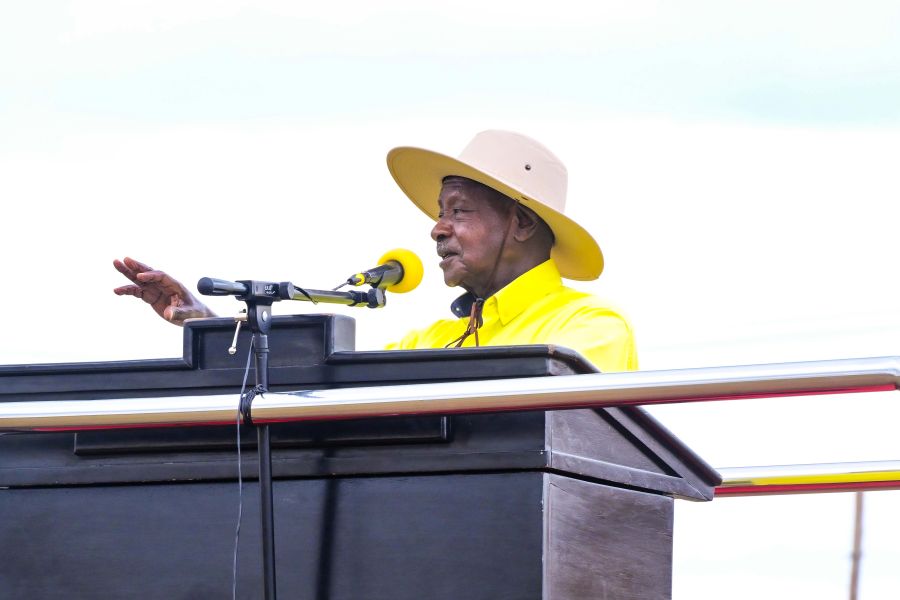
President Museveni has called on National Resistance Movement (NRM) leaders in the Bugisu sub-region to remain firm, ignore what he termed as opposition “lies and distortions,” and champion the government’s long-term priorities of wealth creation, industrialization, and value addition.
Addressing 17,725 NRM leaders at Mbale Secondary School grounds on Sunday, November 16, 2025, Museveni—who also serves as NRM national chairman—accused the opposition of misinforming the public and focusing on salaries and allowances rather than strategic investments that drive economic transformation.
“NRM has no problem. Our analysis is correct, and our strategy is correct. That’s why we were able to defeat all these groups, even in the war, even when we started with 27 people,” he said.
Museveni argued that although NRM strives to work harmoniously with all Ugandans, the opposition continues to mislead the population and undermine government achievements.
Museveni underscored the importance of prioritizing infrastructure that supports long-term growth—such as power generation, industrial parks, and key transport networks.
He referenced the debate surrounding the Mbale–Namagumba–Bududa–Nalugugu road, noting that while such projects are essential, national planning requires balancing regional and nationwide priorities.
He criticized several contenders in the 2026 presidential race, saying some had served in parliament but failed to back crucial development funding.
Naming politicians including Nandala Mafabi, Mugisha Muntu, Robert Kyagulanyi and Mubarak Munyagwa, he said they should not attack the government for delays in road construction when they “failed to support earlier efforts to finance such projects.”
Museveni urged NRM leaders to remain alert to politicians he said aim to discredit national progress.
Turning to the economy, the President highlighted Uganda’s current 7 percent growth rate, with projections to exceed 10 percent once oil production begins.
He pointed to strong industrial output, an expanding hospitality sector, and increasing manufacturing capacity as evidence of sustained transformation.
He cited the Sino-Mbale Industrial Park, which now hosts 75 factories employing 12,000 people, and the Namanve Industrial Park, which has grown to 273 factories employing 44,000 workers, as prime examples of industrial expansion.
Museveni also referenced the fully developed Kapeeka Industrial Zone and expanding clusters in Mukono and Matugga, the latter hosting one of the world’s largest pharmaceutical plants.
He added that Kiira Motors in Jinja, now assembling vehicles, marks Uganda’s strategic entry into automotive manufacturing.
Museveni emphasized the role of the Karuma Hydropower Dam, which generates 640 megawatts, in powering industrial growth, and praised the Kalangala palm oil project for reducing Uganda’s reliance on imported raw materials for soap production.
The President urged leaders to be wary of individuals and organizations he claimed are working to derail Uganda’s development efforts.
On value addition, Museveni reiterated the high cost of exporting raw materials. Highlighting the coffee industry, he noted that although the global coffee trade is valued at USD 460 billion, Africa earns only USD 2.5 billion because it exports unprocessed beans.
Ugandan farmers currently earn between USD 4.2 and USD 4.5 per kilogram of robusta, yet processed robusta could fetch USD 22–25 per kilogram, while processed Arabica could earn USD 30–40.
Museveni asked Bugisu coffee farmers to fully embrace government programmes so they can benefit from value addition.
On governance, he reminded leaders that the Local Council system was introduced to combat corruption inherited from colonial structures. He emphasized that LC leaders must supervise civil servants who misuse public resources.
Speaker of Parliament Anita Among praised Museveni for strengthening local governance, describing LC1 chairpersons as central to community organization
. She welcomed the increase of LC1 chairperson salaries from Shs 10,000 to Shs 100,000, and urged leaders to mobilize overwhelming support for NRM in the upcoming elections.
She also noted the expansion of Parish Development Model funds to include Shs 15 million dedicated to parish-level leaders and their SACCOs.
NRM Secretary General Richard Todwong reminded leaders that effective leadership begins at home, stressing the importance of understanding household demographics and local economic activity.
He urged leaders to use party structures effectively to consolidate support for the President and all NRM candidates.
Eastern Region Vice Chairperson Calvin Echodu assured Museveni that Bugisu remains firmly behind him, saying local structures are mobilized and ready for the next election cycle.
The Mbale meeting attracted a broad delegation of NRM leaders, including Central Executive Committee members, district chairpersons, LCV flag bearers, Members of Parliament, district chief secretaries, sub-county leaders, parish and village chairpersons, and LC1 flag bearers.