











Radiography professionals have warned Ugandans against seeking medical imaging services from unqualified individuals and unlicensed facilities, saying such practices expose patients to wrong diagnoses, financial exploitation, and even long-term health complications.
Speaking during the World Radiography Day celebrations held at Makerere University’s College of Food Science and Nutrition Auditorium on Saturday, Micah Muhangi, the President of the Society of Radiographers of Uganda, said many Ugandans continue to fall victim to quack practitioners operating unregulated X-ray and scan facilities.
“When you are worked on by a person who is not qualified, you end up spending more. They give you wrong results, you buy unnecessary medicine, and sometimes the drugs can even affect your health because you are treating something you do not have,” he said.
Muhangi emphasized the importance of consulting licensed professionals registered under the Allied Health Professionals Council, noting that each facility offering radiography services must display its license visibly.
He also called on the public to demand to see practitioners’ licenses before receiving any imaging services.
“Always ask, ‘Can I see your license?’ If they don’t have one, don’t risk your life. Health is not guesswork. It requires trained, ethical professionals,” he said.
Muhangi revealed that the Society plans to set a standard fee for Radiation Safety Officers, specialists responsible for ensuring that X-ray, CT, and MRI machines are used safely.
The proposed fee, he said, would be shs2.4 million for every two years, aligned with the licensing period of the Atomic Energy Council.
“These officers protect both the patients and the public from harmful radiation exposure,” he added.
“They ensure that every machine is working safely and that the environment around it is not harmful.”
Muhangi also appealed to the Ministry of Health to expand funding and recruit more radiographers, saying the current workforce about 1,200 radiographers serving a population of over 45 million — is insufficient.
“We have one person rotating between the CT scan, ultrasound, and X-ray rooms. By the end of the day, they are exhausted,” he said.
“That’s why the service in public hospitals sometimes delays. We ask the government to increase the budget and hire more professionals so that people receive timely care.”
He noted that while regional and district hospitals have received new imaging equipment, many machines remain idle due to a shortage of qualified staff.
The Chairperson of the Uganda Allied Health Professionals Council, Prof. John Charles Okiria, echoed the concern over unqualified individuals offering imaging services in urban centers.
“There are people sitting on verandas with small computers, claiming to detect 60 diseases and prescribing drugs,” he cautioned.
“Those are quacks. There is no such machine that diagnoses you on the street. Health is not a gamble for everyone.”
Prof. Okiria said accurate diagnosis is critical for proper treatment and urged the public to report suspicious operators to relevant authorities. He stressed that the Council continues to train and monitor radiographers across the country to ensure ethical practice.
“Patient care is a calling,” he said. “If you are not trained or licensed, you have no business in health.”
Delivering a message from Dr. Diana Atwine, the Permanent Secretary at the Ministry of Health, Dr. Susan Nabadda, Commissioner for Laboratory and Diagnostic Services, commended radiographers for their contribution to healthcare and pledged the Ministry’s commitment to improving the sector.
“Technology alone cannot deliver quality care; it needs skilled, committed professionals,” she said.
“We are updating the national imaging standards to match new technologies by the end of 2025 and promoting tele-radiology to support regions without specialists.”
Dr. Nabadda urged practitioners to uphold integrity, professionalism, and ethical standards, saying these values are central to quality healthcare.
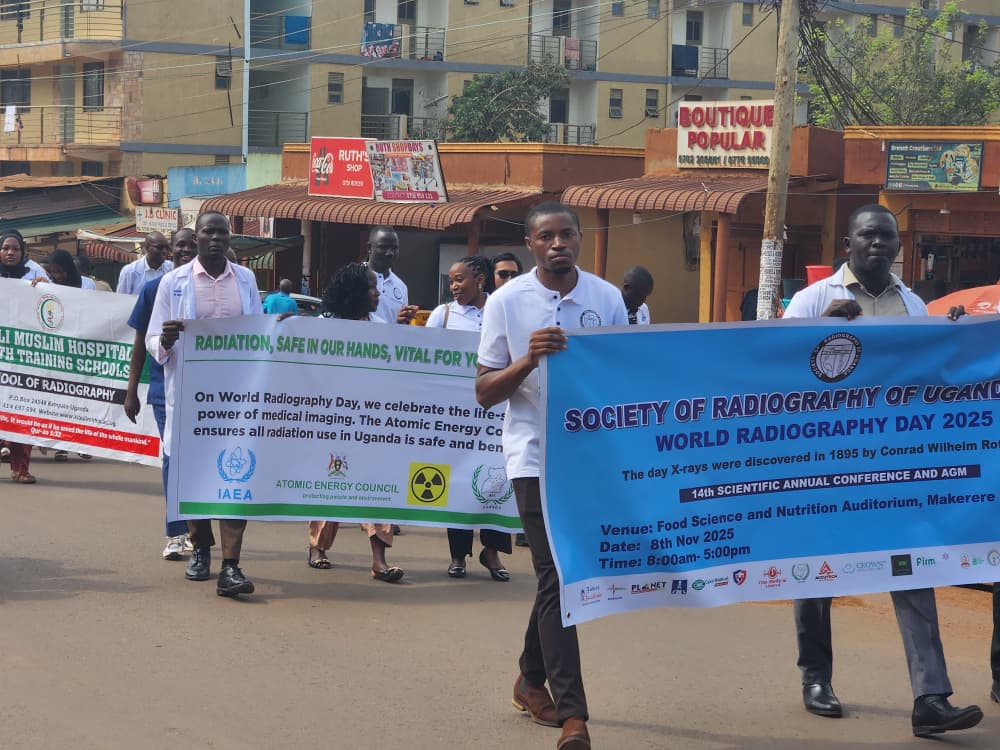
The World Radiography Day celebrations began with an awareness walk from Wandegeya to Makerere University and drew stakeholders from government, academia, and the health sector.
The event, themed “Medical Imaging Professionals Partnering for a Healthier Future,” commemorated the 130th anniversary of the discovery of X-rays by German physicist Wilhelm Röntgen on November 8, 1895.
Midari Awuche, the Society’s Northern Regional Coordinator, said the day serves to highlight the importance of imaging in modern medicine and to inspire more young people to join the profession.
“Radiographers act as the eye of medicine — we see what others can’t see,” Awuche said.
“But we need government support to absorb more graduates and curb brain drain, because many are leaving the country due to limited opportunities.”