








President Yoweri Kaguta Museveni has called on the United States and other global partners to support Africa’s industrialisation and value-addition efforts as a way of expanding the continent’s economy and creating employment opportunities for its rapidly growing population.
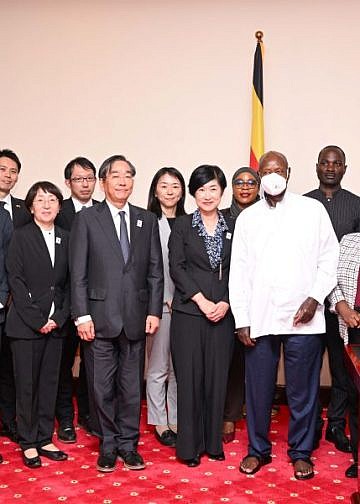
Museveni made the remarks on Monday during a meeting at State House Entebbe with Nicholas Checker, who is in Uganda ahead of the presidential swearing-in ceremony scheduled for Tuesday at Kololo Independence Grounds.
Checker represented Donald Trump and was accompanied by William W. Popp.
Earlier, President Museveni also held talks with Salva Kiir Mayardit focused on strengthening bilateral cooperation and the long-standing ties between Uganda and South Sudan.
During discussions with the U.S. delegation, Museveni said Africa’s economy remains comparatively small because many countries on the continent continue to export raw materials without processing them into finished products.
“Our advice to the United States and the rest of the world is that Africa needs support in value addition. We should not continue exporting raw materials without processing them,” Museveni said.
The President noted that despite Africa’s vast natural resources and growing population, the continent’s Gross Domestic Product (GDP) remains significantly lower than that of major global economies such as the United States and China.
He cited products such as coffee, crude oil and minerals, saying exporting them in raw form deprives African countries of greater earnings, industrial growth and employment opportunities.
“If you export coffee without processing it, you lose a lot of money. The same applies to oil and minerals. Value addition is the key to increasing Africa’s purchasing power and prosperity,” he said.
Museveni also warned that the continent’s rapidly growing population makes industrialisation increasingly urgent.
“Africa’s population is expected to reach nearly 2.5 billion people in the next 30 years. We need bigger economies and more purchasing power for our people,” he added.
The President reaffirmed Uganda’s commitment to private sector-led growth and industrial expansion, highlighting progress in sectors such as dairy production through organised production and value addition.
On regional security, Museveni said Uganda continues to play a key role in peacekeeping and stabilisation efforts in Somalia, South Sudan and the Democratic Republic of Congo.
He further cautioned against sectarian divisions based on religion, arguing that Africa’s liberation struggles succeeded because people united regardless of faith.
“During the anti-colonial struggle, Africans were united. We should not allow divisions based on religion to weaken us,” he said.
Meanwhile, Checker commended Uganda for its continued contribution to regional peace and stability, particularly in South Sudan and the Democratic Republic of Congo.
He also welcomed ongoing cooperation between Uganda and the United States in areas such as health and economic development.
Ambassador Popp, who is concluding his diplomatic tour in Uganda after three years, thanked President Museveni and Ugandans for the cooperation extended to him during his tenure.
“Uganda has truly won my heart. It has been an honour to work with your government and the people of Uganda,” Popp said.
He added that the United States remains committed to strengthening relations with Uganda in trade, investment and regional security cooperation.
The meeting was also attended by Minister Henry Okello Oryem and Uganda’s ambassador to the US Robie Kakonge, among other officials.