





President Museveni has urged National Resistance Movement (NRM) youth mobilizers to focus on addressing real community challenges rather than relying on political excitement and rallies.
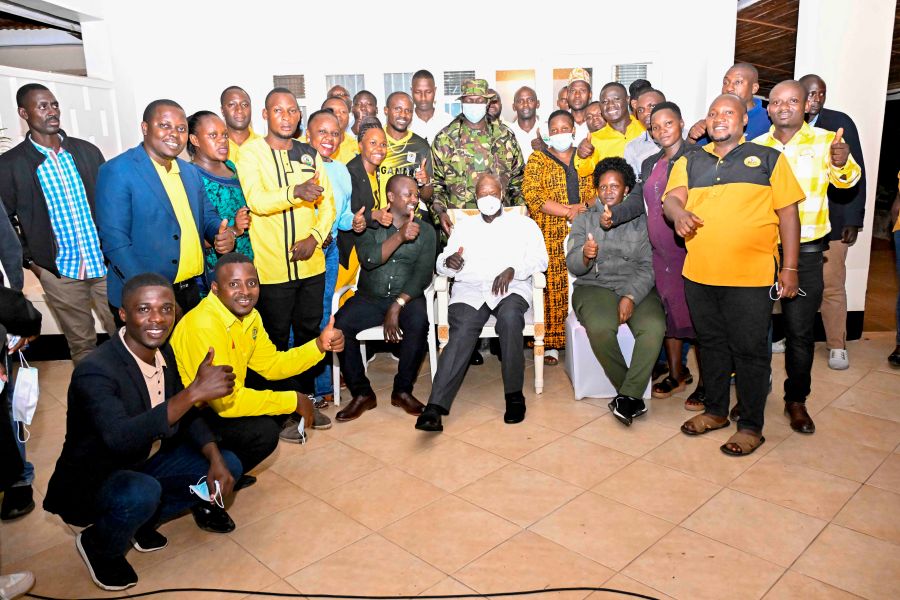
The President made the call during an engagement with various youth mobilization groups at State Lodge, Mbale, emphasizing that meaningful mobilization begins with understanding people’s day-to-day struggles, particularly poverty.
The mobilizers, led by Ms. Hellen Seku, Commissioner of the National Secretariat for Patriotism Corps (NSPC), represented several youth formations, including the Buganda Youth Caucus, the National Youth Council (Executive), Buganda Ku Museveni, the Patriotism Corps, the Yellow Power Movement, and district-level NRM mobilizers.
In a candid discussion, President Museveni said true political mobilization must go beyond excitement, songs, and rallies, focusing instead on helping citizens overcome poverty through practical solutions.
“When you talk of mobilization, you must ask: how are these people? Are they in a good situation or a bad one, especially poverty? The real mobilization is to get people out of poverty. The real mobilization is to know people’s problems and show them how to get out of poverty,” President Museveni said.
He noted that while crowds may gather out of enthusiasm, lasting political support stems from communities recognizing that their leaders understand their problems and can deliver solutions.
“People should understand their problems and how to solve them instead of just moving around singing. They may support you for networking, but the impact is small. People trusted us because they thought we had ideas and answers to their problems,” he added.
The President attributed the large turnouts at current NRM rallies to two key factors — peace restored in previously conflict-affected areas and the success of the Parish Development Model (PDM), which is now reaching households directly.
“In the past, programs passed through intermediaries, and our own people ended up being involved in their own things. That is how I stopped Operation Wealth Creation,” he explained.
Drawing parallels with the Luweero Triangle during the liberation struggle, the President reminded youth mobilizers that the NRM’s early support came from citizens who recognized the movement’s ability to diagnose community challenges and offer practical solutions.
He emphasized that effective mobilization does not depend on large budgets.
“This mobilization does not need a lot of money. The only money you may need is your own transport for fuel, not refund,” he said.
The President encouraged the mobilizers to learn from NRM’s founding approach of unity and purpose.
“I am glad you came. You are young people. When we started, we were like you. We showed the people the way forward. We refused gender and religious divisions. We taught them how to get out of poverty and be well behaved. Let your light shine before men,” he said.
President Museveni also revisited the Four Acre Model, first introduced in the 1996 NRM manifesto, describing it as the foundation for sustainable household wealth creation.
He explained that the model involves dedicating one acre to coffee, one to fruit trees such as citrus or mangoes, one to pasture for livestock, and one to food crops.
The Head of State delved deeper into Uganda’s socio-economic transformation, urging mobilizers to understand the three essential pillars of society — the people, their economic wellbeing, and their politics.
Citing the Banyankole community as an example, he said that despite owning cattle, many traditional herders lived a subsistence lifestyle because they valued livestock for prestige rather than income generation.
“We studied the world. In America, Australia, and New Zealand, they also had cows, but the cows were valuable in terms of money. Our idea was: why can’t our people be like the ranchers in America?” the President said.
He identified four major obstacles hindering cattle corridor communities from joining the money economy — lack of water, bush burning, tick-borne diseases, and the cultural habit of keeping cattle for prestige.
“We had to sit down and read their minds to find out what was stopping them from joining the money economy,” he said.
“For water, we said you must trap water from the roof. For bush burning, we told them to stop burning grass in the dry season. For ticks, they kept running away instead of treating diseases, yet we had Mbarara Stock Farm.”
He concluded that proper mobilization must begin with such a deep understanding of community challenges.
During the meeting, Mr. Henry Luzinda, a mobilizer from Wakiso District, thanked the President for supporting young people through initiatives like the Parish Development Model and the Graduate Fund.
“Youth livelihoods are changing, Your Excellency. Thank you for the 30% of PDM funds you are giving to the youth and for the graduate fund. We commit to take this message village to village so that youth who graduate and haven’t found jobs can benefit from your initiative,” he said.
Ms. Sawuya Nambatta, Chairperson of Buganda Ku Museveni, praised the PDM for transforming lives across communities, noting that mobilizers are spreading its success stories nationwide.
Another mobilizer, Mr. Pauson Twinamatsiko, also expressed gratitude to the President for his continued support of youth-led initiatives aimed at empowering the next generation.