










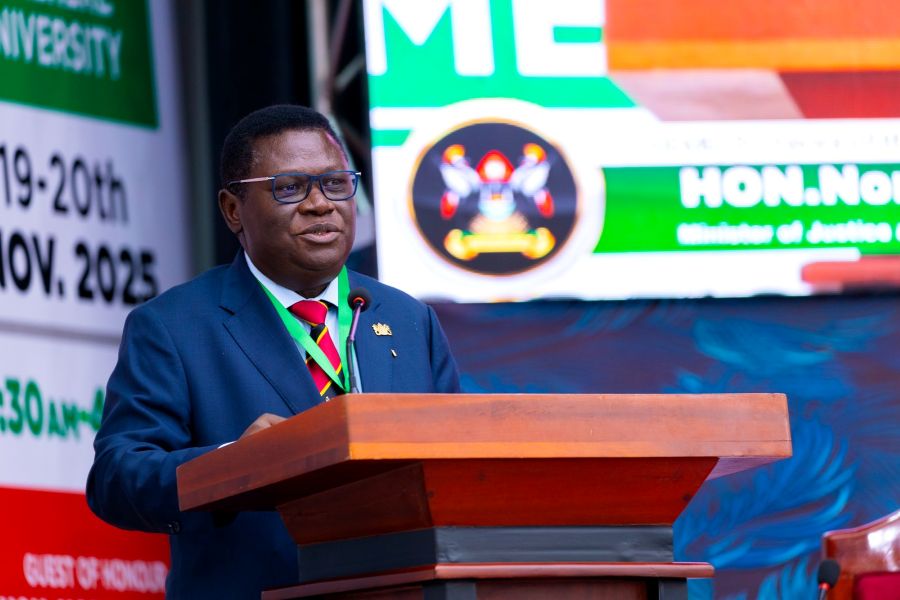
The Minister for Justice and Constitutional Affairs, Norbert Mao, has defended the proposed sovereignty law, saying it is not aimed at ordinary Ugandans but at individuals who misuse their rights in ways that threaten national stability.
Appearing on Uganda Broadcasting Corporation (UBC TV), Mao said the law has been widely misunderstood and misrepresented by critics.
“As Norbert Mao, I know that our biggest problems are not our citizens. It is wrong for anyone to think that this law targets ordinary Ugandans. It is aimed at citizens who are ‘weaponized,’ much like a cancer cell,” he said.
He compared such individuals to cancer cells in the body, explaining that while they originate from within, they become dangerous when corrupted.
“A cancer cell is a human cell that has been corrupted and becomes an enemy to the body. It is not foreign, but it begins acting in the interest of a foreign force and can lead to destruction,” Mao added.
Mao dismissed claims that the law would punish the entire population or discourage investment, emphasizing that most Ugandans are law-abiding.
“To say that 45 million Ugandans are victims of this law, and that no investment will come because of it, is misleading. The vast majority of Ugandans are law-abiding,” he said.
He cited Uganda’s experience during the COVID-19 lockdown as evidence of public discipline and compliance.
At the same time, Mao acknowledged concerns about potential abuse of the law, warning against excessive concentration of power in the executive.
“If there are elements in this law that promote authoritarian tendencies, such as excessive executive discretion, then those aspects should be challenged. Concentrating too much power in the hands of one person is dangerous,” he said.
He also referenced past concerns about preventive detention, noting that while legal tools can be abused, this should not justify rejecting laws that are otherwise necessary.
“Abuse of something is not an argument against its proper use,” Mao emphasized.
The controversial Protection of Sovereignty Bill, 2026 seeks to regulate foreign influence in Uganda.
The bill broadly defines a “foreigner” to include Ugandans living abroad and states that anyone receiving funds or support linked to such individuals could be classified as an “agent.”
It further proposes that individuals or organizations must obtain approval from the minister before receiving such funding.
Opposition leaders and civil society organizations have challenged the bill, warning that it could undermine Uganda’s democratic and economic standing if not carefully scrutinized.