








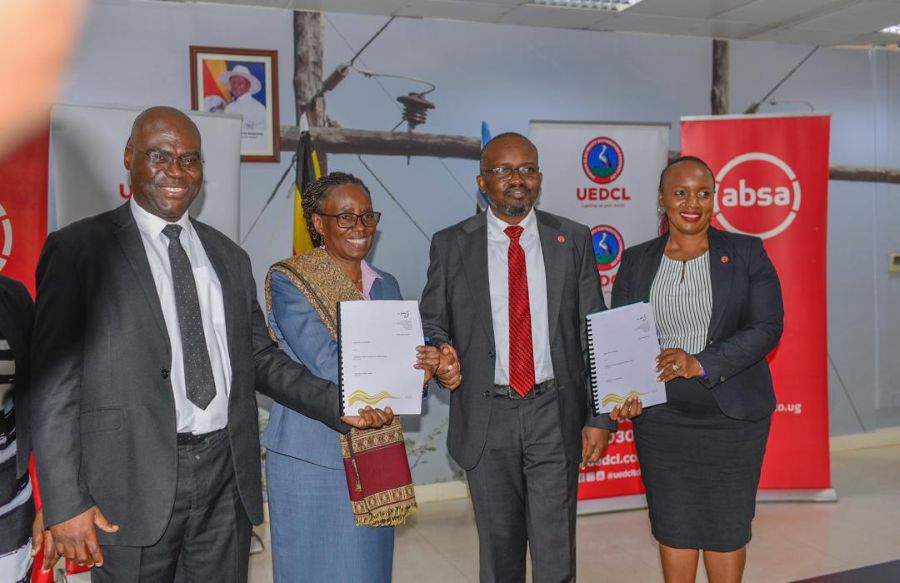
Uganda Electricity Distribution Company Limited (UEDCL) has secured a Shs190 billion (USD 50 million) loan from Absa Bank, positioning the state-owned distributor to fast-track network upgrades while sharply cutting the cost of financing electricity infrastructure.
The five-year facility, approved by the Ministries of Energy and Finance and signed on Monday, will fund new substations and upgrades to overstretched feeders and transformers across key parts of the country, including Kampala and Wakiso.
UEDCL Managing Director Paul Mwesigwa said the deal marks a turning point for the utility, both financially and operationally.
“This loan agreement with Absa Bank will benefit Ugandans. It shows that as a government-owned company, UEDCL can raise capital at a financing rate of less than 8% gross of tax, compared to 28% previously,” Mwesigwa said.
He said the loan is directly backed by UEDCL’s balance sheet, a move he described as a clear endorsement of the company’s governance and performance.
“This is a fundamental demonstration that a government company can go to the market and secure funding based on its own performance. We are committed to putting this money to good use and repaying it on time,” he said.
According to Mwesigwa, Uganda’s electricity distribution network requires about shs 290 billion over the next five years, with the Absa facility providing immediate relief to critical pressure points.
The funds will finance new substations in Magigye–Kasangati to serve Kasangati and Gayaza, as well as a major installation covering Nakasero Hill, Kololo, William Street, and Makerere to stabilize supply in Kampala’s central business and residential areas. Network designs also extend to Mukono, Nantabulirwa village, and surrounding areas.
“As a result, within the next two years since we took over, we expect most parts of the country to experience improved and stable electricity supply,” Mwesigwa said.
He added that cheaper financing will ultimately reflect in consumer tariffs.
“Reducing financing costs from 28 percent to 8 percent will benefit customers while strengthening network stability,” he noted.
UEDCL says network optimization efforts have already increased available power by 13 percent, from 986 megawatts to a peak of 1,115 megawatts, though higher power intake has also strained existing infrastructure.
UEDCL Board Chairperson Lydia Ochieng-Obbo said the deal demonstrates how private capital can support public infrastructure.
“This partnership brings together a public sector entity and a private sector institution, with the private sector supporting the Government of Uganda in mobilizing much-needed capital to invest in, repair, and expand the electricity distribution network,” she said.
Absa Bank Chief Executive Officer David Wandera said the lender sees electricity as central to Uganda’s growth ambitions.
“At Absa, we believe electricity ignites growth by supporting industry and improving people’s lives,” Wandera said.
“Through this USD 50 million facility, we are proud to play a significant role in transforming the energy sector, the economy, and the livelihoods of Ugandans.”
UEDCL says the new financing will ease network congestion, improve reliability, and support Uganda’s industrial and urban expansion at a lower cost to the economy.