










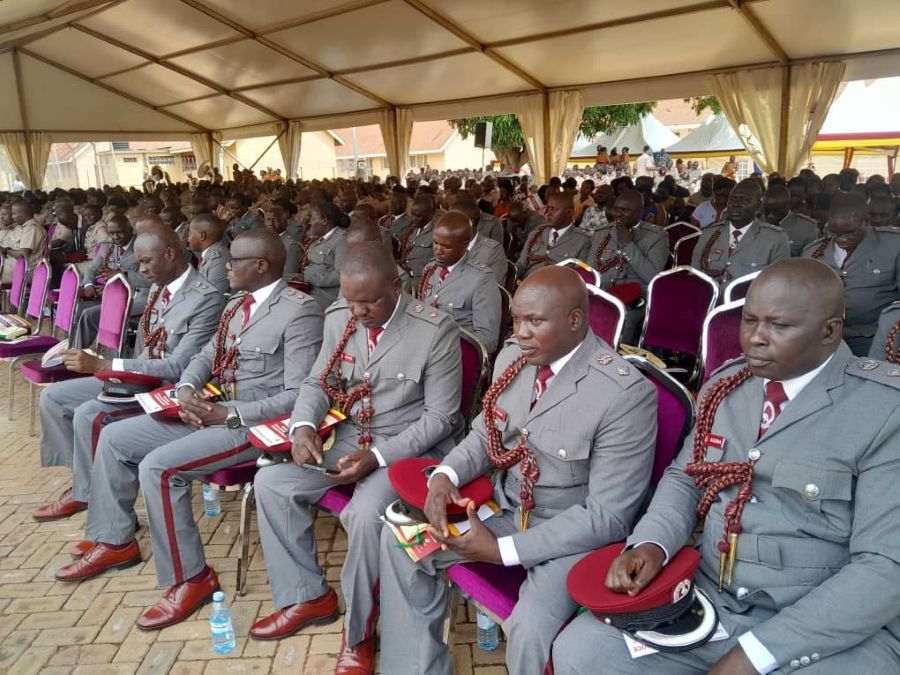
Uganda Prisons Service (UPS) has passed out 58 officers who successfully completed the Prisons Intermediate Command and Staff Course.
Among the graduates were 48 men and 10 women, all of whom undertook the specialised programme aimed at enhancing leadership skills, analytical capacity, and professional competence within the country’s correctional system.
The graduation ceremony, held at the Prisons Academy and Training School in Luzira, marked another milestone in UPS’s ongoing effort to build a modern, professional correctional workforce.
According to Mary Centenary, the Acting Commander of the Academy, the training is a key part of the institution’s broader human resource professionalisation strategy.
“The course was delivered majorly by the Academy’s Directing Staff, facilitators from the Uganda Management Institute (UMI), Makerere University lecturers, and other carefully selected experts,” she explained.
ACP Centenary noted that the programme goes beyond routine instruction, focusing on strengthening officers’ ability to manage emerging correctional challenges.
She added that its primary goal is to “equip prison officers with advanced intellectual and practical skills relevant to correctional management.”
She stressed that with increasing demands on Uganda’s correctional system, there is need for officers who are disciplined, innovative, and prepared to lead effectively.
“UPS must invest in a cadre of officers who are not only disciplined and committed, but also equipped with the knowledge to innovate, manage complex challenges, and lead effectively,” she said.
Commissioner General of Prisons, Dr. Johnson Byabashaija, used the event to highlight UPS’s current priorities, including infrastructure expansion and improved staff welfare—areas he says are central to improving service delivery.
He applauded the officers for successfully completing the demanding course and encouraged them to maintain high ethical and professional standards.
Byabashaija also painted a picture of the realities facing the Service, revealing that the national prison population has reached 78,959 inmates, with half of them already serving sentences.
He said congestion remains one of UPS’s greatest challenges, noting that limited space undermines effective rehabilitation and correctional programming.
Representing the Minister of Internal Affairs, Lt. Gen. Joseph Musanyufu, the Permanent Secretary, highlighted the crucial role UPS plays in maintaining national stability and supporting socioeconomic transformation.
He noted that a secure and law-abiding society forms the foundation for investment, economic growth, and national transformation.
“Continuous professional development of security institutions has a strategic bearing on overall productivity and performance, contributing significantly to national development,” Lt. Gen. Musanyufu said.
He argued that security agencies now shoulder responsibilities far beyond traditional law enforcement, describing them as drivers of human capital development through training, production activities, and resilience building.
“This is achieved through professional skills training, participation in strategic production of goods and services, and building resilience for sustainable economic development,” he said.
Musanyufu also commended the leadership of the Commissioner General of Prisons for strengthening the institution.
“I therefore wish to thank the Commissioner General Prisons for your leadership and for positioning the Uganda Prisons Service as a strategic partner in national development,” he added.
The Intermediate Command and Staff Course serves as one of the key leadership-development platforms for UPS, preparing officers for mid-level command roles and enhancing the institution’s leadership pipeline.