










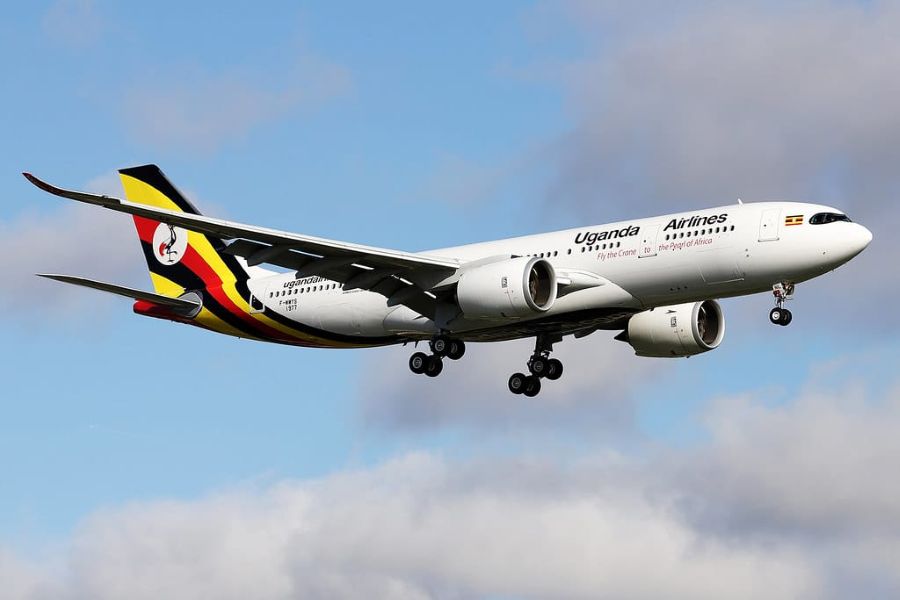
A major aviation investment proposal by the Ministry of Works and Transport has triggered intense debate in Parliament after the ministry requested a shs 1.696 trillion supplementary budget, including shs 422.264 billion as the initial payment for 10 new aircraft for Uganda Airlines.
The request, presented to the Budget Committee by Gen. Edward Katumba Wamala, Minister of Works and Transport, marks one of the largest aviation-related financial commitments since the revival of the national carrier in 2019.
The acquisition plan includes four mid-range Airbus aircraft, four wide-body Boeing jets, and two Boeing cargo freighters, signaling the airline’s ambition to expand both passenger and cargo capacity.
Defending the proposal, Gen. Katumba said the supplementary budget is necessary to secure Uganda’s production slots with aircraft manufacturers who are currently oversubscribed.
“Uganda Airlines is in the process of acquiring 10 aircrafts… The supplementary budget is to cater for the projected initial requirements for the aircraft purchase for this financial year 2025/2026,” he told the Committee.
“It includes pre-delivery payments at purchaser agreement signature amounting to shs 247.019 billion and sharing shs 275.245 billion for the pre-delivery payment required in January 2026 from both manufacturers Boeing and Airbus.”
He warned that Uganda risks missing out on the aircraft if the advance payments are delayed.
“If you don’t pay for your slot, then you’ll never get these aircraft. Companies like Qatar have made an order for 465 aircraft with Boeing,” Katumba noted.
“The most important thing is to secure our slot so that we know when to finish the payment.”
Otuke County MP Paul Omara questioned whether the new fleet would avoid the pitfalls that befell the Bombardier aircraft bought during the airline’s revival.
“You remember the Bombardier we bought; later we discovered there were no spare parts, they were no longer in production. We want assurance that this procurement will have future support for these 10 aircrafts,” Omara said.
Kira Municipality MP Ibrahim Ssemujju Nganda backed the idea of strengthening the national carrier but faulted the ministry for introducing such a large purchase through a supplementary request instead of the main national budget.
“Since when did this become an emergency? Were these things part of the airline’s budget, or discovered along the way?” Ssemujju asked.
“You make Parliament look shabby over things we shouldn’t quarrel about.”
Bugabula North MP Maurice Kibalya questioned the practicality of acquiring all 10 aircraft at once.
“I suggest we begin with maybe three in the first one or two years, then add more gradually. But we are purchasing ten at once,” he argued.
In response, Gen. Katumba insisted that the airline urgently needs additional aircraft to improve operational reliability.
“Uganda Airlines right now manages 38% to 40% of the traffic through Entebbe, but with the aircrafts we have, we are overstretched,” he said.
“Sometimes they have to wait for an aircraft coming from another route to land, be worked on, and go on another route.”
Uganda Airlines CEO Jennifer Bamuturaki rejected claims that recurrent delays stem from poor management. She attributed the disruptions to aviation advisories known as no-terms, which are sudden operational notices issued by civil aviation authorities.
“These delays and cancellations are coming over a cocktail of a few things,” Bamuturaki said.
“Airports may be doing cleanup or construction. When you’re given a no-term, you have to change schedules and that causes a delay.”
She revealed that over the past three weeks, Uganda Airlines has faced no-terms in Entebbe, Bujumbura, Juba, and Dar es Salaam, affecting flight schedules across the region.