








Goodwill Ceramics Uganda Limited has rejected social media allegations questioning the quality and safety of its products, describing the claims as false and malicious and alleging that they are intended to undermine the company’s operations and Uganda’s local manufacturing sector.
Speaking to journalists on Thursday during a media briefing at the company’s plant in Kapeeka, Liao Shen Industrial Park, Namunkekela, Nakaseke District, company officials said their products comply with applicable national regulatory requirements and that the company holds valid certifications from the Uganda National Bureau of Standards (UNBS).
David Mawejje, Administrative Manager at Goodwill Ceramics, said claims circulating online that UNBS and the Ministry of Health had declared the company’s products non-compliant were false.
Mawejje described the allegations as an alleged campaign of unfair competition intended to undermine the company’s position in the market.
“Claims alleging problems with our UNBS certification are entirely fabricated and malicious. They also constitute an affront to the professionalism and authority of UNBS and the Ministry of Health,” Mawejje said.
He alleged that the campaign was being driven by competitors seeking to undermine Goodwill Ceramics through unverified claims rather than competition based on quality, pricing and service.
The company has reported the matter to the Uganda Police Force and requested an investigation into the origin of the social media posts.
Mawejje said the company decided to report the matter after the posts circulated for several days, citing concerns about their potential impact on the company’s reputation and business operations.
“Since this campaign has run for several days, the damages caused will likely be realised in the near future. We couldn’t wait for it to get out of proportion; that is why we went ahead and reported the matter to police to establish the facts behind the perpetrators,” he said.
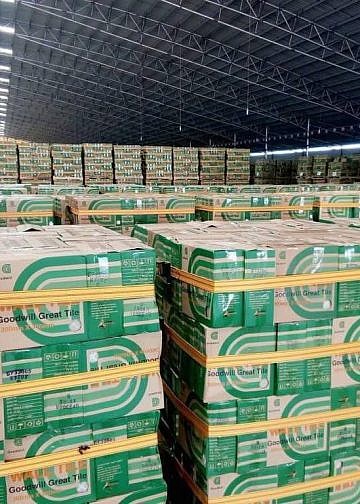
Mawejje said Goodwill Ceramics sources more than 90 percent of its raw materials locally and has established a significant presence in Uganda’s domestic tile market.
He said the company directly employs more than 1,300 Ugandans, while approximately 2,000 Ugandans are employed indirectly through its wider operations and supply chain.
“Supporting Goodwill means supporting ‘Made in Uganda.’ Undermining Goodwill is essentially denying Uganda’s domestic manufacturing sector and holding back national industrialisation,” Mawejje said.
He called on the public and mainstream media to exercise caution and verify information before sharing or publishing claims circulating on social media.
Fan Jun Jun Omar, Public Relations Manager at Goodwill Ceramics, said the company believes the online allegations have also affected its export business in neighbouring countries.
Omar said management had alerted UNBS about the claims and was awaiting an official public statement from the standards body.
During the briefing, company officials displayed laboratory test certificates which they said support the compliance of their products with applicable standards.
Omar also called for stronger measures to address online misinformation targeting businesses. Among the measures he proposed was greater accountability for social media accounts through identity verification mechanisms.
“When people see fake news online, they assume it is true, which causes huge damage to our company. If users registered accounts using valid national identity details, it would be much easier to trace and apprehend perpetrators of fake news,” Omar said.
Beyond the social media allegations, Omar raised concerns about what he described as trade barriers affecting the company’s exports to Kenya.
He said changes to Kenya’s excise duty regime had affected Goodwill Ceramics’ tile exports to the Kenyan market.
“We have been exporting not less than 10 trucks of tiles to Kenya on average daily, but with the new tax policy in place, we no longer export there. This does not only affect us as a company, but the Ugandan government also loses revenue,” Omar said.
He urged the Ugandan government to engage its Kenyan counterpart on tariff and non-tariff barriers affecting Ugandan exporters within the East African Community.
Goodwill Ceramics was commissioned in 2018 by President Yoweri Museveni as part of Uganda’s broader import-substitution and industrialisation strategy.
The company says it remains committed to quality, safety and environmental compliance across its production operations.
“Safe production and regulatory compliance are our permanent core principles. All rumours concerning UNBS and the Ministry of Health are deliberate distortions of Goodwill’s compliant operations and unjust denigration of Uganda’s regulatory framework,” Mawejje said.
The company reiterated that it has reported the matter to police and expressed confidence that investigations would establish the source of the disputed online claims.