
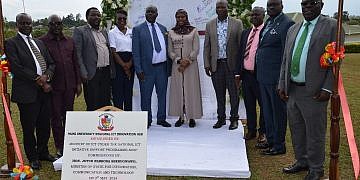






















Homeklin (U) Ltd, one of the players in Uganda’s waste management sector has launched a facility that will turn garbag into biogas.
The facility launched on Wednesday is located in Nsambya Kevina.
Kampala Capital City Authority (KCCA) has raised concerns , stressing the urgent need for sustainable solutions.
Speaking at the launch of a new waste-to-energy facility by Homeklin Uganda Limited in Nsambya, KCCA Executive Director Sharifah Buzeki raised concerns over the growing risks posed by unmanaged waste in the city.
“Kampala, like any rapidly growing city, faces an increasing challenge in managing solid waste. Current data shows that the city produces between 2,000 and 2,500 tonnes of waste daily, yet only about 1,300 to 1,500 tonnes are safely collected and disposed of. This means a significant portion of waste remains unmanaged, posing serious risks to public health and the environment,” Buzeki said.
She warned that the city’s current waste management and material recovery facility in Buyala could face challenges similar to those recently witnessed at Kiteezi if not supported by innovative interventions like Homeklin’s project. She called on private partners to join KCCA in efforts to divert waste from major landfill sites.
“Our statistics demonstrate that we can no longer rely on dumping. We must engineer our landfills, invest in waste-to-material recovery, and make waste diversion a necessity,” Buzeki said.
She added that studies indicate that approximately 70 to 85 percent of Kampala’s waste is organic and biodegradable, making it highly suitable for conversion into biogas, compost, and organic fertilizers.
“For every tonne of organic waste converted into biogas, we reduce one tonne going to Buyala. This lowers methane emissions and creates opportunities to generate clean, renewable energy. Homeklin’s intervention is timely and strategic, and we encourage similar initiatives beyond Kampala,” she added.
Isaac Katureebe, founder and CEO of Homeklin, said the facility marks a strategic pivot from traditional waste collection to advanced resource recovery. In partnership with U.S.-based Cenergy Solutions, the company will convert organic waste into compressed biogas cylinders and liquid biofertilizer.
“Garbage collection is a daily service, and we manage waste as it is generated. It must continue as long as people live, but we need sustainable ways to benefit the community,” Katureebe said. He emphasized that the project provides a scalable alternative to charcoal, Uganda’s primary cooking fuel, which has historically contributed to deforestation and respiratory illnesses.
“This project is meant to help our mothers and children, who have been dying from respiratory diseases caused by unsafe cooking fuels. Firewood and charcoal have never been friendly to our people. This technology will reduce health risks and save money previously spent on treating preventable illnesses,” he said.
Katureebe also highlighted the importance of sorting waste. “Previously, we focused only on collection and disposal. Garbage is often mixed with polythene, stones, and other materials. But when sorted—separating biodegradables—it becomes a resource. We must incentivize our communities to sort waste, as it can then be used to produce energy,” he concluded.