



President Museveni has called on the European Union (EU) and Western nations to support Africa’s industrialization and value addition agenda, warning that continued export of raw materials is keeping the continent trapped in poverty decades after independence.
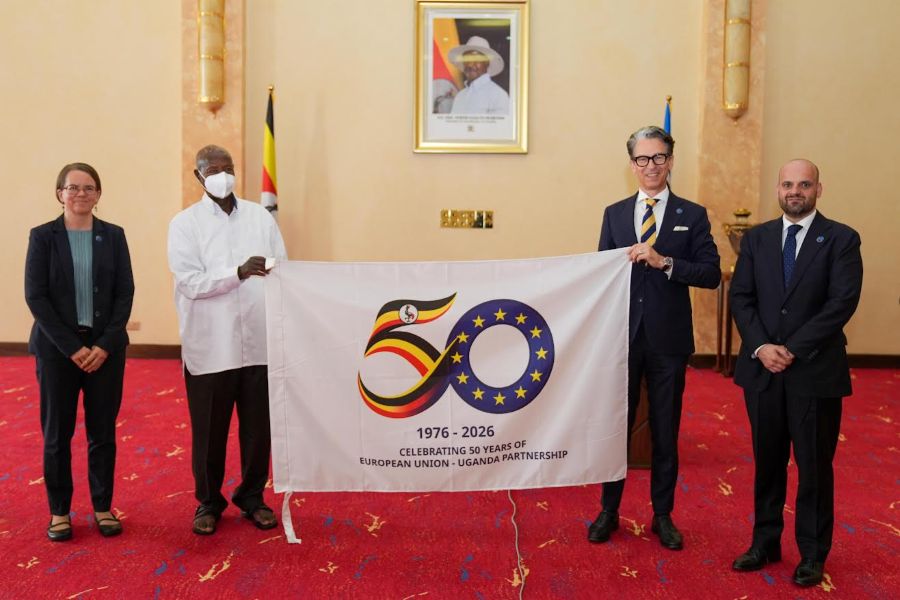
Museveni made the remarks during a meeting with EU Ambassador to Uganda Jan Sadek and a delegation at State House, Entebbe, where discussions centered on the Golden Jubilee marking 50 years of Uganda–EU cooperation.
The President acknowledged the long-standing partnership between Uganda and the European Union, noting that relations date back to the period when the EU delegation was first established in Uganda during the regime of Idi Amin.
“I thank you so much. I am very happy about the 50 years of collaboration between the EU and Uganda,” Museveni said, adding that the relationship has grown steadily over the decades.
However, Museveni used the engagement to restate his long-held position that Africa’s economic transformation has been slowed by failure to prioritize value addition.
“But I want to emphasize what I have been saying, that in the interest of Europe and the US, a more prosperous Africa is very good for business,” he said.
He noted that Africa’s total GDP of about $3.6 trillion, despite a population of over 1.5 billion people, reflects structural weaknesses in economic policy.
On Africa’s economic performance, Museveni said poor policy choices—particularly the continued export of unprocessed raw materials—have limited growth across the continent.
“The reason why the GDP of Africa is still stagnant is because of policy mistakes of exporting unprocessed raw materials,” he said. “This is a very big crime and they will pay historically because it is a betrayal.”
He urged European and American partners to view Africa as a strategic economic partner whose prosperity would benefit global trade.
“We can also do a lot of trade with Europe, but Africa needs to be richer. Why should you trade with a poor man? Why shouldn’t you want your partner to be rich so that you can both benefit?” he posed.
Museveni further highlighted Africa’s untapped market potential, noting that Europe has strong capital resources, including pension funds and investment institutions, while Africa offers a vast consumer base.
He reaffirmed Uganda’s commitment to industrialization and value addition, saying the country would avoid repeating economic mistakes that have constrained Africa’s development.
“For us in Uganda, we are very clear. We shall not make those mistakes of stunting the potential of Africa,” he said.
The President also pointed to infrastructure development, particularly railway transport, as a key driver of competitiveness.
“For competitiveness you need low costs of transport for cargo, electricity and low costs of money in the bank and low costs of labour,” he said.
On governance, Museveni reiterated Uganda’s commitment to diplomacy and multiparty politics.
EU Ambassador Jan Sadek congratulated Museveni on his electoral victory and praised Uganda’s growing regional and global influence, noting the strengthening partnership between Uganda and the European Union.
He said the EU–Uganda relationship has evolved from traditional donor support to a broader partnership in trade, investment, and economic development.
Sadek highlighted that trade between Uganda and the EU has grown from €500 million to €1.5 billion, adding that Ugandan products continue to gain traction in European markets.
He also outlined ongoing EU support in sectors such as infrastructure, energy, education, health, forestry, tourism, and the creative industry, including hydropower projects like Nalubaale and Kiira dams.
The ambassador further noted plans to support Uganda’s preparations for AFCON 2027 and announced continued EU involvement in infrastructure development, including schools and refugee education programs.
He said the EU is preparing to open a new office in Kampala later this year and expressed hope that the partnership would continue to expand over the next 50 years.
During the meeting, Sadek also presented roasted Ugandan coffee from Kisoro, describing it as one of the best-performing products in European markets.