







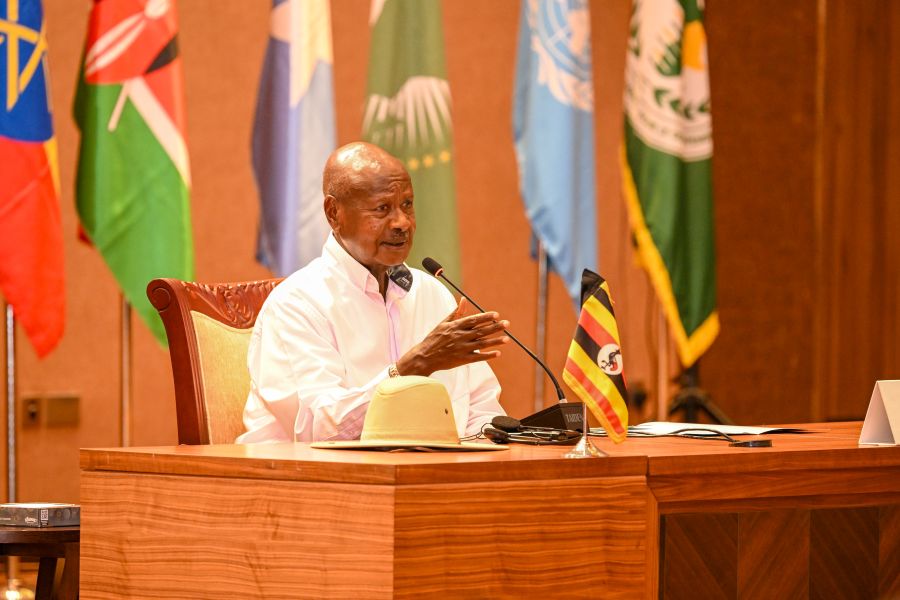
President Museveni has called on African countries to take greater responsibility for securing peace and stability on the continent, saying Africa has the capacity to sustain Somalia’s stabilisation process despite changing levels of international support.
Museveni made the remarks during the Extraordinary Summit of Heads of State and Government of Troop Contributing Countries (TCCs) to the African Union Support and Stabilisation Mission in Somalia (AUSSOM) held at Speke Resort Munyonyo in Kampala.
The three-day summit, held under the theme “To Sustain the Stabilisation Process in Somalia,” brought together leaders from troop-contributing countries, senior officials from the African Union (AU), United Nations (UN), and the Intergovernmental Authority on Development (IGAD) to assess Somalia’s security situation and discuss measures to strengthen the country’s path towards lasting peace.
The meeting was attended by Somalia President Hassan Sheikh Mohamud, Burundi Vice President Prosper Bazombanza, Kenya Deputy President Kithure Kindiki, African Union Commission Chairperson Mahmoud Ali Youssouf, and other senior government and security officials from member states.
The summit followed meetings of Chiefs of Defence Forces on July 29 and Ministers of Defence on July 30, where participants reviewed the preparedness of Somali security forces, AUSSOM deployment, force generation and integration, air capabilities, and operational requirements.
Addressing the summit, President Museveni said Uganda’s involvement in Somalia was not driven by geographical interests but by a commitment to regional security and the fight against violent extremism.
“Uganda doesn’t have a border with Somalia. Therefore, we decided to involve ourselves in Somalia out of principle and strategy,” Museveni said.
The President said Uganda chose to support Somalia because extremist groups posed a threat to African societies and regional stability.
“We did not accept extremist groups that come here and waste our time, saying they want to impose themselves on society. We had similar problems in Khartoum, Sudan,” he said.
Museveni emphasized that African countries must respect each other’s diversity and avoid imposing beliefs or identities on others.
“We Africans of this region have a very rich history. We are different, but we don’t try to impose our identity on others.”
On the possibility of reduced international support for Somalia’s stabilisation efforts, Museveni said Africa should focus on developing its own solutions to security challenges.
“If those Western countries want to pull out, that is their decision. Somalia is not going to be abandoned because of some people outside. We have the capacity. Whether others pull out or not, we shall manage,” he said.
The President cited Uganda’s liberation history as an example of African solidarity, recalling the support received from Tanzania and Mozambique during the struggle against the government of Idi Amin.
“When we got rid of Idi Amin, it was Tanzania and Mozambique that stood with us. Africans have always supported one another,” Museveni said.
During the closed session, leaders considered reports from defence chiefs and ministers on the progress of AUSSOM, the security situation in Somalia, and the readiness of Somali security institutions.
The summit also discussed the need for predictable and sustainable financing to ensure the continued operation of the mission.
In the final communiqué, Heads of State commended troop-contributing countries for their sacrifices in fighting terrorism and supporting Somalia’s stabilisation efforts.
The leaders paid tribute to soldiers who lost their lives and those injured while serving under AUSSOM.
They also called for strengthening Somalia’s unity, rebuilding public confidence, promoting democratic governance, and supporting state institutions.
To address funding challenges, the summit directed Ministers of Foreign Affairs from troop-contributing countries, together with the Federal Government of Somalia and the African Union Commission, to establish a joint task force to mobilise diplomatic and financial support.
The task force will also work towards organising a donors’ conference aimed at securing sustainable funding for AUSSOM during the transition period.
African Union Commission Chairperson Mahmoud Ali Youssouf reaffirmed the AU’s commitment to Somalia’s peace process, saying the progress achieved must be protected through stronger coordination, political commitment, and reliable financing.
Somalia President Hassan Sheikh Mohamud thanked President Museveni for convening the summit and recognised Uganda’s long-standing contribution to Somalia’s peace and security efforts.
“We appreciate your leadership and convening this second meeting of its kind. Your leadership is highly commended, and we seek your continued support, especially in mobilising the financial resources required for this mission,” Mohamud said.
He praised Uganda’s contribution to Somalia’s recovery, describing the country as one of Somalia’s strongest partners in the pursuit of peace and stability.
The Kampala summit reaffirmed African leaders’ commitment to sustaining Somalia’s stabilisation process through stronger regional cooperation, support for Somali security institutions, and renewed efforts to secure long-term financing for AUSSOM.