










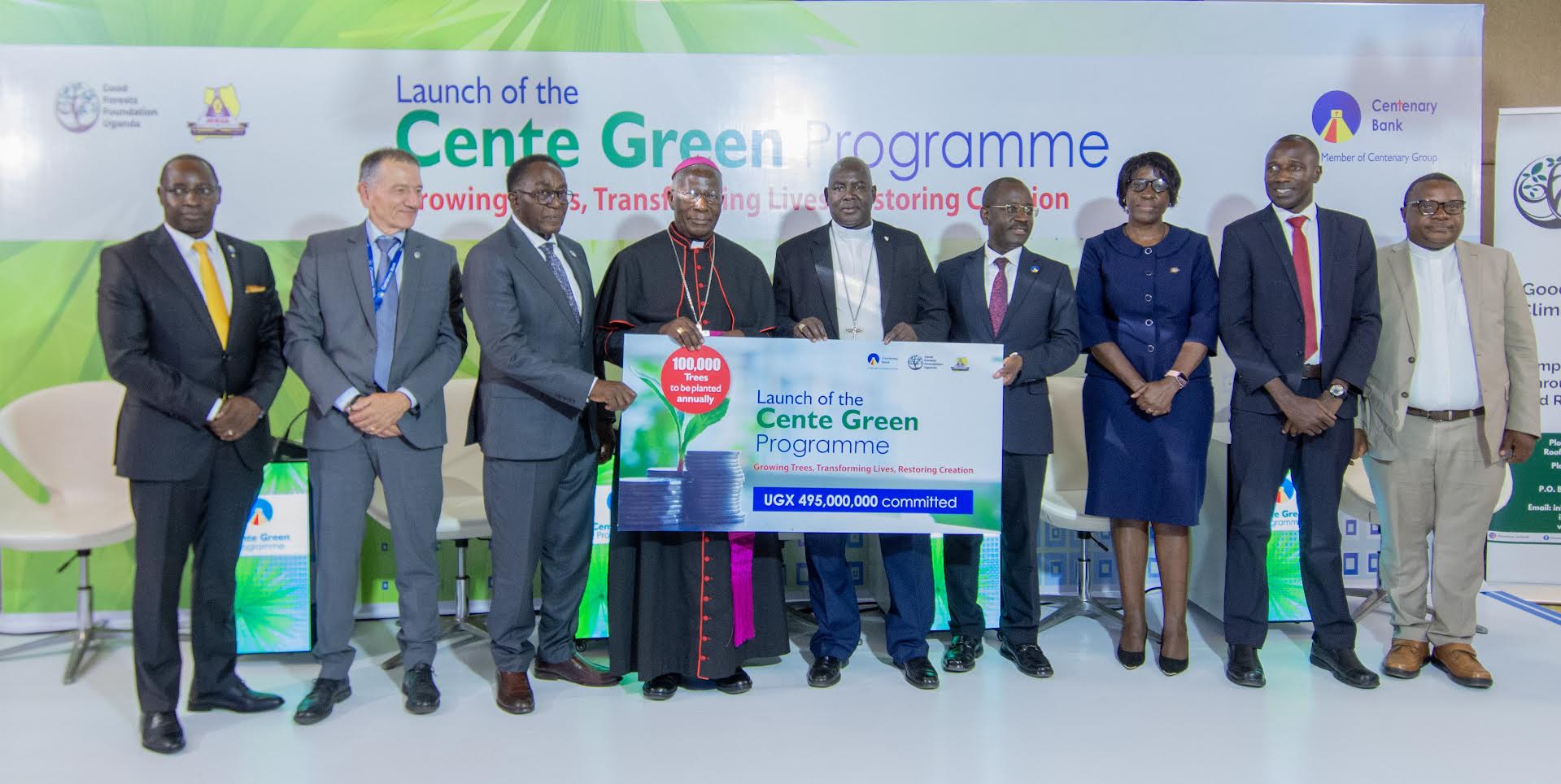
Centenary Bank has launched a five-year tree-growing and landscape restoration programme targeting the planting of 500,000 indigenous timber and fruit trees across Uganda by 2030.
Dubbed Cente Green Days, the initiative is being implemented under the theme, “Growing Trees, Transforming Lives, Restoring Creation,” and is intended to restore degraded landscapes while improving environmental and economic resilience in participating communities.
The bank said the programme will support the planting of 100,000 trees annually over the next five years. This year, the initiative is expected to contribute to the restoration of about 300 acres of degraded land across 12 districts, with the target rising to approximately 1,500 acres over the programme’s five-year period.
Speaking at the launch, Centenary Bank Managing Director Godfrey Byekwaso said the initiative forms part of the bank’s Environmental, Social and Governance (ESG) agenda and its broader commitment to sustainable banking.
“At Centenary Bank, we are a values-based bank that recognises the critical connection between financial services, businesses, communities and the environment in which they operate,” Byekwaso said.
“It is therefore imperative for us to restore the environment in order to enhance the resilience and prosperity of the communities, especially vulnerable ones. Only then can the bank prosper.”
The programme is being implemented in partnership with the Uganda Episcopal Conference and Good Forests Foundation. Twelve dioceses are participating in the initiative: Arua, Nebbi, Kiyinda-Mityana, Jinja, Masaka, Mbarara, Kabale, Kasese, Kotido, Moroto, Fort Portal and Tororo.
Byekwaso said the partnership with the Catholic Church was informed by its community presence, leadership structures and experience in environmental stewardship.
He said the Church would help mobilise communities and provide access to land for restoration, while Good Forests Foundation would provide technical support in areas including site assessment, species selection, planting, maintenance and monitoring.
The bank said the programme will prioritise indigenous timber and fruit trees, which it expects to contribute to soil conservation, food security, household income diversification and resilience to erosion, floods and drought.
“We also want participating communities to receive practical benefits from this programme. Indigenous timber and fruit trees can help protect soils, improve food security, diversify household incomes and strengthen resilience to erosion, floods and droughts,” Byekwaso said.
He called on other organisations to join the initiative by providing financial resources, technical expertise and community networks to expand its reach beyond the initial five-year target.
Centenary Bank has previously supported tree-growing activities. The bank says it has facilitated the planting of more than 250,000 trees across Uganda since 2023.
In 2025, the bank also began measuring its carbon emissions, which it said stood at more than 6,000 tonnes of carbon dioxide equivalent.
The bank said its current environmental initiatives are aimed at reducing its environmental footprint and supporting carbon sequestration through tree growing and landscape restoration.