








n a move hailed as a boost for Uganda’s Christian music sector, the government, through the Microfinance Support Centre (MSC), has provided Shs 200 million to gospel artists.
The initiative aims to empower musicians by building their capacity and enhancing financial literacy among gospel performers.
John Peter Mujuni, Executive Director of MSC, said the funding is a response to the long-standing call by gospel artists for recognition and support.
“They approached us because they felt their work in advancing our country’s mission, while living for God, has not been adequately recognized,” Mujuni said.
He emphasized that the grant will be managed responsibly.
“For starters, we have provided Shs 200 million which will go into their SACCO members at an interest rate of 8% per annum.”
Mujuni also emphasized the importance of organizing the artists, noting that they will undergo training on SACCO management.
“We shall help them to mobilize all their members so that they can join and open accounts in the circle. And then we shall give them financial literacy for them to be able to understand how the Sacco. operates.”
He advised the gospel artists on navigating competition in the music industry, encouraging them to learn from secular artists and adopt the best practices to strengthen and develop their own sector.
“The gospel artists should borrow what is good from the secular artists and leave what is bad. This way, they can compete in the market while maintaining their ethics and values.”
King Wesley, President of the Federation of Gospel Artists Uganda (FGAU), expressed gratitude for the initiative.
“It is with great honour and privilege that we are here with the Microfinance Support Centre. We felt left behind as gospel artists and ministers, and this grant shows that government is including us,” he said.
Wesley also highlighted the size and reach of the federation.
“We are in every region of the country, and we have over 40 associations under our Federation. Our platform, the Royal Gospel Music App, alone has over 5,000 registered artists continuously uploading music.”
He added that the grant will support capacity building.
“The funds will allow us to educate ourselves, align our associations, and empower members who are already active, as well as bring in those who are not yet part of the Federation.”
Romeo Wilbert Odong, a gospel artist from Northern Uganda famous for Pililili Yoleng, spoke about the challenges gospel artists face.
“Growing up as a gospel artist has not been an easy journey. People don’t invite us for shows because we are stereotyped,” he said.
Odong also stressed the new opportunities the grant presents.
“This partnership with MSC offers a fresh opportunity for artists to compete at par with others. Once this kind of money reaches communities from Nkuru to West Nile, the talent that will emerge will be phenomenal.”
He called for unity among gospel artists noting that this is the only way their industry will grow.
“We need to embrace this, work on our differences, and build this industry together from the ground up. Gospel artists, wherever you are listening, I am one of you,” he added.
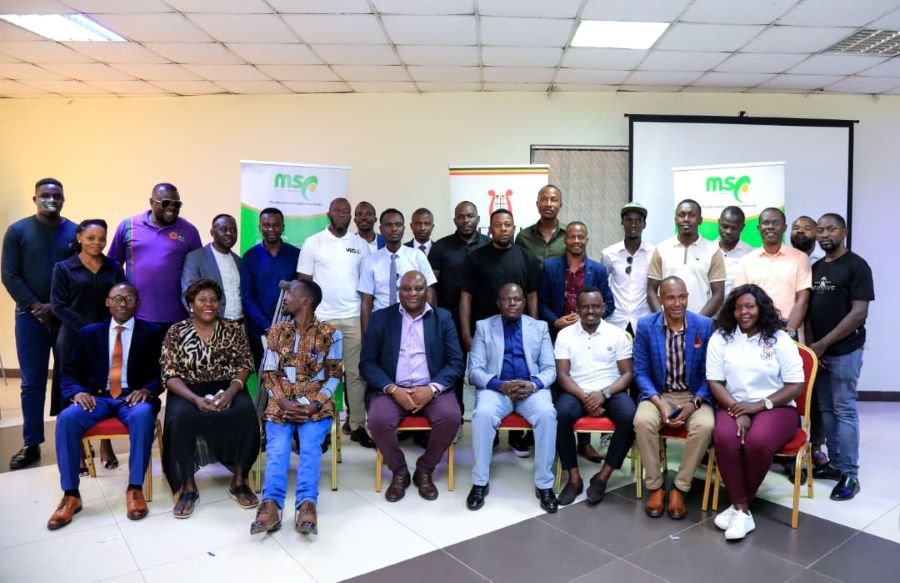
At the orientation session held at Piato Restaurant in Kampala, Denis Odeba from MSC emphasized the importance of mindset change among artists.
“Many artists survive on individual hustle, but SACCOs work on shared vision, trust, and collective progress. We grow faster together than alone,” Odeba said.
He also encouraged long-term financial planning: “The entertainment industry is full of quick income and quick spending. Sustainable wealth demands planning, saving, and long-term investment. It’s not how much you earn, but how much you keep.”
Odeba urged artists to see their craft as a business not just as fun.
“Talent is a gift from God, but monetizing it is a responsibility. Artists must build routines around budgeting, saving, and accountability. I am not just a performer; I am a brand and an enterprise,” he said.
Joseph Tukamushaba, Head of the Emyooga Secretariat, highlighted the broader development vision behind the funding.
“Our role is to provide systems that help every Ugandan engage in productive activities that benefit families, communities, and the nation,” Tukamushaba said.
He also stressed the impact of responsible financing: “Our money is supposed to create positive change in communities. How we use it or work with it determines the development outcomes.”
He also reminded artists about the value of low-interest loans. “We provide very low-interest loans so that everyone can have access and the resources can lead to meaningful impact in society.”