











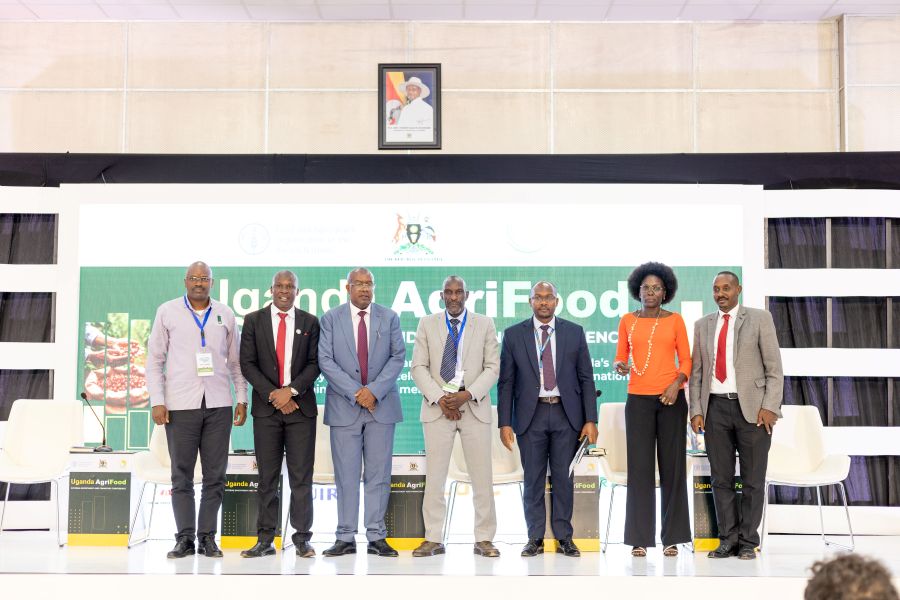
With Uganda’s agriculture sector facing growing pressure from climate change, undernourishment, and funding gaps, the Food and Agriculture Organization of the United Nations (FAO), in partnership with the Ministry of Agriculture, Animal Industry and Fisheries (MAAIF) among other government agencies, has made an urgent call for joint action and investment to transform the country’s agrifood systems.
Speaking at the opening of the Uganda Agrifood Systems Investment and Financing Conference, FAO Representative to Uganda, Mr. Yergalme Taages Beraki, emphasized the critical need for innovative financing and strategic collaboration.
The conference, held at the Uganda Industrial Research Institute in Namanve, brought together policymakers, agribusiness leaders, financiers, researchers, and development partners under the theme: “Catalyzing Innovative Financing and Investments in Uganda’s Agrifood Systems for Accelerated Socio-Economic Transformation and Sustainable Development.”
“This conference comes at a time of declining donor aid to developing countries. Uganda must now turn to alternative and domestic financing mechanisms to close investment gaps in agriculture and trade. The time to act is now,” Mr. Beraki said.
Mr. Beraki lauded Uganda’s efforts to implement global and continental frameworks such as the UN Food Systems Summit recommendations and the African Union’s CAADP strategy, noting that the government’s leadership in food system transformation has set a strong foundation.
“Mobilizing domestic public and private resources will unlock economic, nutritional, and environmental gains,” he said, pledging FAO’s continued support to drive investments aligned with the vision of “four betters: better production, better nutrition, better environment, and better life leaving no one behind.”
Delivering his keynote, Bright Rwamirama, Minister of State for Agriculture, acknowledged the sector’s central role in Uganda’s economy contributing 24% of GDP, 33% of exports, and employing over 70% of the population.
However, he warned that over 34% of Ugandans remain undernourished and more than 12 million face food insecurity.
“Transformation requires more than good policy, it requires financing,” the minister stated.
He added that stakeholders must collaborate to explore blended financing models, and promote systems-based approaches that enhance productivity
“We must work together to mobilize investments, explore blended financing models, and promote systems-based approaches that enhance productivity, nutrition, and climate resilience,” he added.
The minister highlighted government efforts, including agro-industrialization, credit facilities like the Agricultural Credit Facility, and climate-smart agriculture projects with the World Bank.
But he stressed these initiatives need to be scaled through partnerships with the private sector, development partners, civil society, and academia.
The summit’s resounding message was a call to action: For Uganda to achieve inclusive, resilient, and sustainable agrifood systems, stakeholders must align efforts, pool resources, and jointly invest in transforming agriculture from subsistence to a competitive, market-driven sector.
“This is a shared responsibility,” concluded Mr. Beraki. “Let this summit be the turning point where public and private actors commit to unlocking Uganda’s full agrifood potential.”
Mr. Edward Walugembe, Commissioner for Strategic Coordination and Implementation in the Office of the Prime Minister, emphasized the need for unity and effective coordination in driving national progress:
“We need to work together to achieve our national development goals. Coordination, connectedness, continuity, and communication are essential in food systems transformation,” he said.
He further noted that while Uganda’s National Development Plan (NDP) is well-structured, success now hinges on translating plans into action:
“Uganda’s National Development Plan is fit for purpose, and now we need to focus on implementation, financing, coordination, and governance for food systems transformation are critical for our success.”
David Wozemba, AGRA Country Director for Uganda, underscored the importance of a united front in transforming Uganda’s food systems.
“The transformation agenda is not a one-person show, it’s a collective effort that requires all of us to bring in whatever investment is required to change the ecosystem,” Wozemba said.
He stressed the urgency of moving from planning to execution. “With the planning process now complete, it’s essential to focus our efforts on ensuring successful implementation.”
Dr. Ivan Lule, from the National Planning Authority, reflected on the lessons learned from past disruptions and the strategic ambition of the forthcoming plan.
“We learned critical lessons and hope to do better in NDP4. NDP4 is aligned with the 10-fold growth strategy, aiming to grow our GDP from $50 billion to $500 billion by 2040. Food systems transformation is critical to achieving this goal.”