











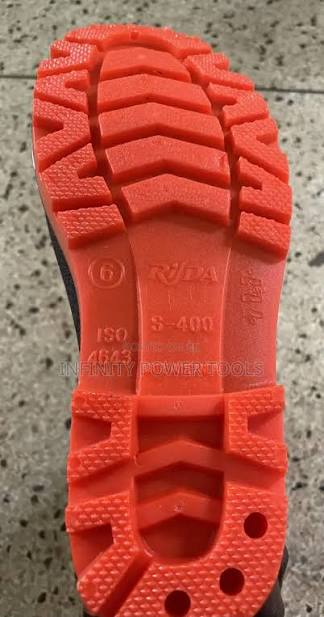
The High Court Commercial Division has ordered Rida International Industry (U) Limited to pay Shs16.768 billion to rival gumboot manufacturer Migoo Industrial and Trading Company (U) Limited after finding that it copied the appearance of Migoo’s products and misled customers into buying them.
In a judgment delivered by Justice Stephen Mubiru, the court awarded Migoo Shs12.768 billion in special damages and Shs4 billion in general damages for financial losses, damage to goodwill and harm to its market reputation.
The court also issued a permanent injunction restraining Rida from manufacturing, selling, importing, stocking or distributing gumboots in a manner likely to mislead consumers into believing that its products were made or sold by Migoo.
How Rida copied Migoo’s gumboots
The dispute arose from competition between the two companies, which manufacture and sell gumboots through similar markets and distribution channels.
Migoo told the court that it had manufactured and sold gumboots since 2012, gradually building a reputation around the distinctive appearance and design of its products.
The company accused Rida of subsequently producing gumboots with a strikingly similar shape, configuration and pattern before selling them to the same customers at lower prices.
Rida denied the allegations, arguing that the design was common in the market and that other manufacturers also produced similar gumboots.
However, Justice Mubiru found that Rida had gone beyond using a design commonly available in the market.
According to the judgment, Rida initially used a visible logo to distinguish its gumboots from Migoo’s products but later removed the distinguishing feature, making the two products more similar and increasing the likelihood of customer confusion.
The court also relied on testimony from Migoo distributor Aida Ndagire, who told the court that some customers had purchased Rida gumboots believing they were buying Migoo products.
Some customers reportedly discovered the mistake only after noticing the Rida branding or differences in product quality. They subsequently returned the gumboots and exchanged them for Migoo products.
Justice Mubiru considered this evidence proof that actual consumer confusion had occurred.
The judge explained that a passing-off claim does not require every customer to be deceived. Rather, the evidence must demonstrate that a significant number of consumers are likely to mistake one company’s products for those of another, or believe the businesses are commercially connected.
The court found that the conduct had harmed Migoo’s business by putting pressure on its prices and undermining the goodwill it had built in the market.
Evidence presented during the trial showed that Migoo reduced the price of its gumboots from between Shs10,000 and Shs10,500 per pair to between Shs7,000 and Shs7,500 as it faced competition from Rida’s cheaper products.
Migoo’s accountant calculated the resulting financial losses using sales records, receipts, value-added tax returns and income tax records.
The accountant estimated that Migoo had lost Shs12.768 billion because of the price reductions between 2017 and September 2021.
Justice Mubiru accepted the calculation and awarded the full amount as special damages.
The judge further awarded Shs4 billion in general damages to compensate for continuing financial harm, damage to goodwill and injury to Migoo’s reputation.
The Shs12.768 billion award will attract interest at 15 per cent annually from May 3, 2019, when the suit was filed, until payment in full. The Shs4 billion in general damages will attract interest at six per cent annually from the date of judgment until payment.
Court rejects Rida’s counterclaim
The court also dismissed Rida’s counterclaim against Migoo over a police raid and the seizure of property from Rida’s premises in 2019.
Rida had accused Migoo of maliciously using the criminal justice system to disrupt its business. It claimed that police seized gumboots, moulds and other materials from its factory, forcing it to suspend production for nearly a month.
The company sought more than Shs1.5 billion in damages arising from the interruption of production and complained that some seized property had not been returned.
However, the court found that Migoo had reported the alleged infringement to police and provided evidence, after which police independently investigated the matter and obtained an opinion from the Uganda Registration Services Bureau before conducting the search.
Justice Mubiru concluded that Migoo had acted as a complainant and had not controlled or instigated the criminal proceedings.
The court also rejected Rida’s claim over the alleged wrongful retention of its property. Although the seizure order was later revoked and the return of the seized items ordered, there was no evidence that Migoo possessed or controlled the property or had directed police to retain it.
Rida’s counterclaim was consequently dismissed with costs.
In a separate but significant finding, the court cancelled the industrial design registrations held by both companies.
Migoo’s design, registered in February 2019, and Rida’s design, registered in August 2018, were both revoked after the court found that the disputed gumboot design was not sufficiently new because similar designs were already in use in the market.
However, the cancellation of Migoo’s industrial design registration did not defeat its passing-off claim.
Justice Mubiru explained that industrial design registration and protection against passing off are distinct legal concepts. A business may still protect the goodwill and reputation associated with its products even where it does not hold a valid registered industrial design, provided it proves that a competitor misrepresented its products in a manner likely to confuse consumers.
The judge concluded that Rida had deliberately exploited Migoo’s reputation and customer base by passing off its gumboots as those of its competitor.