









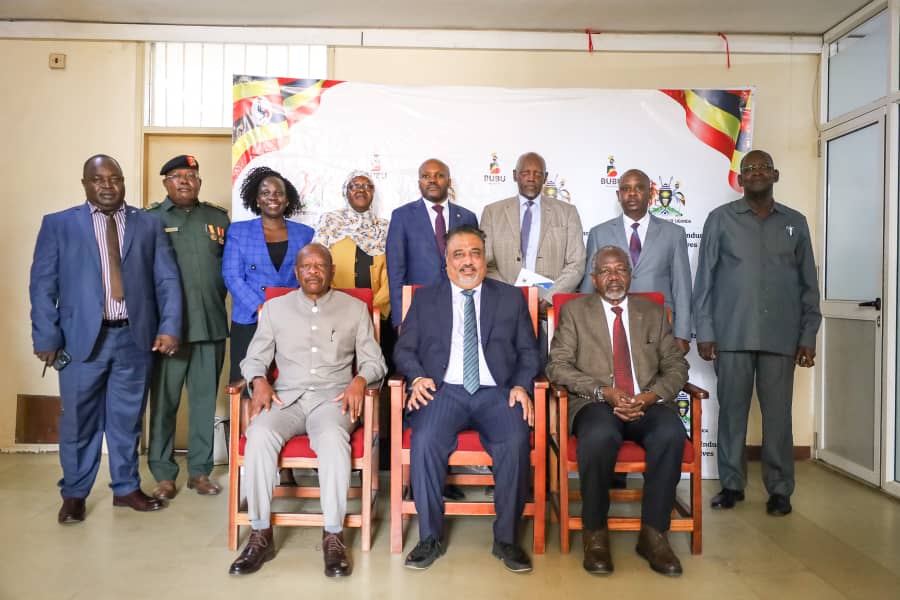
The Minister of Trade, Industry and Cooperatives, Sanjay Tanna, has directed the Uganda National Bureau of Standards (UNBS) to improve efficiency in product certification and reduce delays affecting Small and Medium Enterprises (SMEs) seeking access to the Quality Mark.
Tanna said faster certification of locally manufactured products is essential in helping Ugandan businesses expand, access local and international markets, and contribute to the country’s industrialisation agenda.
The minister issued the directive during a meeting with the 10th National Standards Council, together with the Minister of State for Trade, Gen. Wilson Mbasu Mbadi, at the Ministry of Trade headquarters in Kampala.
The meeting was part of efforts by the ministry leadership to streamline operations and improve service delivery across government agencies under its supervision.
Tanna said the ministry had received complaints from SMEs and large manufacturers over delays in obtaining product certification and clearance of imported goods at border points, which he said affects business growth and competitiveness.
“I task the National Standards Council to refocus and put more emphasis on supporting the growing enterprises, especially Small and Medium Enterprises, by reducing the time they take to acquire the Quality Mark, preferably to a maximum of two weeks. That way, Ugandans will feel the impact of the standards body,” Tanna said.
The minister said UNBS plays a critical role in protecting consumers from substandard products while supporting businesses to compete effectively in domestic and international markets.
He added that the standards body is central to Uganda’s ambition of expanding the economy from approximately US$50 billion (about Shs183 trillion) to US$500 billion (about Shs1.8 quadrillion) by 2040.
Tanna pledged government support to UNBS in executing its mandate of ensuring product safety, promoting industrialisation and facilitating trade.
The Chairperson of the National Standards Council, Eng. James Kalibbala, said the council had recorded progress during its first year in office, including clearing inherited backlogs and increasing the number of enterprises certified by UNBS from 501 to 1,270.
He said improved funding had enabled the bureau to undertake key activities, including developing new standards and recruiting additional staff.
“During the year, the budget for the bureau increased from Shs62 billion to Shs130 billion in the financial year 2025/26, which helped us accomplish a number of deliverables, including the development of 551 new standards and recruitment of an additional 100 staff,” Kalibbala said.
However, he acknowledged that more work is needed to improve service delivery and expand the impact of UNBS across the country.
UNBS Executive Director Eng. James Kasigwa said the bureau had launched its fifth five-year Strategic Plan for the financial years 2025/26–2029/30, aligned with Uganda’s National Development Plan IV and the Ten-Fold Economic Growth Strategy through import substitution and export promotion.
Kasigwa noted that staffing and funding gaps remain major challenges, particularly in border monitoring.
He said that although Uganda has more than 200 official and informal border points, UNBS currently has the capacity to deploy staff at only 34 points.
Gen. Mbadi challenged UNBS to change its approach towards SMEs, saying the bureau should focus more on guiding businesses to meet standards rather than treating certification as a policing exercise.
He said Uganda has secured international markets for local products, but many businesses fail to benefit because they do not meet required quality standards.
The minister urged UNBS to support enterprises through training, technical guidance and advisory services to enable more Ugandan products qualify for domestic and export markets.
The government says strengthening standards compliance among SMEs will be critical in boosting exports, promoting local manufacturing and improving Uganda’s competitiveness in regional and global markets.