








President Museveni has renewed his call for the economic and political integration of Africa, arguing that continental unity is essential for strengthening Africa’s long-term security, defence capabilities and economic resilience.
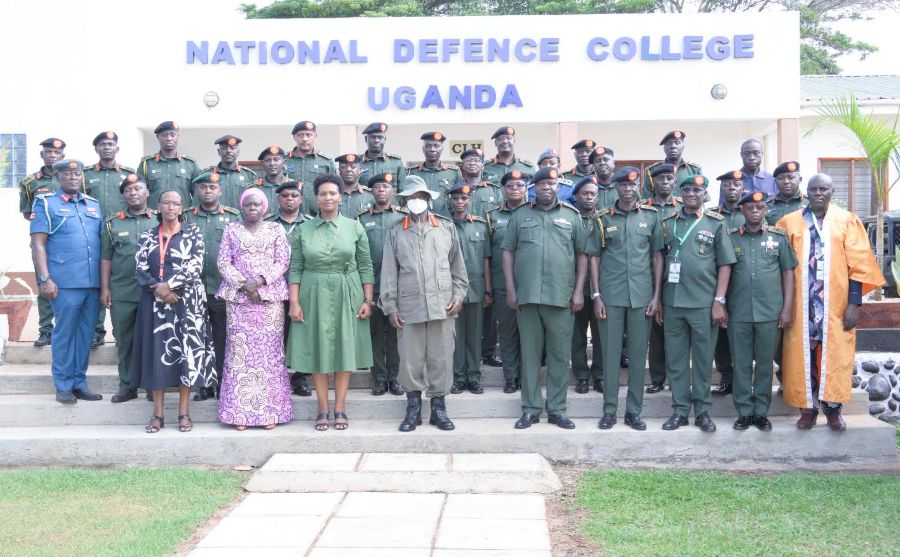
Speaking on Friday during the graduation of Cohort Four at the National Defence College-Uganda (NDC-U) in Njeru, Buikwe District, the President, who is also the Commander-in-Chief of the Uganda People’s Defence Forces (UPDF), said Africa’s fragmented political landscape continues to undermine its ability to defend itself against emerging global threats.
The ceremony saw 21 participants—20 senior military officers and one public servant from the Ministry of Defence and Veteran Affairs—graduate after completing the college’s strategic leadership programme.
Congratulating the graduates, President Museveni challenged them to champion policies that promote Uganda’s socio-economic transformation while advancing regional and continental integration.
“I congratulate you for finishing this course,” President Museveni said.
He outlined what he described as three critical pillars for securing Uganda and Africa, beginning with socio-economic transformation.
“In summary, if you want to defend Africa, I can think of three points. The economy of Uganda must undergo socio-economic transformation whereby all the peasants and the bayaaye must disappear and we have a new society. If not, we shall not be able to defend Africa,” he said.
The President said sustainable national security depends on ensuring that every Ugandan participates in the money economy through commercial agriculture, manufacturing and artisanship, services, and Information and Communication Technology (ICT).
“When we last checked, we had 67 percent in the money economy and 33 percent still working only for the stomach. The whole population must join the money economy in the four sectors,” he noted.
He also identified universal education as a key driver of transformation, saying literacy, numeracy and vocational skills are essential for expanding economic opportunities.
“Everybody must get education in literacy, numeracy and skills. Once you have done that, the economy will grow and we shall be richer,” he said.
However, President Museveni cautioned that economic prosperity alone cannot guarantee national security, reiterating his long-held support for the East African Federation and broader African integration.
He argued that Uganda’s landlocked status limits its strategic defence capabilities, making regional cooperation increasingly important.
“Because of the political fragmentation of Africa, Uganda doesn’t have an ocean. It is Kenya and Tanzania that have access to the sea, so Uganda does not have a navy or the resources to go to space and develop a capable air force. That’s how the third point of economic and political integration of Africa comes in. If you really want to defend Africa, you must work for economic and political integration of Africa,” he said.
According to the President, establishing the East African Federation would significantly strengthen the region’s defence capacity.
“If we achieve the East African Federation, no one can defeat us because we shall have access to the sea, develop a navy, strengthen our air force and build a bigger economy. We shall develop the capacity to defend ourselves on land, in the air, at sea and in space,” he added.
He cited global powers such as the United States, China, Russia and India as examples of countries that have invested heavily in advanced strategic capabilities, including space technology.
Defence College expansion
In a move aimed at strengthening strategic military education, President Museveni pledged Shs50 billion towards the expansion and modernisation of the National Defence College-Uganda.
The Minister of State for Defence and Veteran Affairs (Defence), Grace Akifeza Ngabirano, described the graduation as a reflection of the government’s continued commitment to strategic leadership development and professional military education.
She commended the President and the military leadership for improving the welfare of UPDF personnel through salary enhancements, better accommodation and infrastructure development.
“I also wish to express my special appreciation to Your Excellency and to the Chief of Defence Forces for the significant steps taken to improve the welfare of UPDF personnel through salary enhancements, improved accommodation and continued infrastructure development across barracks and training institutions. These are clear demonstrations of your commitment to building a motivated, professional and capable force,” she said.
Representing the Chief of Defence Forces, Gen. Muhoozi Kainerugaba, the Deputy Chief of Defence Forces, Lt. Gen. Sam Okiding, credited President Museveni’s leadership with transforming the UPDF into a modern and professional force.
“I congratulate all the graduates of Cohort Four, their families and their respective institutions for this remarkable achievement,” Lt. Gen. Okiding said.
The Commandant of the National Defence College-Uganda, Brig. Gen. Alex Olupot, said the President’s presence at the ceremony underscored the government’s commitment to developing strategic leaders capable of responding to increasingly complex national, regional and global security challenges.
“The presence of His Excellency underscores the strategic importance that the Government of Uganda attaches to professional military education, national security and the development of strategic leaders capable of navigating the increasingly complex security environment of the 21st century,” Brig. Gen. Olupot said.
He described the graduation as more than an academic milestone.
“It is a celebration of intellectual growth, national service and leadership transformation,” he said.
Brig. Gen. Olupot noted that the National Defence College, established four years ago, prepares senior military officers, public servants and selected foreign participants for leadership at the highest strategic levels.
He said Cohort Four admitted 22 participants, comprising three Brigadier Generals, 18 Colonels and one civilian officer from the Ministry of Defence and Veteran Affairs, but one participant withdrew midway due to strategic considerations, leaving 21 graduates.
The participants completed advanced studies in strategic studies, research and policy analysis, alongside national study programmes and international study tours in Nigeria and Algeria.
The ceremony also recognised academic excellence, with Brig. Gen. Joseph Freddy Onnata and Col. David Okumu emerging as the best overall students.