









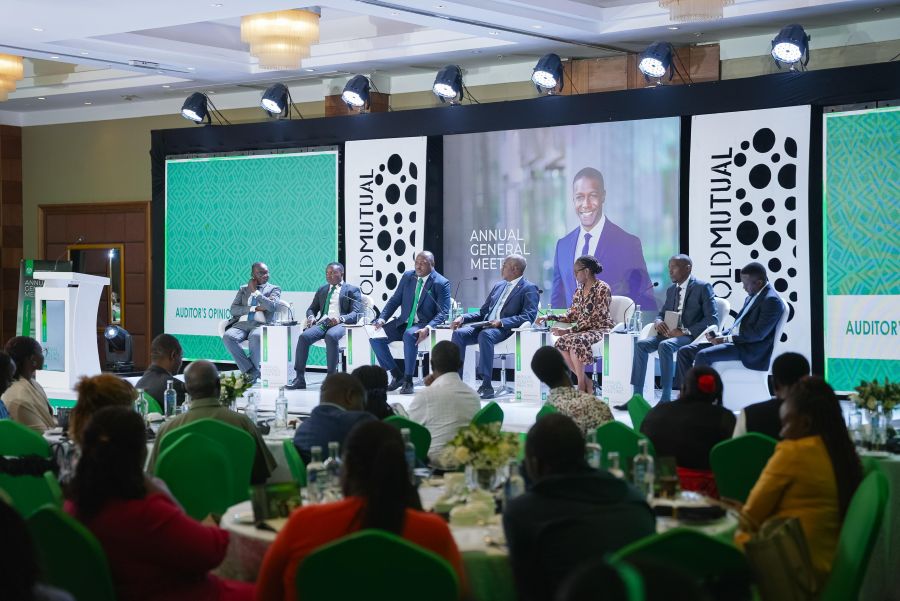
The Old Mutual Investment Group (OMIG) Uganda has reported a significant 43% increase in assets under management (AUM) and a sharp rise in investor participation, according to its 2025 Annual General Meeting (AGM) held at the Sheraton Kampala Hotel.
The meeting brought together over 300 stakeholders, including institutional partners, legal advisors, trustees, custodians, and retail unit holders.
The AGM offered a comprehensive review of the Group’s 2024 financial performance and laid out a strategic outlook for its unit trust funds.
In his opening address, OMIG Unit Trust Chairperson Geoffrey Kihuguru commended Uganda’s macroeconomic progress.
He noted that real GDP growth reached 6.06% in FY2023/24, up from 5.34% the previous year, pushing the economy’s size to USD 41.33 billion.
The growth, he explained, was largely driven by strong performance in services, infrastructure development, and oil and gas investments, which generated over 15,000 jobs and attracted nearly USD 10 billion in cumulative investment by the end of 2024.
Kihuguru also highlighted price stability and currency strength, pointing out that headline inflation averaged 3.32%, while the Ugandan Shilling appreciated significantly, closing the year at 3,670 per US dollar.
These macroeconomic fundamentals supported strong performance in capital markets, with the Uganda Securities Exchange All Share Index rising by 36.94% and the Local Share Index climbing by 12.93%, reflecting renewed investor confidence.
OMIG Managing Director Zac Kisesi acknowledged the growing trust among investors, noting a 67% increase in the number of unit holders—from 30,165 to 50,416.
He celebrated the addition of over 20,000 new investors within a single year as evidence of rising financial inclusion and growing awareness of regulated investment options in Uganda.
Chief Financial Officer John Golooba presented the fund performance results, revealing that total AUM grew to shs2.407 trillion.
He said each of the unit trust funds had posted strong returns. The Balanced Fund delivered an annual return of 12.64%, while the Umbrella Fund posted 11.77% and the Money Market Fund closed the year at 11.28%.
The Dollar Fund recorded a net return of 5.03% and more than tripled in size, reaching USD 39.22 million. Golooba attributed this success to strategic portfolio shifts toward fixed income and longer-dated government bonds.
The independent auditor’s report was presented by Jovita Babirye of KPMG. She confirmed that OMIG’s financial statements accurately reflected the group’s financial position and complied with International Financial Reporting Standards and Uganda’s capital markets regulations.
She further noted that there were no material misstatements or key audit matters identified during the audit, underscoring OMIG’s strong financial governance and transparency.
Legal advisor Hilda Kansiime from Kasirye Byaruhanga & Co. Advocates addressed regulatory shifts anticipated ahead of the 2026 general elections.
She assured stakeholders that OMIG’s compliance posture and governance systems remain adaptive and well-aligned with evolving capital markets reforms.
Representing OMIG’s custodial banking partners, Andrew Omiel of Stanbic Bank Uganda commended the company’s efforts to foster investor confidence through transparency and financial education.
Patrick Ssewanyana of KCB Bank Uganda, trustee of the Dollar Trust Fund, reaffirmed the bank’s commitment to expanding cross-border investor services and streamlining reporting, especially for diaspora investors seeking stable, regulated options in hard currency.
The AGM also highlighted shifting investment dynamics influenced by rising government borrowing needs, which have driven interest rates higher across the yield curve. OMIG responded by increasing exposure to longer-term government securities.
Bond holdings in the Umbrella Fund rose by shs 264 billion to shs760 billion, with 47.4% now allocated to tenors above 10 years.
Golooba emphasized that despite the interest rate environment, OMIG maintained sound liquidity and risk management practices across all portfolios. For instance, the Balanced Fund held a diversified mix of fixed deposits, government securities, and carefully selected equities.
Looking ahead, Chairperson Kihuguru projected that Uganda’s economy will grow by 6.3% in 2025, buoyed by increased oil activity, improved credit conditions, and ongoing macroeconomic stability.
However, he warned of emerging risks, including donor funding cuts, global trade tensions, and heightened domestic borrowing in the run-up to the 2026 elections.
He concluded by reaffirming OMIG’s commitment to prudent, transparent, and responsive fund management.