










Solar energy is increasingly being positioned as a productive economic asset capable of transforming agriculture, expanding rural businesses, creating employment and supporting Uganda’s wider industrialisation agenda.
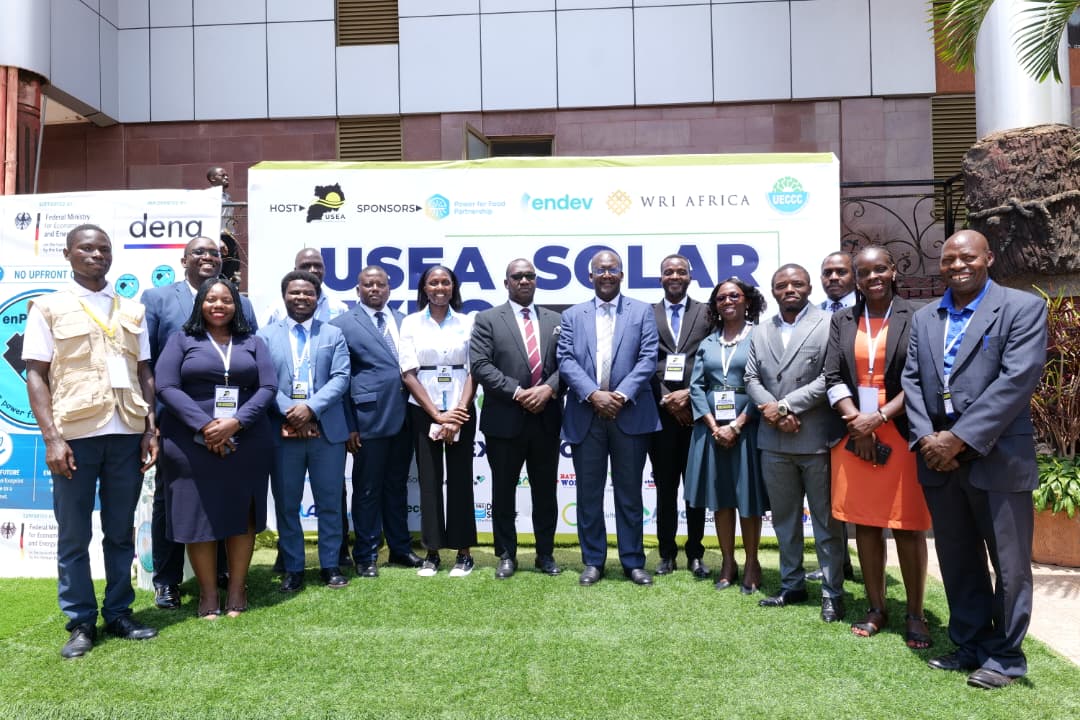
The message emerged during the opening of the three-day 2026 Uganda Solar Energy Association (USEA) National Expo and Conference at Silver Spring Hotel in Kampala under the theme “Powering Productivity with Solar.”
Uganda Energy Credit Capitalisation Company (UECCC) Managing Director Roy Baguma said Uganda’s large agricultural sector provides one of the strongest opportunities for productive-use solar, particularly through irrigation, refrigeration, water pumping and agro-processing.
“Solar energy is therefore no longer merely a source of light. Today it is a productive asset that supports businesses, modernises agriculture, promotes value addition and improves livelihoods altogether. Uganda’s economic structure makes a strong case for the productive use of solar energy,” he said.
He said the economic value of solar lies in its ability to support activities that generate income rather than simply provide electricity for household consumption.
“This represents an opportunity not only to increase electrification rates for the country but also to make productive use of energy to accelerate economic activity across agriculture, trade, manufacturing and service sectors,” Roy Baguma said.
He identified agriculture as a particularly important entry point because of the country’s dependence on farming.
“As you are aware, agriculture is the backbone of our economy, employing over 70% of the population and supporting millions of households, both at subsistence level and also with a few commercial farming initiatives. This makes a compelling case for the solar industry to invest in the distribution of technologies that add to productivity, income generation and resilience,” he said.
Roy Baguma said irrigation should receive particular attention if Uganda is to transform agriculture from subsistence production into a more commercial and resilient sector.
“Across Uganda, solar-powered technologies are already transforming livelihoods. Solar irrigation systems are enabling farmers to grow crops throughout the year, reducing dependence on rainfall and improving agricultural productivity. If we want to change our agricultural sector from a subsistence one, irrigation is the area that we should emphasise,” he said.
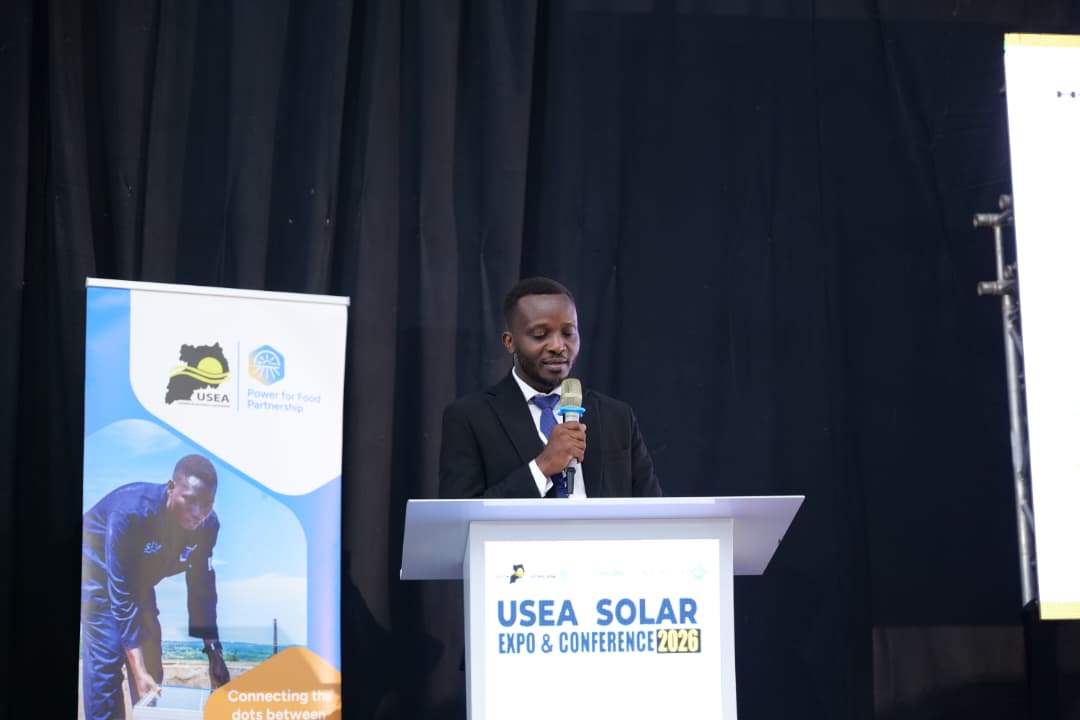
USEA Board Chairperson Douglas Baguma said the economic value of solar should similarly be measured by what it enables people and businesses to produce.
“A solar-powered irrigation system, a cold room, or a water pump is not simply an expense. It is an income-generating asset. Yet many farmers and small businesses cannot meet the upfront cost, while many solar companies lack sufficient working capital to serve these customers, importantly, at scale,” Douglas Baguma said.
He called for financial institutions to develop financing products that recognise the income streams created by productive-use equipment.
“We therefore need financial institutions to develop products that recognise the cash flows generated by productive use equipment. Local currency lending, asset financing, leasing, pay-as-you-go models, and guarantees, and blended finance facilities,” he said.
Baguma also said solar companies themselves must become more attractive to investors by improving their business models and building customer trust.
“At the same time, our companies must become more investor-ready. We must present credible business models, and trust. This is very important. Growth must be built on quality and trust,” he said.
He warned that poor-quality equipment, installations and after-sales services could undermine the industry’s economic ambitions.
“The solar industry cannot succeed sustainably if customers receive substandard products, poor installations, misleading information, or inadequate after-sales support. All we are doing is running after sales. Running after sales and forgetting customer satisfaction,” he said.
UNICEF Uganda Chief of WASH, Climate and Environment Lalit Patra said the economic opportunity also extends to employment and local services, particularly outside Kampala.
He challenged the industry and government to develop vocational training systems capable of creating a network of skilled solar workers across the country.
“Do you have well placed vocational training institutions which can teach even to instal a solar panel to carry out some simple operation maintenance management of the solar panels to set up a small, like what you call a spare parts store in a district? These are the ways people can get small, small employment. This becomes a service sector,” Patra said.
He argued that the solar industry should not remain concentrated around importing and installing equipment but should gradually develop local manufacturing capacity.
“You need to manufacture every component in your country, in your own land. And it is doable, I tell you,” Patra said.
He suggested that Uganda could partner with established manufacturers in countries such as India and China to develop the necessary technology and skills.
“You will say that, oh, we don’t know the technology. Partner, partner with India, partner with Chinese companies. You can make it happen. It’s not difficult,” he said.
Patra also challenged government to create a policy environment capable of attracting more investment into domestic solar manufacturing.
“Some of the countries allow the manufacturers of the solar energy to get a tax holiday. No taxation for five years. Have you ever discussed with your energy ministry? Have you ever discussed with your minister of economic development, planning and finance on this issue? To help you to get a tax holiday, so that you can enlarge your industry,” he said.
Douglas Baguma said Uganda must seize the opportunity to retain more value from Africa’s growing demand for solar technology.
“We have over 600 million people without access to electricity here in Africa. So the question is, of course this is an opportunity, but whose opportunity is it? Is it an opportunity for someone exporting from elsewhere? Or can this be an opportunity for us to ensure that we address this problem locally?” he said.
“Uganda must progressively participate in designing, manufacturing, and exporting the technologies that will empower Africa’s development.”
Roy Baguma said the economic transformation envisaged through productive-use solar can be seen in the practical impact on farmers and businesses.
“When a farmer doubles production through solar irrigation, when a trader preserves perishable goods through solar refrigeration, when a rural enterprise expands because of reliable solar power, energy ceases to be merely a social service and becomes a powerful economic asset,” he said.