








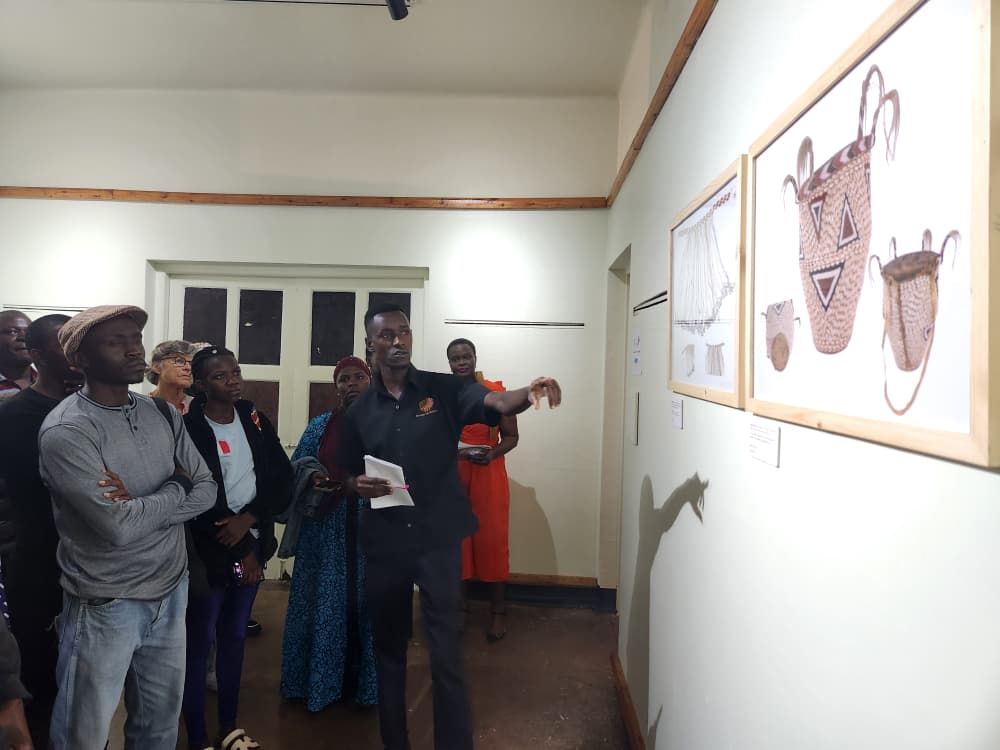
The Ethics of Loaning exhibition opened to great excitement at Nommo Gallery on Friday, drawing hundreds of Ugandans, diplomats, art students, into a spirited conversation about heritage restitution, colonial legacies, and the ethics of holding sacred cultural objects.
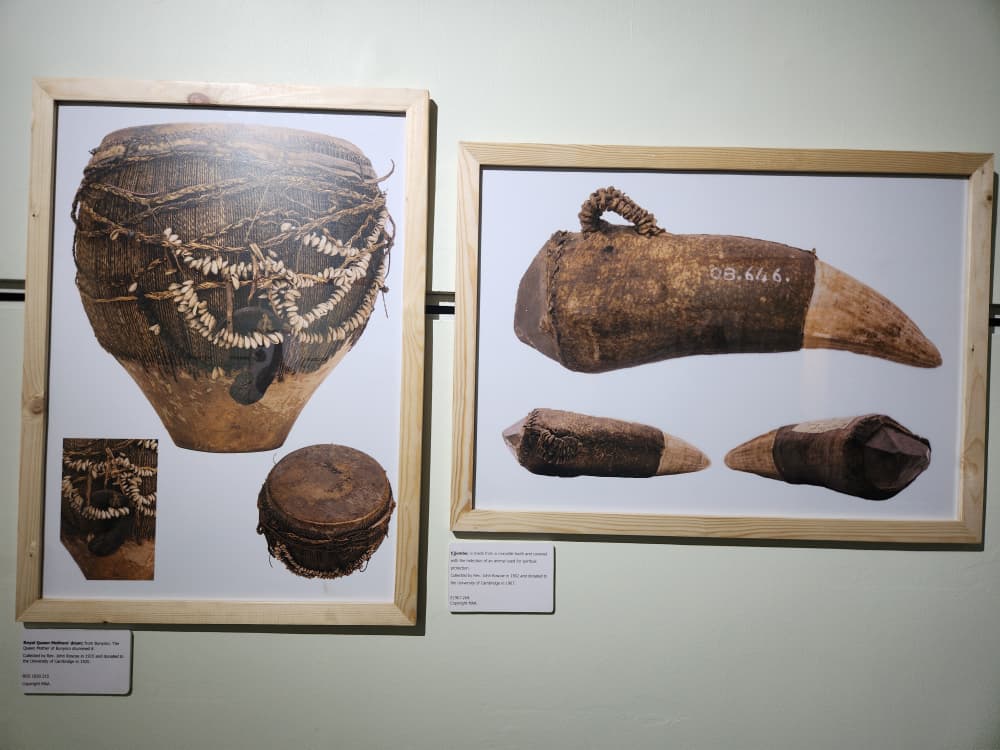
The exhibition, jointly organized by Alliance Française Kampala and Goethe-Zentrum Kampala with support from the Franco-German Fund, will run until October 24 and features 15 artefacts recently returned from the University of Cambridge Museum of Archaeology and Anthropology.
The artefacts are showcased through portraits and immersive virtual reality.
Speaking at the launch, Francis Peter Ojede, the Executive Director of the Uganda National Cultural Center (UNCC), hailed the collaboration as a step toward reclaiming cultural identity.
“All I wanted to say is that we would like to thank you for picking and thank you for accepting to work with us as Uganda National Cultural Center,” Ojede said.
“Thank you very, very much for allowing yourself to work with us, and we look forward to continuing working with you and partnering with you in a number of areas to come.”
He stressed that the conversation was not just about objects, but also about deeper questions of cultural justice:
“This journey is good because it brings in a lot of issues that need to be discussed. We’re talking about ethics of loaning. Obviously, when you start talking about this subject, there are going to be lots of debates, but there are interesting debates and good debates. The most important thing is, at least there is something to talk about.”
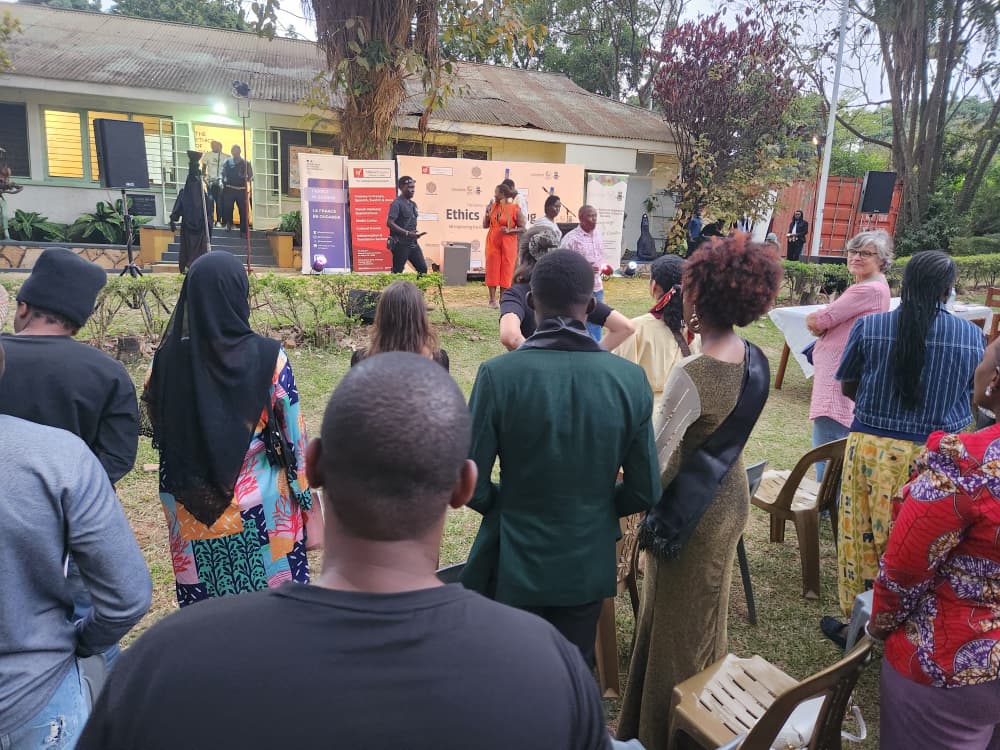
Ojede challenged the audience to see restitution not as a one-time event but as a continuous process of dialogue:
“We are saying there is a loaning, whether you want to call it a loaning, whether you want to call it a restitution. The most important thing is that there is something that is coming back. That, to me, is a good debate, and that is something we can pick on.”
Loïc Boivin, Director of Alliance Française Kampala, described the exhibition as a cultural milestone, thanking the organizers and artists for making it possible.
“It’s an honor to welcome you all here in the Nommo Gallery,” Boivin said. “First and foremost, I would like to welcome you for the opening of this exhibition dedicated to ethics of loaning.”
He applauded the spirit of collaboration behind the event, highlighting the role of Ugandan institutions.
“I would like to warmly thank the Nommo Gallery as well as the Uganda Museum for their support and collaboration, without which this event would not have been possible,” he added.
“More directly, I would like to thank all the teams, artists, and technicians who worked behind the scenes to offer you this evening.”
With music and virtual reality performances lighting up the gallery, Boivin urged the audience to look deeper at the beauty of cultural exchange:
“We’re going to see a lot of beautiful things. There is also a virtual reality experience inside, and I would like to stress that we are going to hear some fantastic music that makes this exhibition a celebration of both heritage and creativity.”
From the Goethe-Zentrum Kampala, Sheila Akwany steered the discussion toward the complexities of ownership and historical injustice.
“It would be a disservice to also not speak about the dynamics of power,” Akwany said. “When you say some things were donated, perhaps to a priest from an African society or to a person who didn’t know the value of that object, then the dynamic of ethics becomes very different.”
She emphasized that the restitution conversation must not be sanitized:
“You can’t really say that things were donated. They were actually stolen, because the person giving that object didn’t understand the value that you saw in it or the way you wanted to use it. These are the dynamics and complexities we must engage with.”
For Akwany, Uganda and Africa must take ownership of shaping the discourse.
“As the people receiving these objects, what do they mean to us? Even for the museum, which holds objects that belong to communities, what are the ethics of holding what is sacred? This exhibition is monumental, not just for Uganda but also for Africa, because it comes at a time when the continent is striving to reclaim its heritage,” she added.
Peter Primus, Deputy Head of Mission at the German Embassy, emphasized Germany’s recognition of colonial injustices and its responsibility to act.
“It’s inspiring to see that the Goethe-Zentrum and the Alliance Française not only share the same premises here in town, but also engage in fruitful cooperation,” Primus said.
“The cultural relationship between Uganda and Germany and, of course, with France, is of great importance. It opens doors to mutual understanding and respect.”
Primus acknowledged Germany’s historical role and ongoing restitution efforts:
“We actively address the legacy of our colonial past. This includes naming and recognizing injustices that were committed, asking for forgiveness, as well as returning cultural artifacts and ancestral remains. We do all this in dialogue with governments, societies, and diaspora communities of former colonies.”
He reminded the people that restitution is about more than just objects.
“Restitution is not just about returning artifacts or remains. It symbolizes respect for cultures and histories and the restoration of dignity for those who were affected. These initiatives bring us closer to justice, reconciliation, and a shared future based on equality and mutual respect.”
A representative of the French Embassy echoed the commitment to restitution, citing President Emmanuel Macron’s landmark speech in Ouagadougou.
“I am very pleased to participate in the opening of the Ethics of Loaning exhibition, which presents the photographs of 15 artifacts recently returned to Uganda,” the envoy said. “The restitution of African works of art appropriated during colonization has long been taboo, but President Macron’s address marked a turning point.”
The French diplomat acknowledged the challenges still ahead, especially around provenance and legal frameworks:
“Progress has been made in recent years, but the road remains long. Many obstacles remain, including documenting provenance and navigating legal frameworks. But France and Germany are committed to enabling Sub-Saharan Africans to admire locally the objects that are part of their cultural heritage.”
He pointed to Uganda’s artifacts as part of a larger continental movement:
“The return of 26 treasures to Benin in 2021, and of 96 bronzes to Nigeria by Germany in 2022, have set a strong precedent. Likewise, the return of 39 objects on long-term loan to the Uganda Museum shows that change is possible when partnerships are built on equality and dialogue.”
As music and virtual reality, mingled under the Nommo Gallery lights, the evening marked more than an exhibition it was a statement of Uganda’s place in a global conversation on heritage, justice, and dignity.
The Ethics of Loaning exhibition runs until October 24 at Nommo Gallery from 9:00 am to 4:30 pm daily.