










Ugandan artists and artisans have been advised to capitalize on the country’s indigenous materials such as bark cloth to access and compete in the United States market.
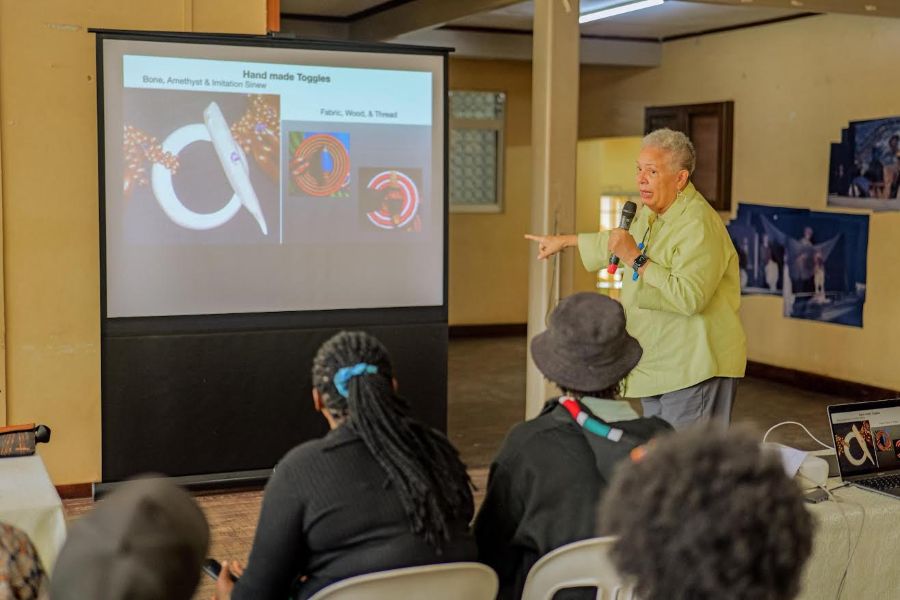
Speaking during a training session at the Uganda National Cultural Centre (UNCC) in Kampala on Friday, US-based artist, jewellery designer, and writer Elaine Robnett Moore said Ugandan products have a unique cultural and commercial appeal abroad.
“The materials here are indigenous, and the quality of workmanship is unbelievable. Barkcloth is amazing—it is beautiful and ideal for items like computer, iPad, and phone covers. I bought one to take to the United States, and I know people there will admire it,” she said.
Moore is in Uganda under Art on a Global Level, a training program initiated by the Ugandan Embassy in Washington, DC, to prepare local artisans for international markets. She stressed that Uganda’s strength lies in offering what cannot be found elsewhere.
“Leather goods are made everywhere, but bark cloth is unique to Uganda. That uniqueness makes these products highly marketable,” she added.
Artists exploring storytelling in art
Among the participants was Angella Kakobyo, founder of Manzuru, a group blending string art with natural wellness products. She said her success has come from producing art that tells stories.
“Many people are making crafts, but I try to collaborate and innovate. By combining string art with barkcloth and color, the final product is different. Not many are doing contemporary storytelling through art, and that’s how I’ve been able to stand out,” Kakobyo explained.
She said the workshop offered new insights into using indigenous materials: “We must improve our work, make it more uniquely Ugandan, so that international buyers can purchase it in big quantities.”
Creative artist and consultant Nuwa Wamala Nnyanzi noted that while Uganda’s artistry is rich, challenges remain with scaling up production to meet global demand.
“Sometimes you can have the products, but producing them in large numbers becomes a challenge. Elaine has guided us on how to approach this. She will take samples to the US, introduce them to the market, and return to help us plan for larger-scale production,” he said.
Uganda’s exports to the United States have grown nearly 28-fold between 1996 and 2022, according to the Uganda Bureau of Statistics (UBOS). From less than US$10 million in the late 1990s, exports rose to US$62 million in 2017, reaching record highs of US$87 million in 2021 and US$89 million in 2022.
Coffee and vanilla remain leading exports, but experts say artisan crafts represent a new frontier for growth—capable of creating jobs, empowering communities, and strengthening Uganda’s position in the global creative economy.