









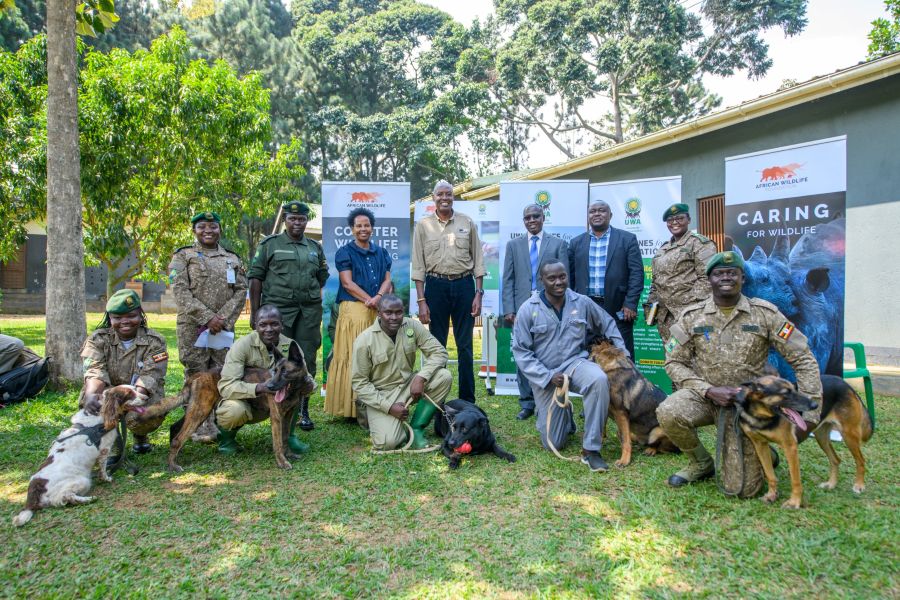
The Uganda Wildlife Authority (UWA) has officially assumed full control of the country’s canine detection unit at Entebbe, marking a historic milestone in Uganda’s fight against wildlife trafficking.
The transition ceremony, held at the Uganda Wildlife Conservation Education Centre (UWEC) in Entebbe, follows nine years of collaboration between UWA and the African Wildlife Foundation (AWF) under the Canines for Conservation Program, launched in 2016 with support from the U.S. government.
The program has trained dogs and handlers to detect ivory, pangolin scales, rhino horn, and other contraband at airports, border points, and in the field. It has transformed Uganda from being among the “gang of eight” countries once implicated in global ivory trafficking, to a nation recognized for enforcement leadership.
Regional success story
Speaking at the event, Kaddu Sebunya, CEO of AWF, emphasized that the canine program was not just a Ugandan achievement but a continental model.
“This program is not just about how we’ve succeeded in Uganda, but because we’ve been so successful across Africa. We are in Kenya, Tanzania, Botswana, Cameroon, Mozambique, and Ethiopia. These dogs form a frontline defense against wildlife trafficking,” Sebunya said.
He cited Ethiopia’s Bole International Airport, where detection dogs inspect thousands of bags and consignments weekly, as part of the broader Africa-wide network.
“These results illustrate the larger truth—Africa is not waiting to be rescued from wildlife crime. We are building the tools, the systems, and the leadership to stop tampering with our heritage,” he added.
Sebunya also announced AWF’s donation of three additional detection dogs to Uganda, stressing the handover reflected true local ownership.
“Our philosophy has always been to build local ownership. The dogs, the kennels, the infrastructure—these have always belonged to the Ugandan government. Today, we celebrate that UWA has fully integrated canine operations into its structure. This is not a departure, but a new chapter.”
From weak enforcement to global recognition
For UWA, the takeover represents the fulfillment of a commitment made more than a decade ago when Uganda was identified as a key ivory trafficking hub.
Charles Tumwesigye, UWA’s Director of Field Operations, recalled.
“Around 2013, Uganda was identified among eight countries fueling illegal ivory trade. Ivory was leaving through our airport undetected and only intercepted abroad. That showed our enforcement was weak, and we were asked to act.”
The introduction of canine units became a game-changer.
“Dogs cannot be bribed. You can corrupt a person, but not a dog. If it detects contraband, it will show a sign. Since we started, we’ve made arrests, dismantled networks, and even secured a life sentence under the new Wildlife Act. Uganda is no longer on that blacklist,” Tumwesigye said.
He assured that UWA now has the budget, staff, and infrastructure to sustain the program.
“Any program that lacks sustainability is bound to fail. Today, AWF has handed over, and we assure the public and partners, we have the capacity and resources to carry this forward. With the new dogs, new staff, and full integration into our operations, Uganda will no longer be used as a conduit for wildlife trafficking.”
Unsung Heroes and Impact
Imelda Imetur, UWA’s In-Charge of Canine Conservation, outlined the program’s growth:
Starting with 12 handlers, the unit now has 22,
12 detection dogs for airports and border points,
and 2 tracker dogs for pursuing poachers in the field.
“The detection dogs secure our airports and border points, while the tracker dogs pursue poachers in the field, even into villages and bars if needed. This program has become a national shield,” she said.
Imetur credited the dogs and handlers with removing Uganda from the “gang of eight” list:
“We’ve made over 360 arrests, secured a life sentence, and turned repeat offenders into informants who now help us catch others. That is real success.”
She also hailed the handlers as “unsung heroes” whose discipline, courage, and bond with the dogs are the backbone of the program.
Looking ahead
During the ceremony, guests witnessed a live demonstration at Entebbe International Airport, where detection dogs uncovered hidden contraband. A second showcase of tracker dogs in action will be held in Karuma on September 5, 2025.
Officials stressed that Uganda’s assumption of the canine units is more than symbolic—it secures the future of a program that has reshaped Uganda’s global reputation and sent a clear message to wildlife traffickers: Uganda is no longer an easy route.