










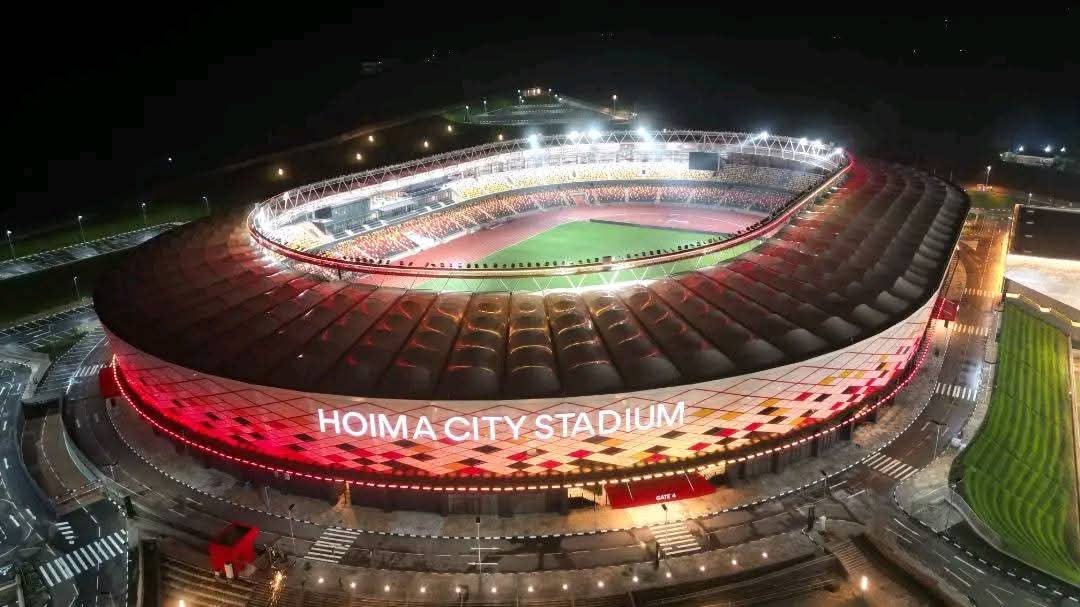
Uganda is not yet ready to host the 2027 Africa Cup of Nations (AFCON), according to a latest Confederation of African Football (CAF) inspection report that exposes critical gaps in stadiums, training facilities and supporting infrastructure.
The assessment, conducted last month on key venues including Mandela National Stadium and the newly commissioned Hoima City Stadium, found that none of Uganda’s proposed competition stadiums currently meets CAF Category 4 standards, the minimum requirement for hosting AFCON matches.
Stadiums Fall Short of Required Standards
CAF noted that Uganda’s AFCON infrastructure programme remains in a “mixed phase of construction, upgrading and operational redesign,” raising doubts about timely readiness.
At Hoima City Stadium, although construction is complete, the facility was found to have serious operational flaws. These include poor segregation of fans, overlap between teams, media and spectators, and non-compliant dressing rooms.
The report also highlights substandard media facilities, a wrongly positioned mixed zone, and team benches that obstruct fans’ view — all of which require major redesign despite the stadium being structurally complete.
Meanwhile, Mandela National Stadium still requires extensive upgrades, including partial demolition of the West Stand, expansion and roof replacement.
CAF warned that the proposed 15-month renovation timeline is unrealistic, recommending instead that works be expedited and completed by December 2026.
The status of Akii Bua Stadium remains uncertain after inspectors failed to visit the site, leaving its readiness unverified.
Training Facilities and Infrastructure Lagging
CAF further established that training facilities across Kampala and Hoima are uneven and largely non-compliant.
Several grounds require pitch rehabilitation, installation of certified floodlights (minimum 500 lux), and completion of dressing rooms and technical areas.
Hoima was specifically flagged for having too few compliant training venues.
Beyond sports infrastructure, the report points to major weaknesses in Uganda’s broader tournament ecosystem.
Key concerns include the readiness of Kabalega International Airport, limited availability of high-end hotels in Hoima, and poor road connectivity between Kampala and Hoima.
CAF is demanding confirmation that the airport can handle international traffic, availability of at least five 5-star hotels with a minimum of 50 rooms each, and visible progress on road upgrades before the next inspection.
State Minister for Educstion and Sports Peter Ogwang confirmed that the inspection was initiated by government as part of quality checks.
“I would like to confirm that last month, we requested CAF to come and conduct an assessment of the state of our sports facilities Mandela National Stadium and Hoima Stadium, as part of the quality control and assurance measure ahead of AFCON 2027,” Ogwang said.
He admitted that CAF identified gaps, particularly at Hoima Stadium, but said steps are being taken to address them.
“It is true that CAF, in their report, cited a few gaps the contractor has since held several meetings with us and has hands on deck to ensure that the issues raised are addressed before the next inspection in August this year,” he added.
On wider infrastructure challenges such as roads, hotels and the airport, Ogwang said government has already committed additional resources through an inter-ministerial committee chaired by Education and Sports Minister Janet Museveni.
“Government agreed to provide additional resources to address such challenges,” he said.
Despite the concerns, Ogwang maintained that Uganda, alongside Kenya and Tanzania under the East Africa Pamoja bid, remains committed to delivering a successful tournament.
Pressure Mounts Ahead of Next Inspection
With no stadium currently meeting CAF standards and major infrastructure still incomplete, the report paints a stark picture of Uganda’s readiness.
The country now faces a tight deadline to implement sweeping upgrades and infrastructure improvements before CAF’s next inspection in August 2026 or risk falling behind in preparations to host Africa’s biggest football tournament.