









President Museveni has paid tribute to the founding fathers of the Non-Aligned Movement (NAM), praising their resistance to global hegemonic influence and affirming that the Global South now stands as a beacon of hope for a fairer world order.
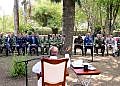
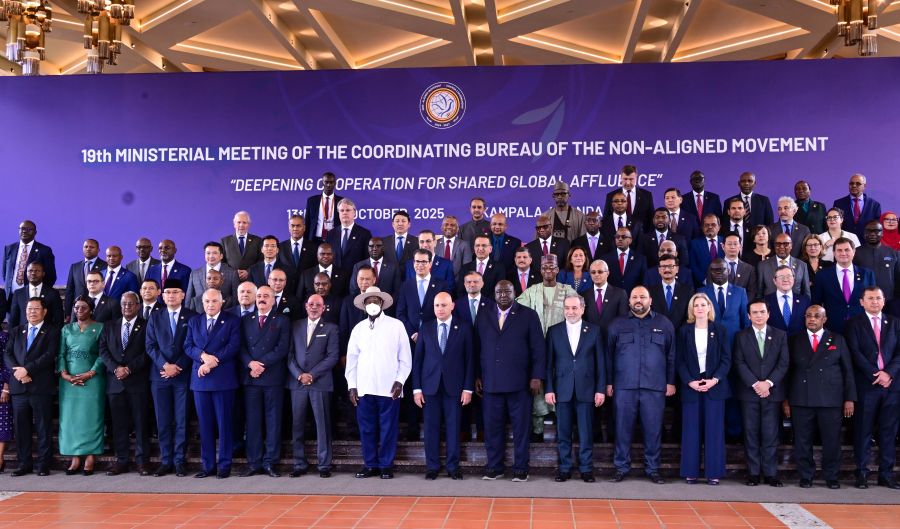
Speaking at Munyonyo Speke Resort during the 19th NAM Ministerial Review Session, Museveni said the movement was built on a clear resistance to domination by powerful blocs that emerged in the 1940s.
“I wish to salute the founding fathers of the Non-Aligned Movement who gave us a solid start in the fight against the influence of hegemony that emerged in the 1940s,” Museveni said, noting that past attempts at global domination from European religious control to colonial empires eventually collapsed.
Museveni, who described himself as “a third-generation anti-colonial fighter from Africa,” said the current momentum in NAM under the theme “Deepening Cooperation for Shared Global Prosperity” signals a new era of opportunity.
“Looking at the turnout and momentum, I feel strongly that we may be the hope of the world,” he remarked.
The president thanked the 121 member states for entrusting Uganda with leadership of the movement, pledging to channel efforts toward “the world’s minimum common interests,” including trade, investment, tourism, and security.
Highlighting the value of technological advancement to all nations, Museveni rejected the notion that progress in one country threatens others.
“The advancement of one nation through technology and other means is not a threat but an opportunity for the rest of the world,” he said.
He cited the example of global mineral markets, noting how the rise of new economies transformed demand and created opportunities for previously sidelined nations.
“In the past, we were discouraged from processing our minerals, citing low global demand. This low demand was due to a small circle of beneficiaries. The emergence of China and other economies changed that landscape, with prices—for example, of steel—rising from 200 USD to 900 USD,” Museveni explained.
He reaffirmed Uganda’s commitment to championing equitable global development within NAM.
He dismissed the ambitions of global hegemony as outdated and counterproductive.
“Anybody who thinks they should control the world is wasting their time.”
Museveni emphasized that nations should focus on “minimum mutually beneficial interests” such as trade, investment, tourism, and other areas of cooperation instead of coercion and conflict.
“Where we don’t agree, let us act by good example and not coercion. If you think you are right, show it by doing things properly in your own country so that others learn from you.”
He referred to the 30 year’s war in Europe, caused by religious intolerance, and the fall of the Austro-Hungarian Empire following resistance to emerging social systems.
“When one of the kings of England wanted to become Protestant, the Pope refused to allow anyone to change from Catholicism, and that caused a lot of chaos. In the end, the Pope failed.”
“When capitalism emerged in France after the Revolution, Metternich of Austria-Hungary tried to stop it but failed. Where is Austria-Hungary today? It disappeared because it wanted to stop the evolution of history, which is impossible.”
He stressed that each nation must be allowed to choose its own social and political system.
Museveni argued that scientific advancements benefit all humanity and should be embraced by all countries.
“Once there is an advance in the control of nature through science, we should be very happy. I don’t see why anybody would worry that country X, B, or C has come out of poverty. After all, if you want to do business, why do you want to do business with a poor man? Why don’t we want all our partners to be prosperous so that we can do better business?”
He cited China’s transformation as a positive example that has indirectly benefited Uganda and other developing nations by making technologies like steel more accessible.